Archive for December, 2006
Another great post about founder equity
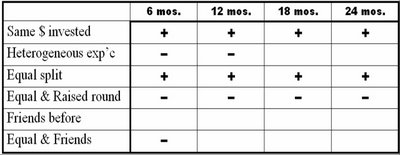
Another great post by the very smart Noam Wasserman on Founder Equty: Implications for Team Stability.
Included is this handy diagram on various stability and instability factors. Pluses indicate stabilizing factors, and minuses indicate destabilizing factors. Read the article for the full analysis.
Why is Google offering domains?
Link: Google Starts Selling Domains For $10 Per Year.
Huh, Google’s selling domains? Maybe it seems weird, but my theory is that Google makes so much money through ads from small businesses that it’s in their best interest to subsidize EVERYTHING that small businesses pay for.
The more they can offer, and the more sticky that relationship is, the more they can ingratiate themselves on the advertising side.
So other than domains, transactions (Google Checkout), and analytics (Google Analytics), what else might be on the table?
- Server hosting
- Commodity storage and compute power
- Small business software (as services of course) like CRM/accounting/etc.?
- Supply chain or fulfillment?
- Banking services?
- Web design or outsourced programming relationships?
- Outsourced HR, accounting, legal relationships?
Obviously some of these are more likely than others, but it’s worth thinking about.
Interestingly enough, Amazon is way ahead of Google in offering some of these, as Businessweek’s recent article on Jeff Bezos mentions.
Dating site within an MMO
I love it: MMO in the business of matchmaking.
One of the main reasons why games don’t turn into huge multi-billion dollar franchises is that they can’t make money off of offline items and services. If they could, they could get a piece of any transaction, the way that eBay and Google do.
This is one interesting step in that direction, where a game becomes a competitor to dating services. What’s next? An eBay booth in Second Life? :)
Congrats to the Isilon guys
In a day filled with storms and accidents here in Seattle, Isilon kicked some ass: Isilon’s IPO best performer in years. Great news for the Seattle tech scene, of course. (Although the big pop means it was mispriced, silly bankers)
Old media versus new media
… except in this analysis, it’s TV versus cable: Bear Stearns analyst report on media value chains.
Great analysis of the media value chain, including content creation, content packaging, distribution, and user interface. However, the best part starts on slide 16, which covers a retrospective on TV versus cable, and fragmentation and trends that ensued.
TV started out at 3 channels, then went to ~40 with cable, and now 125+ with digital cable. What happened with this proliferation of choice?
– Overall demand for TV went up
– Audiences fragmented
– Hits became less big
In the long run, the “long tail” of TV now drives more revenue than broadcast TV. Very interesting to look at the history of media to understand the potential impact of podcasts, video games, and other new media channels.
Everything on Valleywag is true…
Or so you could interpret from this NY Times article: Workplace Rumors Are True
:)
eHarmony’s matching mechanism is useful for other problems too!
A friend of mine started using eHarmony and I became fascinated with their people matching mechanic. It’s made me ask, why is it effective? What other kinds of problems could a similar matching be useful for? But first, a brief overview of online dating.
Classic dating sites overwhelm people with choice
A site like Match.com is like a bar scene, times 1000. You enter in a zip code, and it gives you 100s or 1000s of hits. You sort through them slowly, winking and messaging the ones that interest you, and skip the ones that don’t. Perhaps you read through their profiles, but because they are so many, I’m guessing that many folks simply glance , write, and keep going.
My guess is that it creates a “winner take all” type system, where desirable people get a huge number of matches and perhaps, haha, a Long Tail effect. It’s a “hits driven business” :) You don’t even have a physical limitation like in real life, where a person can only have a conversation with one or two people at once.
eHarmony’s matching mechanism is a selective black box
Compare this with eHarmony’s model, where the selection criteria is based on a black box. You go and take a long quiz about your interests, personality, and interpersonal style. Then you sit back and wait for matches. You might not even get matches immediately, but rather, you get matches over time, once a couple days.
Then once you’re matched, you go through a very long funnel process where you start by asking each other quiz questions, then more open ended questions, and finally you have unstructured discussion. I think this is a 5 or 6 step process, which is amazing.
This mechanism caters to a different crowd, and it’s marketed as such:
- First off, the high qualification bar means only serious daters get involved
- The low number of matches means that each match will be highly considered
- More qualitative information is conveyed through the lengthier process, which means less opportunities for bad first dates
Where else might it work?
Ultimately, it seems that eHarmony’s matching mechanism might be useful for other problems, particularly when the following criteria are met:
- Both parties need to have qualitative, compatible values
- Each experience has to be highly personalized
- Equivalent levels of interest are useful
- “Bad” matches are highly undesireable
(Maybe other folks have parameters here that they agree with)
So what else would work really well here?? I think there are many possible opportunities, but just to throw some out, what if you used this to select service providers like graphic artists and programmers? Would it be important to have compatible aesthetic values, the same professional style choices (structured versus unstructured, etc.), the same technology ideas (RoR versus ASP, etc.)?
Another option here is also jobs – what if you picked your criteria for jobs and then had a couple hand selected for you rather than browsing hundreds of random job descriptions? Would that get you a better fit?
I will leave it an exercise for the reader to think through these scenarios. Another interesitng question to ask, as well, is how to do a multi-person eHarmony, to help find study or activity groups where people are all compatible.
I’ll probably blog more about this later :)
Evolution of eBay’s technology platform
Great slides detailing the evolution of eBay’s technology platform, from the initial version onwards. In fact, here are the short bullets from V1.0:
V1.0
– Built over a weekend in Pierre Omidyar’s living room in 1995
– System hardware was made up of parts that could be bought at Fry’s
– Every item was a separate file, generated by a Perl script
– No search functionality, only category browsing
See the slides here.
UPDATE: Fixed link – thanks Mike and Noah.
It’s hard to be serious and fun at the same time
Pretty fun review of an upcoming Christian RTS game: dorkbot talk I attended earlier this week. The quote is about the fact that “Serious Games,” a new genre focused on learning or imparting ideas in addition to creating fun, often suck:
I confess I did not expect much of the game. The history of Christian computer entertainment is not particularly, uh, blessed. The games have tended to be numbingly boring side-scrollers in which the action serves merely as a clumsy deus ex machina to entice kids to reading dollops of in-game scripture.
They suffer from the tragic flaw of all “serious” games, which is that they get so wrapped up in honing their message that they don’t notice until too late that, yikes, the gameplay sucks. Play is an incredibly precious thing, and an extremely difficult thing to craft. Forcing it to serve moral instruction is like dipping it in formaldehyde.
It turns out that making things fun is very, very hard. The typical way that a game starts is not by building menu systems, installation programs, etc., but rather trying to perfect a very small slice of the program: The Core Mechanic. Basically whatever you spend 99% of your time doing, you try and prototype that really fast. In Pong, it would be moving the paddle around trying to bounce the ball back. In Mario, it’s jumping. In Zelda, it’s moving around the map exploring and occasionally hitting things. You spend months experimenting with, and refining, the core mechnic until it’s shiny. Popcap did a presentation of this which showed their mastery of this process of creating fun.
As an aside, web developers have a lot to learn about this. Rather than building things like user management or database caching or other infrastructure, web applications should probably be built from their innards out. So if you were building Digg, the most important part is to make the 90% lurker view of browsing from page to page of articles fun and interesting, then the 9% of folks who comment and vote useful, and then the 1% contributors to make posting articles really easy. Anything else is should probably be built later.
Ultimately, if you prioritize learning (or function) over fun, you might end up with what you wished for, an educationally-packed yet boring game.
Anyway, at the dorkbot talk, the Popcap presentation showed a complete focus on fun at the expense of pretty much everything else. The “Serious Games” presenters were instead very academic, and focused more on abstract educational ideas and didn’t really even talk about fun. Something tells me they won’t be releasing any games through EA :)
How to get random people to e-mail you
Just a quick continuation of my LinkedIn post – ultimately, even using Google and LinkedIn, it was still hard to get in touch with people. It’s surprising to see this even in cases when you had people that WANTED to be discovered (For example, consultants or other service providers)
I think almost everyone on LinkedIn, ultimately, would welcome inbound e-mails in some form or another. Depending on what you do, perhaps you want to make a couple hurdles to ensure qualified people, but talking to interesting people is fun.
So here were the various levels of contact information obscurity that I saw on LinkedIn. Some of the encouraged me to contact them, others made it incredibly difficult to the point where I gave up:
1) Name but no last name, no profile information
2) Name but no last name, company information or two
Even then, Mary A from Microsoft is not that useful :)
3) Name with last name, company information
4) Name with last name, company information, blog link, etc.
The folks above are generally pretty easy to get ahold of using the Google + LinkedIn method
5) Name with last name, company information, blog, AND e-mail in the profile
Obviously having the full panel is great. A blog is a huge plus. This way, you can very easily identify this person, browse their blog to get a sense of what they’re interested in, and contact them regardless of your connections to them.
So if you want random people like me to contact you, remember to edit your LinkedIn and stop being so introverted :)
How to meet lots of people through LinkedIn
I’m winding down my last month in Seattle – sorry for the light blogging lately!
I’ve been very busy in the last week (and in the next 2 weeks) closing up shop in Seattle and meeting folks related to gaming and startups. One interesting question that pops up is, if you pick industry X, how do you meet lots of people who work in X. (In my case, it’s gaming)
Over the years, I’ve experimented with lots of different methods, but this time I tried a couple:
1) Subscribing to mailing lists and posting “Will you talk to me?”
Sometimes this works, but most of the time, you only get 2 or 3 people writing you back. I think the reason is that it seems random, people assume other people will help, and it’s generally a pain in the ass. I usually meet a couple through this method (in my case, spamming the IGDA mailing list) but this didn’t work well.
2) E-mailing friends and contacts at gaming companies
I also just e-mailed a bunch of friends and asked them to introduce me to people involved in gaming. This definitely worked, and I had at least 5 referrals this way, whom I’ve met for coffee. I think this completely depends on how “adjacent” the industry is – for example, if I’m in tech and I want to meet folks in video games, that’s not too bad. But if I wanted to meet people in the coffee or restaurant industry, that might be a lot harder since the connections are fewer.
3) Searching through LinkedIn and googling
It turns out, however, that the fastest way to meet a bunch of people is to use a combination of LinkedIn and Google. You use LinkedIn to see peoples’ names and companies – but you have no contact information. But then you follow up with Google and you can often find their e-mail address, or e-mail addresses for other folks within the same company (John.Doe@somecompany.com lets you guess their e-mail address) and finally, you can always e-mail the company address and specify the full name of the person you’re trying to reach.
This method has produced the most meetings out of any – you can easily use LinkedIn to find dozens of names, send brief e-mails with topics and ask to chat, and find at least a dozen folks willing to talk to you.
Definitely an interesting recent experiment, and I’m well on my way to understanding the gaming industry better. I’ll write up a post on what I’ve learned sometime later. Needless to say, the games industry is undergoing the same big revolutions as music, movies, and other digital goods.
The power of the mainstream publisher is both a stifling force on innovation, yet their power is diminishing over time. New models are emerging which focus on the idea of consumer choice, and having infinite choice, rather than traditional models which focus on finite shelf space (or screen space).
It definitely links to Chris Anderson’s idea of the Economics of Abundance rather than the Economics of Scarcity.
Here’s another great presentation on the topic from Raph Koster.
What a button can teach you
How cool is this site?? History of the Button.
Yes, that’s right, it’s an entire blog about buttons (like the kind you press, not the kind you have on your shirt). And I think it’s an incredibly fascinating angle on how people view technology. In an age where techie folks (like me) have our heads above the clouds thinking about complex technologies (usually with complex interfaces), it’s interesting to see how much richness (and difficulty) a button can give you.
Anyway, it reminds of this meme, which Steve Jobs keyed on the Apple Remote having 6 buttons and their competitors having dozens.


I suppose the software version of this is the perpetually ill-used dialog box. Lots of examples here. Here’s another set of examples.

(I see crap like this all the time, sadly)
Cute little blog

How to draw in MS Paint
People to meet in Seattle before I take off?
Today was a big day for me! It was my last day at Revenue Science, where I’ve been immersed in online advertising for the last 4 years.
I only have about 30 days before I move down to Silicon Valley and start at MDV.
Do you know anyone in Seattle that I should meet before I start my adventure?
If so, send me a note at voodoo [at] gmail [dot] com.
Yahoo’s problems with search monetization
Good article today for search nerds: Yahoo just needs to fix one thing: Monetization.
At the end of the day, the article is saying something pretty obvious: Yahoo needs to make more money based on the traffic they have :)
CPA is not the cure-all…
The question is, how? The author claims that somehow CPA is a solution – it may help, but at the end of the day, it’s a complicated issue. Sophisticated buyers (which constitute most of the dollar volume on these marketplaces) are already pricing based on CPA, even if they are bidding on price-per-click. They take the PPC they are bidding, the conversion rate on their landing pages, and figure out the effective CPA. So if you were to switch to CPA, they might love you more, but they won’t necessarily increase their pricing.
Also, CPC is a great compromise between publisher and advertiser – it’s part of the reason why it’s a very balanced pricing model. For publishers, they prefer CPM (guaranteed revenue) without being accountable for anything, particularly conversions. For advertisers, they prefer CPA since it’s guaranteed margin for them. CPC means that both party take risks.
Even so, CPA has been around for a long time. Commission Junction, Linkshare, and all those guys have been doing the CPA affiliate model for years. Recently, new folks have emerged like Adteractive and Azoogle who arbitrage high-ticket CPA offers against all sorts of different media. See Jay Weintraub’s awesome blog for a ridiculous amount of detail on this topic.
If not CPA, then what? (I don’t know)
I won’t dare to speculate how Yahoo should improve their monetization. I know there are people much smarter than me thinking about that exact topic. My only point is that it’s not as simple as pointing to something like CPA and claiming that’s the way out.
Fundamental economic issues?
The more worrisome issue is that it may be that Google has hit some weird critical mass with advertisers and publishers that will be very hard to compete with, in the long term. When an ad network first starts out, they have a chicken-and-egg problem since they need advertisers to attract publishers, and publishers to attract advertisers. There are ways to bootstrap, but it’s a difficult proposition.
But even when an ad network gets bigger, that chicken-and-egg problem doesn’t go away. The more advertisers you have bidding, the more competitive the pricing is, per click. This means that publishers (and Yahoo) can monetize their inventory better, but it’s hard to attract more and more advertisers without growing the amount of high performance inventory.
I believe people in 1999 called this a “network effect.”
Ultimately, Google may be too far ahead. I’ve heard rumors that Google is actually paying certain publisher partners over 100% revenue share(!), just because the economics dictate that the overall keyword market benefits even if they lose money at the deal. Basically these publisher partners keep the keyword prices very high, which pays dividends throughout the marketplace. This would point to the idea that Google is being so aggressive in defending their marketplace in a very savvy way, as to not give any chance for Yahoo and MSN to breathe.
So all in all, it may not be so easy to catch up with Google as to invest in technology. eBay is a very simple concept, yet its marketplace is VERY defensible. Just look at Yahoo Japan, which got a marketplace going first before eBay, and they’ve been able to keep their lead.
One last note on this – Microsoft sorta has a trump card in all of this since theoretically, they can create a bunch of high-value search out of thin air through Vista, and that’s an option no one else has. It may be possible that with that influx of inventory, they could grow without directly engaging Yahoo and Google in the Internet attention wars.
Fun casual strategy game :)
Link: DICEWARS – flash game.
Play it a couple times and you’ll notice there’s actually a bit of depth in there.
Here’s some analysis from one of my favorite bloggers, Danc from Lost Garden: Fighting the Dice Wars demon.