Archive for June, 2018
The Startup Brand Fallacy: Why brand marketing is mostly useless for consumer startups
Brand marketing is mostly useless for consumer startups. Startups build a great brand by being successful, finding product market fit and scaling traction, etc. But it’s not a real lever. Let’s not mix up correlation with causation!
If this seems contrarian to you, it’s because there’s a vast ecosystem of consultants, agencies, and other middlemen who are highly incentivized to have you spend $ and effort on non-ROI/non-performant activities. Early startups should opt out of all of this
It’s easy to confuse correlation and causation: If you’re starting a consumer startup, you see successful late stage cos with fawning media coverage, amazing conference speaking slots, celebrities on the cap table, etc., and think that’s what caused their success: Great brand.
But great brand is the lagging indicator of success. The buzz is created by the hard work that the entrepreneurs put in: Finding product/market fit, hiring a great core team, finding acquisition channels that scale. Brand marketing is great, but it should be layered on later.
The greatest consumer products in recent years slogged through years of obscurity. The overnight success of Uber, Airbnb, Instagram, etc were actually multi-year successes driven by hard work and multiple pivots.
Working on press mentions, conferences, etc can be a good way to get an initial hit of traffic. It’s great! But it’s not enough. Here’s an article from a few years back: After the TechCrunch bump, there’s life in the trough of sorrow.
Anyone who’s been on the homepage of TechCrunch, AngelList, Hacker News, or even in the NYTimes knows that it’s a increase to your dopamine but not so much your customer acquisition :) It’s great for the early days, but you need a lot more to scale.
Furthermore, the metrics-driven argument is obvious. Ultimately, the engagement in every product can be deconstructed into a series of user cohorts that join and decay over time. How does brand help these cohorts? My observation: They don’t help much.
One argument is that brand marketing can create buzz and word of mouth. OK if that’s the case, why does every brand-driven commerce company have >60% of their customer acquisition happen through paid marketing? Why do they have to buy all their customers?
If brand marketing helps make acquisition ultimately cheaper, then why does every startup’s paid acquisition become less efficient over time, even as the company becomes more well known? The same arguments apply to startups’ re-engagement efforts.
It’s true that a strong brand can confer defensibility in a noisy space – but it’s brittle, hard to create, and hard to sustain. Hard to bet on that in the early days of a startup.
Where brand marketing does matter, especially outside of consumer: Recruiting a great team. Raising money. Partnerships. These are all small targeted audiences where you can reach them with more touchy feely efforts, and it can work! So put your emphasis there.
For early consumer startup efforts, it’s better to focus on the basics. Understand your users, deliver a great product to the market that grows by itself, built moats, monetize in a user-aligned way. Grow your team, work with the best advisors/investors/etc. The basics.
Do all that, and your product’s brand will take care of itself – and then you can layer on more brand marketing efforts to 10x the effect. Just don’t do the steps out of order!
[Originally tweetstormed at @andrewchen]
The IRL channel: Offline to online, Online to offline

(📷 dmagazine)
We’ve heard about Facebook ads, Google adwords – but today let’s talk about the “IRL Channel.”
The IRL channel is an underappreciated advantage of companies that exist in the real world – Amazon Echo, Envoy, Lime, Uber, etc – that use constant in-real-life reminders to try out and use the product
The viral acquisition benefits are pretty obvious. If you’ve never seen/tried a product, but you see them swarming around your city (or your workplace), then naturally you’ll want to try it out
More importantly, some product usage patterns are naturally viral. Couple examples:
- Transportation fits into this bucket, which is why Uber’s rider acquisition mostly viral/WOM Traveling and going out are social activities. You bring your friends and loved ones in the car with you, to share the costs. Even the fully utilitarian version – going from point A to point B – can be social, since there’s often a person on the other side.
- The new scooter/bike trend is another obvious example. Lots of brightly painted Lime scooters all over SF makes a splash. Put some pricing and instructions on the actual hardware, and riders who have big smiles on their faces, and you have a natural acquisition channel.
- With Amazon Echo, the physical presence gets you an retention/engagement benefit. Sitting on your kitchen counter naturally encourages you to use it. The newest one, the Show, has a display which invites you to interact. Sometimes the Amazon Echo thinks you’re talking to it when you’re not. I’ve always thought that Amazon is unlikely to ever fix this since it probably increases engagement when it occasionally gets things wrong :)
- Envoy is a B2B example. I’ve signed in with the system at the lobbies of dozens of companies, which means if I ever have to make a purchasing decision in the category, they’ll be the natural choice.
There’s not a ton of entrepreneurs who are brave enough to build new consumer hardware cos, but if you are, I think this has to be a key consideration!
The IRL channel is about a physical experience that drives you into a digital one. But the other way around is pretty profound as well.
When you see your social feeds populated with photos from highly instagrammable retail experiences like Boba Guys or the Museum of Ice Cream, like below…

(📷 Boba Guys fb page)

(📷 laweekly)
… you can’t help but pull up Yelp to figure out the closest place to go!
The other mega trend here is esports and the fandom community, of course. One day you’re playing League of Legends and reading Star Trek fan fiction, and the next day you’re going to esports arenas and checking out vidcon. It’s a thing.
The IRL channel is real. It helps you with acquisition, retention, and more. It’s starting to go both ways – from online to offline, which has been a force in retail for the past few years – but also offline to online, where IRL products remind you to interact with their digital sides.
Super fascinating, and I’m excited to see where this will all go!
[Published with some modifications, originally tweetstormed at @andrewchen]
How startups die from their addiction to paid marketing
[Originally tweetstormed at @andrewchen, Follow me for more!]
Many of the biggest implosions in recent history – especially ecommerce – have been due to startups getting addicted to paid marketing while fooling themselves on Customer Acqusition Costs. As spend scales, it always gets more expensive and harder to track – never less.
A familiar story: New product launches. Nice spike, but it dies down. The product is low freq – gotta spend to grow. Marketing spend increases, it’s profitable! More is spent, more money is raised via VCs. OMG this is working! Party!
Suddenly top line hits a ceiling. Payback period goes from 9 months to 12, then more. Unit economic profitable, but not with staff + HQ. Without top line growth, more investment dollars can’t be raised. Budgets get slashed, then layoffs.
Even slower growth means a pivot is in order. Try something else, also powered by paid marketing. Maybe subscription? Premium? Try another thing. Then another. Irrelevance – or maybe bankrupcy.
This happens enough that y’all should be nodding your heads now – it’s tough, but there’s a pattern. This is the Paid Marketing Local Max.
The key insight here is that Paid Marketing is tricky to grow, at scale, as the primary channel. It’s highly dependent on both against external forces – competition and platform – as well as the leadership team’s psychology when things get unsustainable.
The first mistake is to start by thinking of everything as Blended CAC – dividing all your acquisition against dollars – as opposed to understanding CAC of each channel (Facebook, Google display, Google AdWords, etc.). The former is misleading.
Because your initial organic users are your biggest fans, your Blended CAC and per-channel CAC can often by off by 2-5X. As you scale your paid, your organic won’t follow 1:1. So as you grow, your Blended will approach your dominant channel’s CAC.
Scale effects mostly work against you in paid marketing. The longer your campaigns run, the less effective they become – people start seeing your ads too often. The messaging becomes stale, and novelty effects are real. Market performance has a reversion to the mean.
Saturation is also a thing. As you buy up your core demographic, the extra volume comes from non-core, who are less responsive. The first US-based ad impression on a property is the most responsive, but you eventually run out of those.
Competitive dynamics are real. They’ll come in to copy not just your product, but also ad messaging and creative. It’s not hard to fast follow, especially if you can start the test just with a experiments on millennial-friendly ad copy and landing pages.
Contrast that to viral channels, folder sharing in Dropbox or team channel creation for Slack – these are highly situational and only a few folks can copy. Whereas in ads you’re competing with everyone going after your same demographic.
Addiction to paid marketing can get you into a local maximum. It’s much harder to fix the underlying issues – creating real moats, product differentiation, doing deeper adtech integrations. Easier to just spend more and push the LTV window from 9 months to 12 to 18.
There’s a few scenarios where paid marketing is justified, but it’s situational. If your product has network effects that kick in after an activation point and really scale, you can use paid to help bootstrap that. Facebook uses paid to build out new regions, for example.
If you are really going to invest a ton of time from engineering/growth to integrate with all the APIs, try out a ton of things algorithmically, then you can develop a lasting edge. I’ve heard Wish does this well, but it’s not common.
The new generation of ad platforms makes it possible to scale revenue to new heights, but without profitability. Make sure you don’t get addicted. Build out new channels. Fix churn and frequency. Don’t congratulate yourself too early. And calculate LTV/CAC correctly :)
So what do you do about it? One of the best case studies of this is from @drewhouston’s Dropbox presentation from the early days. Lots of great stuff in this deck and it’s worth paging through, now nearly 10 years later. Here it is.
On slide 18, Drew talks about early experiments they did on paid search. They executed the industry best practices at the time – go to trial-based pricing, hide the free option, optimize landing pages. Slide:
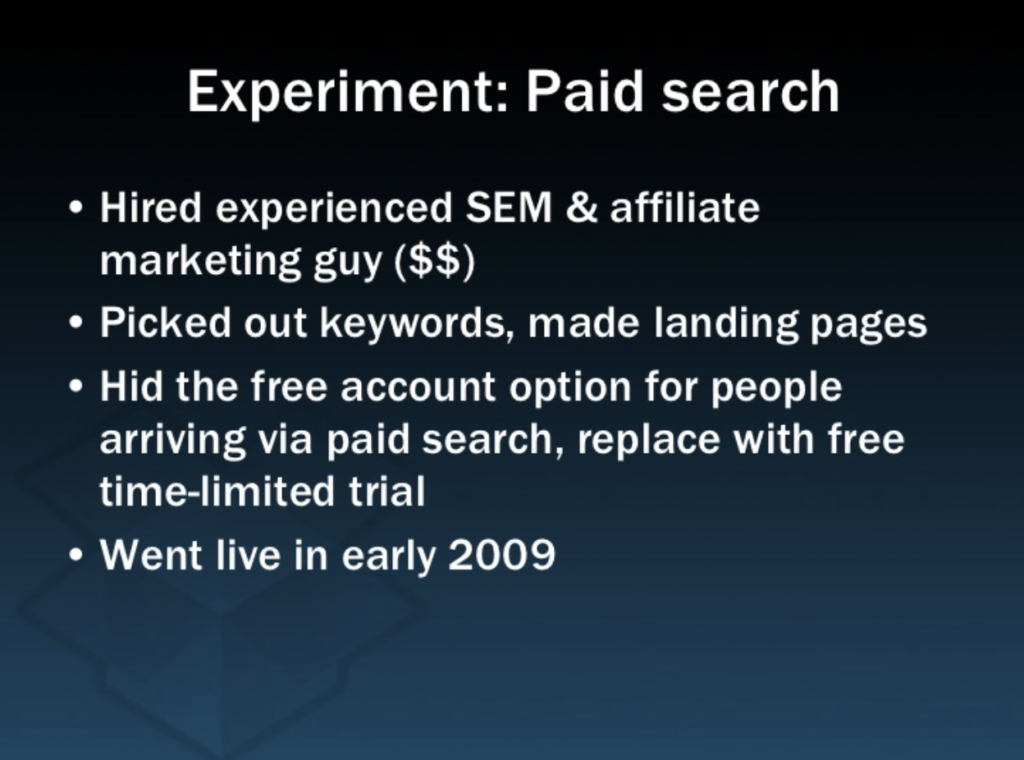
What they learned was that, in the mature market for cloud storage, there was already a lot of competition. All the paid marketing channels were unprofitable. Hiding the free option wasn’t user aligned. Etc etc.
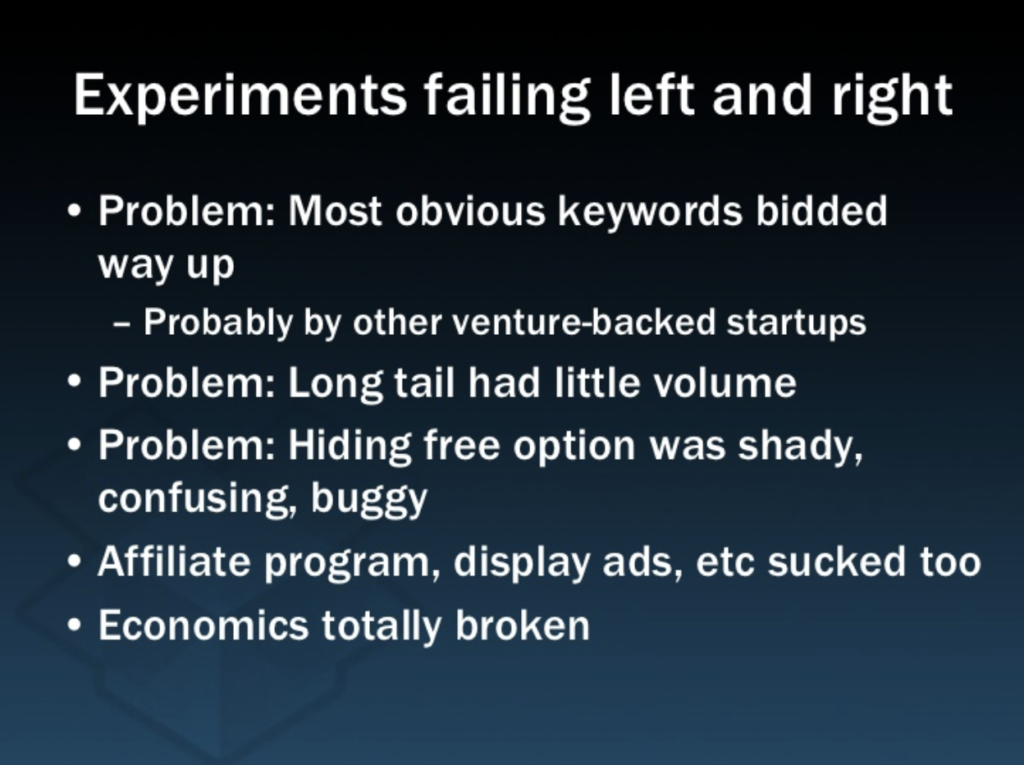
The obvious move would have been to continue to grind on the problem! Tweak pricing, optimize more ads/funnel/landing pages, etc. And many would have been tempted to do that, because it’s worked for others
The interesting thing, and you can see in the deck, is that grew virally instead – via folder sharing, the give/get disk space program, etc. It seems obvious now, remember that back in the day, “cloud storage” was the space, and it’s not clear that you can go viral there.
Dropbox has done well since then, of course!
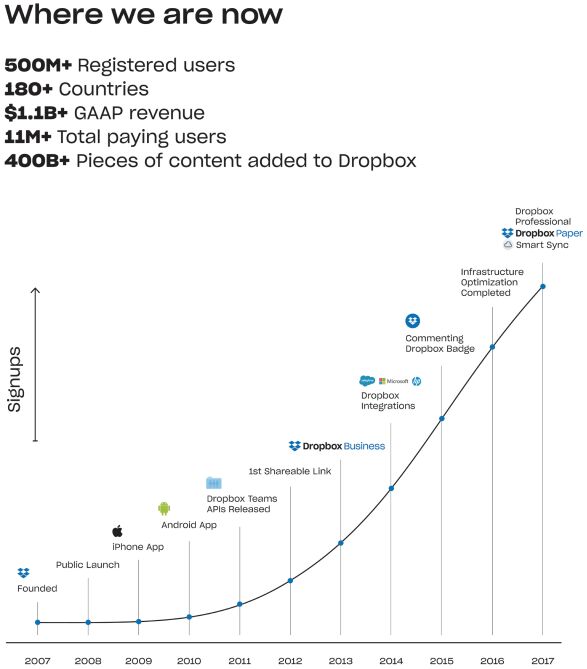
As an aside, isn’t it interesting that exponential growth curves always look linear instead? Here’s Slack’s as well:
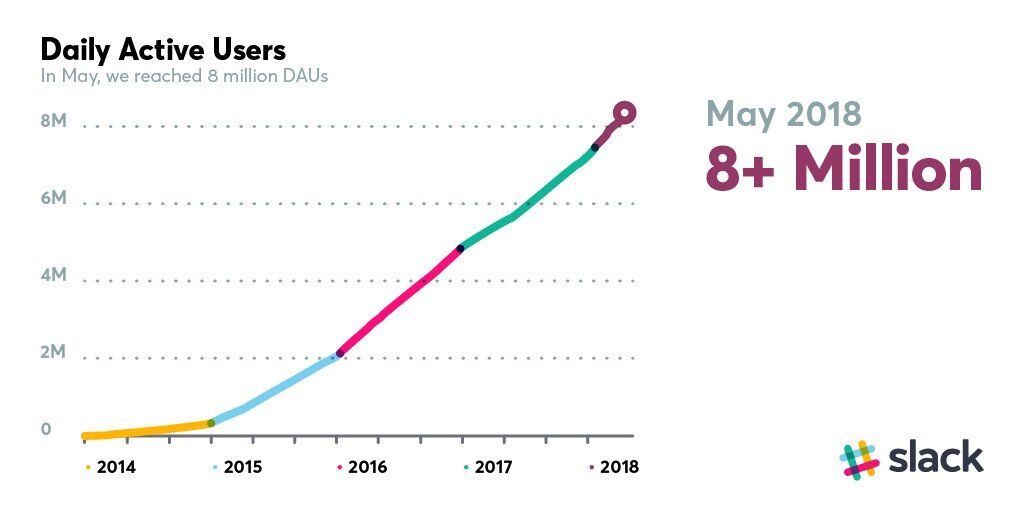
In some ways, you could argue that Dropbox is lucky that their initial forays into paid marketing didn’t work. That made it easier for them to stop their efforts there, and to focus on the viral channels that are now their bread and butter.
On the other hand, it takes a lot of insight and reflection to go away from the current industry “best practices” – even if they erode profitability, cause shark fins, etc.
So for those of you who are thinking about going all-in on paid marketing, I challenge you to go deeper on that strategy. Perhaps cap your paid acquisition at 30-40% of TOF. Instead, where can you innovate?
In addition to Dropbox, I sometimes use the story of @Barkbox, which created a whole media property, Barkpost (http://barkpost.com ) as a viral content sharing engine that can cross-sell the subscription product.
Or at Uber, although they never became significant channels, we were keen to work on sharing viral sharing features like Share ETA, Fare Split, and Location Sharing to potentially drive acquisition.
The point is, knowing that Paid Marketing is highly addictive and hard to scale down, all of us in the industry should always be thinking about the 2nd or 3rd channel, in addition to organic/WOM, to give us a way to wean off an ever-increasing ad budget.
To do that, you’ll need empower your creative team to attack the problem from all angles- new viral product features, really investing in your referral program, building out your content/SEO strategy even though it’ll take years. It’s worth the investment!