Archive for March, 2008
Search stats for this blog
I recently installed a Lijit add-on to the blog, and have gotten some interesting stats. Thought I’d share them below. Not surprisingly, there’s a ton of people searching about Facebook and viral marketing.
First, here are the searches that people do on the site:
- facebook 14 times
- registration funnel 7 times
- viral coefficient 7 times
- viral 7 times
- "meet new people" 5 times
- traction 5 times
- registration 4 times
- social gaming 3 times
- viral marketing 3 times
- dating site 2 times
- coefficient 2 times
- co-founder 2 times
- virtual goods 2 times
- yelp 2 times
- facebook viral 2 times
Second, these are the keywords for how people are searching for on Google and other search engines, in order to reach the site:
- andrew chen 127 times
- entrepreneur in residence 22 times
- andrew chen blog 20 times
- viral loop 18 times
- futuristic play 17 times
- futuristic 11 times
- vertical ad network 11 times
- "andrew chen" 9 times
- new diner games 9 times
- viral coefficient 8 times
- viral 8 times
- social networking monetization 7 times
- facebook quotes 6 times
- create a social network 5 times
- vertical ad networks 5 times
Web 2.0 Haikus
Sorry for the lack of posts recently, have been very busy in the last week.
I was at lunch with some friends and started typing out some viral marketing haikus on my phone – so secondly, sorry for the bad haikus that follow:
Viral marketing
Friends who spam you all the time
Aren’t really your friends
Just raised some V C
Social websites make no cash
Google can’t save you
Techcrunch Valleywag
Techmeme Mashable and more
Why work? Just read blogs
Fickle teenagers
Herded ruthlessly for cash
You got an invite
Lack of retention
Viral loops are not enough
You just jumped the shark
Please post your own in the comments ;-)
Reader question: What fuels you?
A: I think this YouTube video is appropriate:
What is best in life? (Conan the Barbarian)
Bridging your traffic engine with your revenue engine
Viral loops are only good for one thing
… and that thing ain’t revenue. Viral loops generate traffic, but you still need to:
- Retain the traffic that’s generated virally
- As well as also monetize the traffic
Between these steps are transition points from acquisition to retention, and then from retention to monetization. You can think of these transition points as a series of bridges (or more accurately, funnels) that you analyze and optimize.
Why separate your viral loop and your retention loop?
Some of you might have noticed that oftentimes, viral loops are extremely simple user flows that build on users’ need for:
- reciprocation (gifting, accepting invites)
- social norms (comparison/rating)
- greed (free ipods)
- etc.
For many of these loops, you can get a user to invite their next set of users, but after the process, it’s easy to feel a sense of completeness and leave the site. There are many Facebook apps, for example, that are just “pure” viral loops – there’s really no retention loop that the user enters after they’re done.
And as I argued in a previous post called “When and why do Facebook apps jump the shark?” the lack of a retention loop can hugely damage the long term value that you’re creating.
That said, the Shangri-La of viral marketing would be a product that not only was viral, but the viral loop was the same as a retention loop. Perhaps this is the easiest to do when you are building a communication app, because ultimately every time you use Hotmail, you are helping them advertise and acquire users.
But if you’re lazy, you can use one of the “pre-built” viral loops that are out there (like gifting, invitations, etc.) and try to integrate that into yoru site. You then have a viral loop that you use to acquire users, and after they’ve helped you acquire some traffic, you then transition them into a user experience that retains them.

HotOrNot case study
I want to use HotOrNot as an example of bridging your traffic engine with your revenue engine, because I think they do it very well. Please go to HotOrNot.com to refresh your memory, if you haven’t visited the site recently.
HoN is really split into two completely different experiences:
- The classic hot or not ratings experience
- Then, a dating site with virtual goods as the monetization
The first experience is the one that ultimately drives all the traffic. Without using any “productized” viral techniques, the site was viral because it was fun, and people sent it to their friends. This is their traffic engine, and for some companies, it might have been enough to slap some ads on the site and call it done.
However, the company went further than that – each picture on the site is actually an AD that bridges users into the dating site. At the top of each picture, you see “Click here to meet me,” but also clicking ANYWHERE on the picture also takes you into a registration landing page. Some % of users then convert on this page, and then successfully transition into a general dating site.
Why it works
There are some key things that make HotOrNot work, and I’d encourage you to think about it in the context of your web property also:
- HotOrNot has a novel user acquisition technique – user ratings that drive word-of-mouth viral
- The bridging process is tailored to work with the traffic engine, and thus is also very novel
- The traffic engine is bridged to the revenue engine via pictures that constitute 30%+ of the real estate on any given page
- Once you click, the picture of the person you’re interested in is used on the landing page to “smooth” the transition point and increase conversion rates
I think it’s very important that both the traffic engine, the bridge, and the retention loop are all motivationally aligned.” This means that if the user’s there for hot chicks, then the entire process bridges them into a retention loop that’s all about hot chicks. Or if it’s about making money, it permeates the entire funnel as well. HotOrNot has a very smoothly designed transition, as as a result, I’m sure the conversion rates are quite high.
Measuring the efficiency of your bridge
One might ask, how do you measure the smoothness of the transition? Well, consider the following – would you rather have:
Scenario A:
Acquire 1,000,000 users which turn into 10,000 retained users
or:
Scenario B:
Acquire 100,000 users which turn into 25,000 retained users?
It’s pretty obvious, of course, that acquiring LESS users but ending up with more retained users is better – thus I’d prefer scenario B. Because the carrying capacity on Facebook is roughly 60,000,000, then a more efficient bridge ultimately leads to more retained users, which generate much higher total visits, whcih in turn generate more revenue.
So let’s define a new metric, which I’ll call “Activation Efficiency,” using the marketing parlance of how many contacts you can “activate” into leads and then into sales:
Activation Efficiency = total retained users / total acquired users
where:
- Retained users means total # of users that had 2 visits or more, let’s say
- Acquired users means the total number of uniques that come in through your viral loop
Once you start measuring this, then it becomes much easier to think about connecting your viral loop and retention loops. After all, if you acquire 100 million users but only 0.1% activate, and you have a site of 100,000 active users, your ComScore numbers might look nice, but you’re right about to jump the shark!
Too many social networking aggregators?
OK, this is pretty funny. Check it out ;-)
Reader question: What’s the difference between “Viral Marketing” and “Word of Mouth?”
A: I tend to think of Viral Marketing that include both systematic and unsystematic ways that your current customers acquire new customers, including:
- Chain letters
- Tupperware parties
- Youtube embedding
- E-mail forwards
- Consumer “buzz”
- … etc
In some of these cases, the virality has been “built-in” to the system – for example, but chain letters explicitly promise you something in return for sending on a letter, as do Multi-Level Marketing systems like Tupperware. These incentives and systematic design are originated with the intent to propagate a viral process.
On the other hand, when I think of Word of Mouth, however, I specifically think of consumers telling other consumers about a product just because they like it, rather than there being a direct incentive to do so. This feels more organic or natural to me, and perhaps, it’s what people usually think of as your passionate influencers propelling your company forward.
Perhaps this distinction is arbitrary, but it helps serve the point that viral marketing can be defined very broadly – beyond word of mouth and other “natural” vectors.
Google’s second click versus Facebook’s second click

Google’s second click
For those of you who haven’t read Dave Morgan’s article on Google trying to capture the "second click" you should do so here: MediaPost – The Fight for the Second Click. It’s a couple months old, but worth the read if you haven’t seen it.
The point is, because of Google’s position as the de-facto start page of the internet, they are able to control where users go – and that control makes them powerful, because traffic = money. The fight for the "second click" refers to Google thinking about how they can control not just the first click (Search!) but also provide a shortcut to answer the query on a second click. And because of their control of the search engine result page (SERP), they can always place their content above everyone else’s.
Examples of capturing the second click
Here are a couple examples of this – check them out:
It might seem like a big deal to do this, but you can imagine that if you ran a business in weather, real estate, dictionary reference, or movies, you’d want to know where Google was planning to expand here.
The reason is that in a lot of these vertical businesses, like movies, your only hope for getting users to come back to your site is via search engines. It’s hard to have a daily relationship with your users, and thus you are dependent on the "start pages" to point you in the right direction.
So when you see Google starting to build into this area, it can cause trouble because it siphons away traffic.
Is the SERP Google’s platform?
When it comes to platforms, maybe it makes sense to think of the search result page as Google’s platform. After all, let’s compare to Microsoft:
- Windows is Microsoft’s horizontal platform across applications
- Applications build on top of Windows and have to adapt to its APIs
- Microsoft can use Windows to cross-sell their vertical apps (think Office, IE, XBox, etc)
- Back in the old school days, Microsoft could change their API or have "secret" APIs that would give their own applications an advantage over standalone companies
Let’s compare this to Google:
- The search results page is Google’s horizontal starting point across websites
- Websites build on top of the Google index and have to adapt to its algorithm changes – that industry is called Search Engine Optimization
- Google can use their search results page to cross-sell their vertical apps (think Google Toolbar, the mini-results listed above, etc.)
- Google changes tweaks their algorithms and put their own results above others, to give their own apps advantages over standalone companies
Again, the notion here is of controlling distribution – both platforms are able to cross-sell their applications and promote their usage in a way that undermines their competitors/partners that are at their mercy.
In fact, if anything, Google has been shy about using their SERPs to cross-promote their other products – which is why there’s so many Google products that don’t have much traffic to their competitors.
If Bill Gates ran Google, he’d probably cause all searches for "facebook" redirect to Orkut.com :-)
Comparing Google’s platform to Facebook’s
Facebook is in a similar position – like Google, they are one of the "start pages" of the internet. But rather than reference, they are focused on communication, which makes them one of the few sites on the internet people use every day. And like Google, people also leave their Facebook pages open all day, and thus, they can control access to subsequent pages.
Unlike Google, however, rather than sending users away from the site, Facebook opted to open up their website for application developers. Interestingly enough, what that means is that they control the first click, the second click, and maybe even the 50th click.
In this way, they are far more open than Google in letting people leverage their distribution, and allow developers to create rich functionality within the Facebook site. This may also be great for them because it causes far more dependence on their platform.
So let’s talk about what it’d mean for Google to open up their SERP, and treat it like their platform:
Google: Open up your SERP!
Right now, there are only two ways to build on top of the Google search experience:
- Buy text ads
- SEO your website and get into the organic index
And these are both great triggers for when people search for a specific type of text content.
But let’s run through a couple crazy "What If?" scenarios:
- What if Google let developers build INTO the search index pages with richer applications (like what Facebook/OpenSocial provides)?
- What if when you searched for "definition of ironic", it wasn’t a Google chosen result that came up at the top, but rather an "app" that placed itself there through driving the best relevance?
- What if Google created an open standard that allowed each result to return themselves not as an automatically processed paragraph of text, but as a rich application?
If these scenarios were possible, then you might argue that all the smart stuff that Google’s doing to improve their SERP – like making YouTube video thumbnails, or Google Image Search shortcuts – could be done automatically by the people building the underlying sites and integrating with a SERP API.
In fact, you could imagine that the ads could function this way as well, so that a real estate site might be given X by Y pixels of app real estate if they bid into the top slot.
Without this, the SERP is a walled garden platform that gets slow, incremental features based on whatever Google chooses to implement. And that’s the furthest thing from open, yet it’s also not Googley to let people clutter up the SERP. So we’ll see how this tension evolves over time ;-)
Rethinking Facebook’s “Daily Active Users”

What’s the key metric for Facebook apps?
You might recall that initially, Facebook apps were measured by installs, and shown on leaderboards as such, and as a result, people optimized for that.
These days, you see people quoting DAUs, meaning Daily Active Users.
Problem is, as I wrote in my last post on "When and why do Facebook apps jump the shark?" DAUs can still hide a festering retention problem underneath a very viral app. Ideally, you want something that gives you a sense for how good the retention is, regardless of how viral it is.
Viral apps can have inflated active user counts
As you might expect, as you are acquiring tons of users in a viral process, you can inflate the active user counts. That means:
DAU = users acquired through invites + users that are repeat users because they’re happy
… and ideally, you want to separate the two, and provide metrics to reflect the information. For the second term above, let’s call that "Daily Repeat Users"
How about "Daily Repeat Users?"
One way to do that is to use the cohort method, which I discuss in the jumping the shark article above, and also here. What you’d want to expose is what % of users, after getting exposed to the app one time are likely to come back and use it again.
As a result, you want to count users that come back MULTIPLE times, but subtract out first-time users.
You might also think about how to subtract out users who come back via notifications, or other shenanigans that app developers may use to boost this new metric. Obviously you’d expect some gaming either way – it’s inevitable with so much visibility at stake – but the more transparent the better.
If anyone has other suggestions for a better way to do this, I’m all ears!
Reader question: What are you working on?
Reader question: Does Facebook + performance ad network = awesome?
A: There are a couple interesting angles to consider here:
Facebook has a very interesting local play, due to their understanding of geographic and friendship networks. Very few companies in the world have as much information about your location and interests. However, the problem with local is mainly that the CPL to actually acquire a plumber in Tacoma, WA is often more than the revenue you’d ever get from it.
From the perspective of inside the Facebook site, I pretty much think it’ll be a grind-it-out brand ad sales play the same way Yahoo is. The more I think about Facebook, the more I think they are the new Yahoo – primarily strong in messaging and communication, they are more of a social utility than they are anything else. For them to succeed in generating significant revenues driving traffic to other sites, they have to move from a more people-oriented model to one where links to external sites play a bigger role in the interaction. That’ll be hard to do since it mucks with Facebook’s core mechanic.
And yet another angle is for Facebook to start their own performance ad network that places ads OFF of Facebook, as the reader suggests. This is absolutely feasible, but my guess is that any use of the information from on the site would cause a privacy nightmare for the company. I mean, it’s one thing to have Beacon which tracks data from OFF the site, but once you start trying to use data from on the site and giving it to any ol’ publisher to use, then you are in deep trouble. Obviously it’s likely that the privacy line is moving and evolving over time, but the public’s not ready for it now. (Even as companies like Fair Isaac, Axciom, etc are all mining even more sensitive information)
Even if the privacy implications were mitigated, how well would the Facebook ad network do? I’d think that with how smart their folks are, they could probably get somewhere quickly. However, remember that much of ads is not a technology problem – a lot of it as a sales execution problem – and that may not be where they want to spend their effort, even if they could be successful in the short run. After all, when you have a $15B valuation, picking up $100MM in revenue here or there may not be interesting if it’s hard to scale it up to $1B in revenue later on.
Reader question: Specialized resources for driving traffic?
A: I’m often pinged for requests to recruit for people who are great at viral marketing, or traffic generation, or the like. Here’s the quick answer to that, blogged for posterity:
- Because traffic is greatly valued right now, all the best people in viral marketing are off doing their own companies – in this list, I’d include the founders of Slide, RockYou, Hi5, Flixster, Tagged, etc. The short list of experts is probably around a dozen or two at most, and they are certainly all in San Francisco
- Obviously, anyone who says they are a viral marketing expert but runs a consulting firm probably doesn’t know what they’re doing, otherwise they would have their own destination site that they were growing. In many cases, they are experts in “word of mouth,” not the viral marketing techniques online that generate millions of users
- Since the science of quantitative viral marketing is new, few people have written about it, and in fact, the community as a whole is pretty secretive about the entire thing (for better or worse)
I think for the folks who are interested in viral marketing, the best place to start is to understand website metrics really really well. Then go read about the SEO industry, then learn about affiliate/leadgen practices (including optimization techniques), and then go study Facebook apps. It’d take a good 6-12 months to do (that’s about the time it took me), but once you’re done with it, you can really pick up a lot.
If you’re an engineer and actually like to build stuff, I’d be open to meeting folks here in SF – just shoot me a mail.
Reader question: First-time entrepreneurs
A: Here are the steps I’d follow:
- Move to San Francisco
- Meet investors that know how to judge first-time team in early stage situations
- Get funded, and start a company :)
Anyone who is having trouble doing this, particularly if you’re from an engineering background, please e-mail me and I am more than happy to help.
Reader question: What 5 blogs do you read regularly?
A: I read all the same blogs as everyone else – Techcrunch, Venturebeat, Mashable, GigaOm, etc. :)
I think more interesting is probably the places where I get information that’s “proprietary” that a lot of other people don’t spend too much time looking through. I’ll give a couple examples here:
- Talking to end users: I’m often recruiting users using Google Adwords, Facebook ads, MySpace messaging, or Craigslist in order to talk to them about how they use websites, what their day is like, what they are thinking about these days, etc. I’ve also gone out to odd places like Sacramento and Renton to talk to users that are substantially different than me
- Perusing through “bottoms up” internet reports: Going back to my ad days, I like to look at a bunch of reports from comScore, Nielsen, Alexa, Quantcast, etc., and come through dozens of pages of websites. I enjoy trying out new domains, if I don’t recognize them, as well as looking them up on WHOIS, trying to figure out who the founders are, etc.
- Creating queries for odd or unique terms: I have dozens of Google alerts set up for terms like “viral loop” or “viral coefficient” or “social gaming” or other key terms where if someone’s using it, I probably want to learn more about them or the topic
- Talking to people in other industries: Sometimes, you can find analogies in other industries that apply back to your own – I’m often talking to folks in Finance to get their quantitative perspective. I also talk to folks in the creative industries, like design, or writing, etc., because they have something specific to add. And I enjoy hearing from people in the advertising industry, both traditional and interactive, because their world is so different from the consumer internet world, yet the issues clearly apply. Same for games.
I think the worst thing you can do is to surround yourself with people who are too similar to you. It’s more fun to hang out with folks who are passionate about other things – just like the future-engineer kid who takes apart his dad’s toys and gets in trouble, I think you have to spend time dissecting the way other smart people think in order to develop the amateur psychology skills necessary to think about consumer behavior.
Facebook viral marketing: When and why do apps “jump the shark?”
Excel spreadsheet download
For those of you who are interested in the gory details, please download the following spreadsheet here:
Download: Viral and Retention Excel Model
Math warning!
This blog post will be a little more technical than usual, so I apologize to those of you who are bored by this. Anyway, let’s get started.
See this image before? Many would describe that as, EPIC FAIL ;-)
That’s what happens when you “jump the shark” and your app goes from successful to completely not successful. Why does this happens? This blog post is to dissect that exact issue.
Modeling user acquisition
First off, let’s look at some ways to model user acquisition. For those of you with the spreadsheet, this is the second tab. You first start with a couple constants:
- Invite conversion rate % = 10%
- Average invites per person = 8.00
- Initial user base = 10,000
- Carrying capacity = 100,000
(note that these are just example numbers)
To understand how these constants work, you basically want to think about how viral marketing works. What happens is that you start out with an initial userbase (=10k), and every time your userbase grows, each user ends up sending out invites (=8.00), which then have a specific conversion rate (=10%).
That means that in the first time period, you have 10k. In the second time period, you get 10k*8*10% more users, which equals 8k more users, who are the next round of users who send invites. Then in the third time period, it’s 8k*8*10%, and so on. Note that the new batch of users needs to exceed the previous batch, in order to “go viral.” That ratio is often referred to as the viral coefficient. In fact, here’s the equation for this unbounded viral equation:
u(t) = u(0) * (1 + i * conv)^t
where u(0) = 10k, i = 8.00, conv = 10%, and t is the # of time periods
However, note that this assumes that your “carrying capacity,” that is, how many users are in the total network, is unlimited. However, on Facebook, that’s not true – once you burn through the 60 million new users, then you don’t have any left. Similarly, it doesn’t reflect the reality that as you saturate the network, your invites may end up going towards people who have already evaluated or installed your app, and they are unlikely to install it again.
A simple model for network saturation
Thus, one simplifying assumption is that as you saturate the network, the conversion rate on your invites goes down. In one possible model, you’d argue:
- If you have installs on 0% of the network, then your natural conversion rate (10%) holds
- If you have installs on 50%, then your natural conversion rate is discounted 50%, which equals 5%
- If you have installs on 99%, then your natural conversion rate is discounted 99%, and etc.
Note that you might even argue that this is an optimistic view. You might argue, for example, that the “discount” on your conversion rate should be related to the total % of the userbase that’s been invited, not the total % that’s installed something.
In that version, if someone hates your app and doesn’t want to install it, it’s unlikely that they will ever install it. In the version I’m describing, the only people who won’t install your app are the people who have already done so.
To describe this mathematically, you might say that at each point, there’s an “adjusted conversion rate” which looks like:
adjusted conversion rate
= natural conversion rate * saturation %
= natural conversion rate * (1 – current installs / total Facebook population)
so if you agree that’s true, then you can combine the this last equation into the initial one:
u(t) can be defined as:
= u(0) * (1 + i * adjusted_conv)^t
= u(0) * (1 + i * conv * u(t-1) / carrying_capacity)^t
(This can then be simplified further, but I’ll leave the math to the reader – the spreadsheet reflects this thinking already)
As a result of this, you see that your cumulative install base kinda looks like a logistic curve:

Now that you see that the cumulative users follows an interesting trend, where it starts to grow exponentially, but then starts to hit saturation. Then it eventually takes some time, but it starts to plateau as you reach the carrying capacity of the network.
Quick break for Cohort analysis re-introduction
Before reading through this post, you might want to glance over a previous blog I wrote on cohort analysis and its relationship to user retention reports
You may want to read that before going further…
Back to our story…
Previously, I discussed how you can mathematically model the viral acquisition process, particularly as you hit the network saturation point. However, while the model shows a growth curve for cumulative users, it doesn’t take into account how retention metrics fit in.
In the spreadsheet linked above, you can flip to the “User retention” tab, which shows a cohort analysis perspective of the hypothetical site. Here’s how to read it:
- On the Y-axis are “Time period cohorts” which are defined by the group of users that joined in a particular time period. So #1 means, the users that joined in period #1
- On the X-axis are the “Time period” which defines the time period that the specific cohort is in
So for example, in 1×1, there are an initial 3,000 active users on the site.
However, by the next time period, the 3,000 active users have declined to 1,500 users. However, because there are a bunch of virally generated users, there’s a new cohort of 2,328 users who have joined as cohort 2. The number of “new” cohorts is defined by the rows in the other spreadsheet tab, “Viral acquisition.”
Then notice that at the bottom of each time period, there’s a count for how many users are active in total, in each specific time period.
Does this make sense? If not, shoot me an email at voodoo[at]gmail with what you’re confused by, and I’ll update this blog with more clarifications!
Introducing the retention coefficient
So the key driver for retention is the % of users that stay alive in a specific cohort, between one period to the next. If it’s 50%, then if you start out with 3k users, in the next period you’ll be left with 1.5k users. If it’s 100% retention, then 3k users ends up with 3k users.
So let’s play around with the numbers.
At 99% retention, which means that over 20 periods you are losing very few users, you get a graph of total active users that looks like this:

This chart looks pretty good, of course. You start with exponential growth, then hit a plateau, and you have a very slow burn on your userbase. I suspect that the Facebook site, among other highly popular sites, essentially have >99.999% retention between days. I say that because people seem to use the site for years at a time, and probably the early users of the site are probably mostly still on it.
Now for the EPIC FAIL.
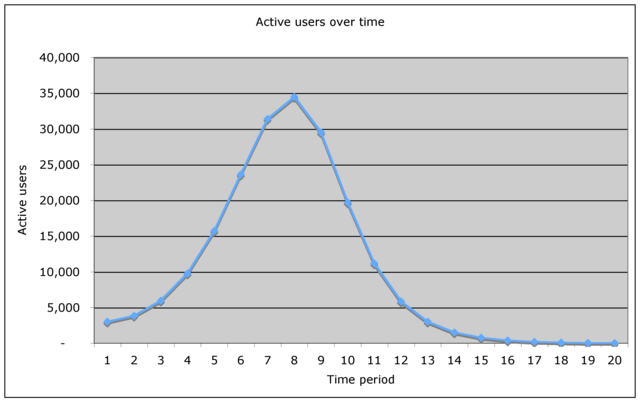
OK, here’s the fun part, which is when you drop the retention coefficient down to 50%:
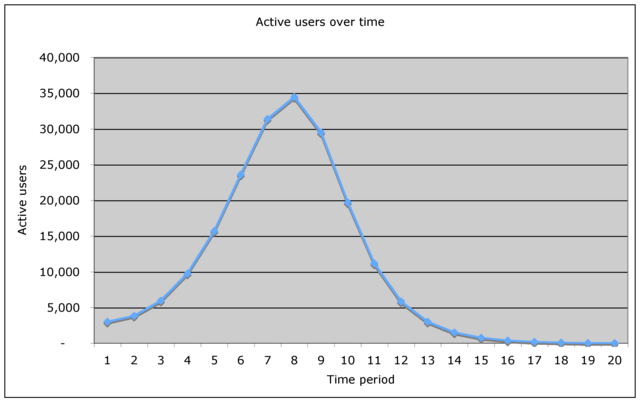
Ouch. Doesn’t look good. If you’ve read all the way this, far it’s pretty clear why this happens, but let’s summarize:
Key conclusion
The key in this calculation, if you look at the stats, is that:
- Early on, the growth of the curve is carried by the invitations
- However, over time the invitations start to slow down as you hit network saturation
- The retention coefficient affects your system by creating a “lagging indicator” on your acquisition – if you have good retention, even as your invites slow down, you won’t feel it as much
- If your retention sucks, then look out: The new invites can’t sustain the growth, and you end up with a rather dire “shark fin.”
Things look great at first, but if you can’t retain users long-term, then you don’t have a business.
Improvements to the model
I want to make a couple comments on how the simplified model contained within the spreadsheet could be improved dramatically:
- Don’t just model invites, model multiple viral channels
- Include “usage loops” not just the “invite loops,” which are triggered by users trying out the product
- Try both a global carrying capacity, as well as a “niche discount” for the number, if your app is super-niche and focused on a particular demographic or user behavior
- Be able to handle realistic numbers – perhaps even retrofit it onto Adonomics data, for example
- Factor in re-engagement channels
- etc.
Obviously if anyone would like to think about this more, feel free to and shoot me an email.
Facebook and Platforms conference: Graphing Social Patterns (San Diego) recap

Back from San Diego, and back from my blogging break
I was recently at the Graphing Social Patterns conference, where the illustrious Dave McClure of 500Hats and Justin Smith of Inside Facebook invited me to be on a panel on viral marketing. Thanks again Dave and Justin!
I wanted to write down a couple high-level observations I made from the conference, and then expand on them:
- Platforms opportunities are growing (but fragmenting)
- Is "jumping the Facebook shark" the new "jumping the Techcrunch shark?"
- Key verticals are starting to get defined, in particular "social gaming"
- Monetization can support "garage entrepreneurs," but venture returns are still elusive
More below…
Platform opportunities are growing (but fragmenting). Does run-anywhere mean succeed-anywhere?
The good news is that, for app developers, the choices for where they can build new widgets/apps is increasing over time. And more choices means that there’s more demand for app developers, and the leverage moves to them versus the platforms.
The best thing that happened for Slide and RockYou, when they were confronted with a hostile MySpace regarding their initial slideshow widget was for Facebook to open up. And now that platforms have aggregated a total of 250M+ users, they are in the business of courting developers – this means app developers will be able to get more leverage in the relationship when it comes to viral marketing, monetization, data portability, and other key issues.
That said, the problem is that more choice means more fragmentation. It’s yet to be seen whether OpenSocial will provide a consistent set of APIs, or if it’ll descend into buggy and slightly incompatible containers. Anyone who’s done development trying to support both IE6, IE7, Firefox, and Safari will know what I mean when it comes to supporting slightly compatible interfaces.
In particular, while the OpenSocial API provides specifications around key areas, it’s clear developers will still have to think through each particular social network design for issues like:
- viral channels and distribution
- app spamminess
- additional API extensions
- language localization and demographics
- audience “mindset” and usage context
After all, OpenSocial may allow apps to "run-anywhere," but not "succeed-everywhere."
I’m sure the players that will win in each specific social network will have to customize the entire app to integrate as tightly as possible into the underlying platform. In fact, this may open plenty of niches to form where the larger players (Slide/RockYou/etc) won’t pursue – net/net, this is probably great for the small teams that are just getting started
Is “jumping the Facebook shark” the new “jumping the TechCrunch shark”?
Now that apps have had significant run-time on the Facebook platform, several have shown that there’s a high-water mark for the DAU (daily active users). The reason is that a lot of companies focused on viral marketing early on, but even while they saturated the usersbase, they weren’t able to retain many of them.
Thus, when you do the math, what happens is that you have an exponential growth curve at first, which then plateaus out as you hit network saturation, and then turns into a shark fin as the bulk of your earlier users decays into nothingness. I will write much, much more on this model in a later post, and I even have an Excel spreadsheet to match!
Furthermore, it makes me wonder how much depth there is on the retention analytics side – after all, while a select group of developers have been building viral dashboards where they calculate viral factors, optimize their registration funnels, and so on, how many of them have been applying cohort analysis?
Key verticals are starting to get defined, in particular "social gaming"
There was a ton of discussion around the new "social gaming" category, and what that means. First off, the evolution of this space has been very interesting, and covered well by Jeremy Liew at Lightspeed. Ultimately, the group of Facebook developers who are working on these products are:
- Coming from the web side of the world, not the games industry
- Focused on games as a communication and social activity, not a 1-player experience
- Trying out mostly asynchronous, short time-commitment game designs
- And experimenting with monetization models beyond advertising, like virtual goods
There’s a ton of activity here, and it’ll be interesting to see how it develops, and ultimately how it bleeds out beyond Facebook.
Among the other verticals, there’s a bit of controversy as there are multiple types of apps with different characteristics, like:
- Deep and viral
- Deep but not viral
- Shallow and viral
- Shallow but not viral
I bolded "Deep but not viral" and "Shallow and viral" because it seems like many of the apps being developed are either one of the other. The guys making deep apps who are trying to deliver real utility, and some of them with actual business models, are having trouble acquiring users. This while little quick apps like "Send Hotness" and "Kiss Me" explode and acquire millions of users.
Games, of course, is interesting because they might be one of the only categories that’s both deep and viral!
Monetization can support “garage entrepreneurs” but venture returns are still elusive
Another great discussion was around the monetization path for these apps and widgets running on social networks. I’ve written about many of these issues in 5 things that make your social network monetize like crap. Here are some datapoints:
- Plain ol’ AdSense and ad networks provide some developers with $100k+/month
- However, very few can support more than 4-5 guys working in a garage – there aren’t venture style returns ($50MM+/year) yet
- Currently, CPMs are in the $0.10-$0.20 range but need to get up to $1 range
And as a result, you have folks playing around with alternative monetization models:
- Virtual items and virtual currencies
- Co-registration, lead generation, CPA
- Many are looking forward to Facebook payment model for e-commerce
Overall, the issues that I outlined in my previous blog still hold true. The social network environments are not great for direct response revenue, and for the branding opportunities, the agencies are still uncomfortable with the user-generated content environments.
What’s next?
Next, I’ll be catching up on my e-mail and getting some real work done ;-)