Archive for June, 2008
25 reasons users STOP using your product: An analysis of customer lifecycle
Churn from a customer lifecycle perspective
As much as I blog about viral marketing, it can’t be avoided that having healthy product retention is an equally (and incredibly) important part about having a successful product. Thus, in addition to talking about the issues around user acquisition, a similar discussion must be had around user churn.
In the customer lifecycle perspective, you look at the product from the perspective of a user that has a series of experiences starting from newbie and going into an advanced role. In addition to looking at the success cases, looking at the failure cases is informative too – you want to analyze your product for potential exit points and relate them to both quantitative and qualitative measures. More on the customer lifecycle concept here, by Josh Kopelman at First Round Capital.
Anyway, here’s a good example of this from the games industry: At the Austin Game Developers conference last year, there was a great presentation on why players leave their MMOGs from Damion Schubert (who also writes a mean blog here). There’s a very convenient writeup of his talk at Massively, which includes a great list. I’d encourage reading it in full. Obviously, the challenges that face more web-like products are very different, yet the same approach can be used.
Customer lifecycle within a social product
I imagine that many in the readership are working on social products – for any product in this space, you often have a number of fuzzy stages that a user can move through during their lifecycle. This may include stages like:
- First experience
- Soloing and single user value
- Encountering some friends(?)
- Hitting critical mass for social
- Becoming a site elder
Obviously every product is different, but the rough idea should hold for every social product out there. Early on, the initial experience is all about whether or not the user sees value in the product, and whether or not it “looks okay.” Then, oftentimes the users won’t have enough friends to make the site useful, in which case they fall back on a solo experience. Once they start hitting some other folks on the site, and making friends, then if done correctly, the site will hit critical mass and things will be sticky. And finally, in some products, some % of these users will turn into mods or admins or otherwise be elders within the product.
25 exit points
Now let’s look at all the different reasons why people might leave at any point – and obviously, the retention gets stickier and stickier in each stage, so perhaps reasons like “the site is too addictive!” become less effective :)
Anyway, there they are:
- First experience
- “I don’t get what this site is about”
- “This site is not for people like me”
- “The colors/design/icons look weird”
- “I already use X for that”
- “I don’t want to register”
- Soloing and single user value
- “I don’t have time to get involved in a site like this”
- “I’m lonely, not enough happens”
- “I forgot my password”
- “I don’t know how to talk or meet people”
- “I’ll just check on this account every couple months in case something happens”
- Encountering some friends(?)
- “People on this site are mean”
- “People I don’t know keep messaging me, WTF?”
- “I want my friends to use this, but none of them are sticking”
- “I’m getting too much mail from this site”
- “I only have 3 friends, this site is still boring”
- Hitting critical mass for social
- “This site takes up too much of my time”
- “Too many people are friending me that I only sorta know”
- “People are stalking me based on my pics and events!”
- “This Top Friends thing causes too much drama”
- “I’m getting flooded by e-mails for everything that anybody does”
- Becoming a site elder
- “The guys who run this site aren’t building feature X that we really need!”
- “The guys who run this site build feature Y that’s going to destroy this site!”
- “I’m doing a lot of work but I’m not getting anything for it”
- “I’m bored because there’s nothing left to do”
- “Newbies are fun to pick on :)” (wait, maybe that’s a benefit!)
Obviously, this is just a quick brainstorm of a list, but the point is, the reasons why people churn is often very different depending on their lifecycle. And some of the best things you can do for your product, in terms of retention, are things that are very positive for newbies, but might have side-effects elsewhere. You always want to balance each of these things off, depending on your product and business goals.
Am I missing anything else obvious? Comments and suggestions are always welcome!
Companies reading Futuristic Play – advertising, games, media, and more
One of the more unfortunate things about writing a blog focused on long-form essays that are not easily discussable is that you don’t get a ton of information about your audience just from comments and e-mail dialog. Through limited methods, I have some very rough visibility from what I can put together based on referrer logs, subscribed email addresses, and other sources.
Anyway, here’s a meta-blog post, in tradition with previous ones on top referrers, subscriber boosts from Scoble, and others, I wanted to share a short collection of the wonderful audience I’m very grateful to have reading this blog.
It’s pretty amazing to see how wide and interdisciplinary the audience is – there’s a ton of folks from super-consumery publishers/games, but also advertising and finance folks.
Here’s a selection of the companies that caught my eye:
Advertising and B2B:
- Aster Data Systems
- Medio Systems
- Revenue Science
- Tacoda
- Right Media
- Publicis Groupe
- … and a bunch of ad networks
Games and entertainment
- Electronic Arts
- Linden Lab
- NCSoft
- Sulake
- … and numerous startups like IMVU, Gaia, AreaE, and Weeworld
Media
- Joost
- Yahoo
- Virgin
- Slide
- MTV
- Hi5
- Tagged
- … and tons of Facebook developers and apps
Finance
- Lazard Freres
- Elevation Partners
- Mohr Davidow Ventures
- Blue Run Ventures
- Sierra Ventures
- Bessemer Venture Partners
Sorry if I’m missing anyone – I have a lot of empty referrer URLs, personal gmail/hotmail/yahoo addresses, and many other untraceable sources :)
Anyway, thanks to everyone for reading!
Poll: How do you launch a new product or service?
(If you’re viewing this in an RSS reader, you have to view the actual blog to see the poll below)
Craigslist to surpass eBay in 2009? Compete and Quantcast seem to think so…
At the Structure '08 conference, one of the eBay guys made the comment that scalability was a solved problem for them. A fellow conference goer observed:
airplanedan: must be nice to be ebay… James Barrese says they have scaling figured out and never have to worry about it again #structure08
This comment made me curious… Growth obviously makes scalability really hard, and how much is eBay growing anyway?? After pulling up a couple charges, in particular comparing things to Craigslist, you see some interesting results.
According to Compete, Craigslist has grown 76% in the last year while eBay has declined 11.6%:

If that pace continues – and your high schools stats warned you about the dangers of extrapolating- then Craigslist will pass eBay within the year. Wow! That would be big.
That means Craigslist will not only be the bane of all the old media newspapers, but also a former dotcom darling.
Here's the Quantcast graph for another datapoint:

More detailed analysis of social network value on Techcrunch
Michael Arrington posted an article this morning called Modeling the Real Market Value of Social Networks that uses a similar approach more data (and a better granularity of data) than the blog I wrote last week on the same topic. It's absolutely worth reading, so check it out.
(And Mike, thanks for the shoutout in the article!)
His blog concludes with the following chart, detailing valuations:

As you can see, MySpace, Facebook, Bebo, and Hi5 are all in the top 4, but interestingly enough, you also have companies like Ameblo.jp, Buzznet, Skyrock, Mixi.jp, and a bunch of other companies that have not quite entered the Web 2.0 discussion. Obviously it's looking at data like this which prompts those kinds of questions. In particular, thinking about the role of international traffic in social networks drives awareness of the fact it's harder to monetize.
After all, a pageview is not just a pageview – you have to think about where it's coming from, where it's being displayed, when it's being displayed relative to the user's session, who it's being sold by, and a myriad of other constraints that determines advertising CPMs.
MySpace versus Facebook: Analysis of both traffic and ad revenue, using Google Trends

(above, Facebook beating MySpace in Australia with the crossover at Oct 07)
Social networks have weaker network effects than previously speculated
- First off, MySpace is staying dominant in a few countries, like the US, Germany, Italy, Japan, etc
- Across the board, MySpace is the incumbent, and Facebook is coming from behind
- However, Facebook beaten MySpace on traffic in 14 countries over the last year
- In particular, June ’07 to Oct ’07 was particularly rough for MySpace, where 10 of the 14 countries were passed in this period
- In the markets where MySpace leads, you may consider them “mature” markets in the sense that both services have plateau’d in traffic – it’s not like MySpace growth is outpacing Facebook’s
Here’s the full table of data, so you don’t have to do the work:
| country | myspace leads | facebook leads | crossover date |
| Australia | X | Oct-07 | |
| Austria | X | ||
| Belgium | X | Nov-07 | |
| Brazil | X | ||
| Canada | X | ||
| China | X | May-07 | |
| Denmark | X | Oct-07 | |
| Finland | X | Sep-07 | |
| France | X | Nov-07 | |
| Germany | X | ||
| Hong Kong SAR China | X | ||
| India | X | ||
| Italy | X | ||
| Japan | X | ||
| Netherlands | X | Mar-08 | |
| Norway | X | ||
| Portugal | X | ||
| Singapore | X | Jun-07 | |
| South Korea | X | Sep-07 | |
| Spain | X | May-08 | |
| Sweden | X | Jul-07 | |
| Switzerland | X | Oct-07 | |
| Taiwan | X | Apr-07 | |
| United Kingdom | X | Jun-07 | |
| United States | X |
Overlaying advertising markets
Now, the second question is, how do advertising markets play into this? After all, it’s not enough to win on traffic, but you want to win on valuable traffic. For this discussion, I’ll borrow a diagram Jeremy Liew from Lightspeed wrote about regarding ad spend both domestically versus internationally, in 2007:

Here, you see that the US is by far the largest ad market, and is worth more than the rest of the world combined. I think that’s a key observation. Another observation can be made by combining this diagram with the traffic table above:
| country | myspace | crossover | 2007 ad spend (MM) | |
| United States | X | 19500 | ||
| United Kingdom | X | Jun-07 | 4727 | |
| Japan | X | 3397 | ||
| France | X | Nov-07 | 2548 | |
| China | X | May-07 | 1269 | |
| Germany | X | 1142 | ||
| Canada | X | 950 | ||
| South Korea | X | Sep-07 | 779 | |
| Brazil | X | 400 | ||
| India | X | 86 |
- MySpace leads in the major market (the US) but is losing ground overseas
- The overseas losses are material losses – not just random non-revenue countries
- The major losses all occurred in the mid/late 2007 timeframe
- Several markets are plateauing in traffic, meaning that the social network market is starting to mature – consider that MySpace+Facebook uniques, duplicated, is over 90M active users, which is a huge percentage of the online audience in the US
- How strong are the network effects of social sites, if incumbents can be displaced? Maybe it’s not so strong after all
Comments or suggestions welcome!
Free consulting on retention metrics* :)
*in exchange for data
Looking for usage/retention data
I am looking for some usage/retention data to analyze using some tools I've built in the last couple weeks. In particular, I'm interested in better understanding retention rates and segmentation analysis for web products. Unfortunately, I myself do not have a lot of this kind of data at this point, and would like to work on it.
So, I'm offering some consulting services around this for free, in exchange for a complete dataset that I'm hoping some of my readers may have. I won't guarantee anything, but I'll share whatever I come up with, and keep it completely confidential.
Data specs
This is the kind of information you'd need:
- list of user IDs and when the users were created
- list of user sessions with timestamps, or list of all user events with timestamps (which we can use to approximate sessions), or list of when each user uninstalled an app, etc.
- that's it!
If you're interested, shoot me an email at voodoo [at] gmail.
Thanks!
Andrew
Are you working on a product targeted at teens? 10% off YPulse Conference on July 14-15

Thinking about Generation Y, not just tech
One of my favorite blogs, YPulse, covers a great range of marketing, tech, and lifestyle issues around the teen demographic. The reason why I'm a fan is because they aren't just tech focused, but consider the research from A-Z on this demographic. Obviously it's great for people who are:
- Working on social gaming or virtual worlds
- Building out social networking sites based around games, media, or otherwise
- Similarly, anyone who's doing Facebook or OpenSocial apps, to figure out what makes this demographic tick
Anyway, they are having a conference on July 14-15 in San Francisco, and they let me share a discount code. Here's the registration info:
REGISTER HERE
10% discount code: FUTURISTIC1
You can view the agenda here. They are having a screening of a documentary covering the demographic as well as a Q&A with a panel of teenagers at the end of the night also, which should be fun.
Sessions
A couple sessions I'm interested in – see you guys there:
Brand Engagement in Virtual Worlds for Youth
* Creating virtual world experiences residents will love
* How do you measure ROI in virtual worlds?
* Connecting virtual engagement with real world engagement
Panelists:
Lauren Bigelow, General Manager, WeeWorld
Teemu Huuhtanen, President, North America, Sulake (Habbo)
Craig Sherman, CEO, GaiaOnline
Michael Wilson, CEO, There.com
Are Girls The New Geeks?
* Understanding how girls and boys use the web
* What works in reaching girls vs. boys
* Girls are creating content, but what are they learning?
Panelists:
Nancy Gruver, Publisher, New Moon Girl Media
Allison Keiley, Online Content and Community Manager, Girls, Inc.
Ashley Qualls, CEO, WhateverLife
Holly Rotman, Senior Web Editor, eCRUSH/eSPIN; Writer, "Advice Girl" column, eCRUSH.com, Hearst Magazines
Where are all the video startups? Maybe Content=King, online and offline
I ran across this interesting diagram from comScore on the top video properties online:
|
Top U.S. Online Video Properties* by Unique Viewers |
||
|
Property |
Unique Viewers (000) |
Average Videos per Viewer |
|
Total Internet |
134,471 |
81.6 |
|
Google Sites |
83,720 |
49.7 |
|
Fox Interactive Media |
52,046 |
10.7 |
|
Yahoo! Sites |
37,323 |
9.4 |
|
Microsoft Sites |
29,908 |
9.0 |
|
Time Warner – Excl. AOL |
20,627 |
6.7 |
|
Viacom Digital |
19,367 |
10.3 |
|
AOL LLC |
19,115 |
5.0 |
|
Disney Online |
10,805 |
9.1 |
|
ESPN |
9,026 |
9.2 |
|
CBS Corporation |
7,993 |
7.1 |
My first thought was… why are there no startups on this list? YouTube is the closest, and obviously they are dominating, but how about all the other folks?
A theory on this is that most startups have focused on aggregating long-tail video online, and displaying it as a "content site" similar to YouTube. That is, one would focus on just aggregating and displaying content, rather than building too much complexity on top of it.
Compare this strategy to the one employed by many of the top media companies listed above – they are taking their wells of proprietary content and posting it online, and mainstream content is able to drive traffic with or without surrounding featureset. If you check out ABC.com or many of the major network sites, they don't do anything fancy – just post the content in Flash and off you go. It really makes you believe that content is king, both online and offline.
Social gaming design – Bartle types versus Web 2.0 participation pyramid
By spending time in the “social gaming” space, it’s interesting to see the intersection of approaches from both the consumer internet folks versus the traditional game folks. In addition to business models (ads versus subs/virtual goods) or product emphasis (functionality versus storytelling/characters/etc) or other topics, I’m particularly fascinated by the difference in how they think about their players/users and their activities.
Let’s look at the two approaches – both the “Web 2.0” view as well as the games perspective. The former is represented by a pyramid, and the other is a 2-axis landscape.
A while back, Bradley Horowitz (then at Yahoo) wrote an article on a “pyramid of value creation” classifying Creators, Synthesizers, and Consumers. He uses the following diagram and writes – bold formatting is mine:
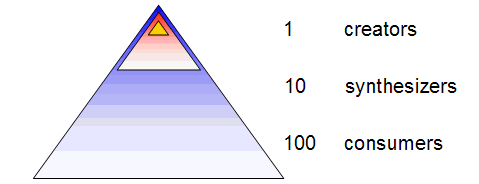
The levels in the pyramid represent phases of value creation. As an example take Yahoo! Groups.
- 1% of the user population might start a group (or a thread within a group)
- 10% of the user population might participate actively, and actually author content whether starting a thread or responding to a thread-in-progress
- 100% of the user population benefits from the activities of the above groups (lurkers)
There are a couple of interesting points worth noting. The first is that we don’t need to convert 100% of the audience into “active” participants to have a thriving product that benefits tens of millions of users. In fact, there are many reasons why you wouldn’t want to do this. The hurdles that users cross as they transition from lurkers to synthesizers to creators are also filters that can eliminate noise from signal. Another point is that the levels of the pyramid are containing – the creators are also consumers.
The use of a pyramid reinforces some subtleties which I bold above:
- There’s a hierarchical view of how users are perceived, with a linear path
- Creators are generally seen as “higher value” than the less involved users
- There’s an effort to “convert” lower value users into creators
Another good discussion and example of the pyramid point of view is here at Jeremiah Owyang, in an article called See Actual % of “Community Pyramids” with Technographic Data.
Let’s return to the pyramid a bit later in this blog.
The Games point of view

The four things that people typically enjoyed personally about MUDs
were:i) Achievement within the game context.
Players give themselves game-related goals, and vigorously set out to achieve them. This usually means accumulating and disposing of large quantities of high-value treasure, or cutting a swathe through hordes of mobiles (ie. monsters built in to the virtual world).ii) Exploration of the game.
Players try to find out as much as they can about the virtual world. Although initially this means mapping its topology (ie. exploring the MUD’s breadth), later it advances to experimentation with its physics (ie. exploring the MUD’s depth).iii) Socialising with others.
Players use the game’s communicative facilities, and apply the role-playing that these engender, as a context in which to converse (and otherwise interact) with their fellow players.iv) Imposition upon others.
Players use the tools provided by the game to cause distress to (or, in rare circumstances, to help) other players. Where permitted, this usually involves acquiring some weapon and applying it enthusiastically to the persona of another player in the game world.
Later on in the article, he also touches on the dynamics between each one of these Bartle types, and how they interact to create the community that makes up a game. He also discusses methods of increasing or decreasing the prevalence of certain types, since oftentimes having too many or too little of a particular type can cause imbalance to the community.
A couple observations on this:
- The 4 types are primarily treated as peers to each other
- By presenting it as a 2×2 landscape, it also expresses the idea that a player might be in one type yet flirt with another
- Yet, the diagonals are problematic, since it’s hard to express an Achiever who is also a Socializer
Let’s compare the two viewpoints now.
Comparing the two perspectives
It’s clear that there are clear differences between the two views. While one more closely resembles a linear, hierarchical view, the other represents a flatter, multi-variable view.
In general, I think the two views are in conflict with each other due to the emphasis on user-generated content versus company-created content. In a pure UGC web 2.0 site, you need the content creators otherwise there’s nothing to do for anyone else. Take a site like Digg or Facebook, and if it’s just you on the site, it’s not so interesting. Compare this perspective to the games world, which has long built gradual “solo” experiences that then open into social experiences.
In almost any MMO, you can still play it for a while before you have to start thinking about other people. There’s a long “single user” experience that makes the game fun and entertaining, even if you’re the only person logged on. For socializers, you can talk to NPCs and get your kicks that way. For achievers, you can fight monsters and level up your character. For explorers, you can still check out the world and try out all sorts of different things. By investing in a content experience up-front, there’s less of a reliance on content creators to make it all work.
In general, comparisons like this make me think more about the user/player lifecycle of any product – how do you bootstrap the initial experience and make that fun? How do you pivot the user into trying other things, in particular with real live people? How do you build the critical mass to make social experiences interesting? As always, there’s a lot for Web folks (like me) to learn about from the games people.
Comments and suggestions always welcome!
Social Gaming Summit: Recap and observations

For every conference event summary that's posted, there's already an existing one that's earlier, more comprehensive, and better written ;-)
In this case, Justin Smith and Mashable have already posted some partial writeups here and here. Instead, I'll just focus on a couple observations shared during the panel discussions which I found interesting.
A very compelling point made today by the IMVU CEO Cary Rosenzweig was around the process of designing IMVU from the ground up, rather than their previous project There.com. He said that when the IMVU originally constructed There.com, the problem was that they created a ton of "space" without the social activity to make it dense enough and interesting enough. It was too easy for users to end up wandering around the environment without interacting with each other enough. This description reminded me of the problems that Half Life faced early on, described here, where the levels weren't fun and had to be reconstituted to be as "dense" experientially as possible, to make it interesting.
Another comment I liked was when Daniel James from Three Rings pointed out that in many cases, virtual worlds can be much tougher to build than traditional "games." The reason is that for his previous game, Puzzle Pirates, which revolves around a pirate theme, there is clear context. You know that pirates seek treasure, fight other pirates (and the British Navy), steer ships, say "ahoy" and "AARRR," and other ideas that fit into the mythology. This ultimately creates an internal set of motivations where the players sorta know what to do!
Social Gaming Summit tomorrow – see you guys there!
Charles Hudson of Gaia invited me to attend the Social Gaming Summit tomorrow in San Francisco. Should be a lot of fun! I'll write a quick blog covering the conference, to sum it all up.
10:00am – What Makes Games Fun?
We all like to have fun, right? What is it about games that makes them so fun? Is it gameplay? Social interaction? Achievements and accomplishments? Our panel of thought leaders will share their perspectives on what it takes to build a fun game and why building fun into games is more difficult than it looks.
» Erik Bethke – CEO, GoPets
» Dr. Ian Bogost – Founding Partner, Persuasive Games
» Nicole Lazzaro – President, XEODesign, Inc.
» John Welch – Co-Founder, President & CEO, PlayFirst
» Jeremy Liew – Managing Director, Lightspeed Venture Partners (moderator)
11:00am – Casual MMOs and Immersive Worlds
Many so-called “casual MMOs” and immersive worlds are casual only in the sense that the point of the game is not to bash gruesome looking monsters or the game isn’t set in a sci-fi fantasy world. The engagement story around existing and upcoming casual MMOs is real and very compelling. This panel will discuss what it takes to build a successful casual MMO that users love to play.
» Min Kim – Vice President of Marketing, Nexon America
» Patrick Ford, VP Marketing and Community Development, K2 Networks
» Kyra Reppen – SVP and GM, NeoPets
» Craig Sherman – CEO, Gaia Online
» Joey Seiler – Editor, Virtual Worlds News (moderator)
1:30pm – Asynchronous Games on Social Networks
There are a lot of interesting asynchronous activities happening on social networks. Some of them are traditional games, others are games in disguise. Join us and hear from some of the leading voices in this space share their views on how to build great gameplay characteristics into social networking applications and what opportunities exist for gameplay to take advantage of the social graph.
» Siqi Chen – Founder, Serious Business (Friends for Sale)
» Blake Commagere – Founder and VP Engineering, Mogad
» Shervin Pishevar – CEO, Social Gaming Network
» Mike Sego – Developer, (fluff)Friends
» Andrew Chung – Principal, Lightspeed Venture Partners (moderator)
2:30pm – User Generated Games in Social Networks and Virtual Worlds
Games are one of the most popular activities on social networks and virtual worlds. Increasingly, users are taking it upon themselves to create games and entertainment of their own within the context of existing online environments. Curious as to what’s driving this behavior? This is the panel for you.
» Daniel James – CEO, Three Rings
» Jeremy Monroe – Director of Business Development, Sports & Entertainment, North America, Sulake Inc.
» Ted Rheingold – Founder, Dogster and Catster
» Cary Rosenzweig – President and CEO, IMVU
» Dean Takahashi – Writer, Venture Beat (moderator)
4:00pm – Building Communities and Social Interaction In and Around Games
Social networking and games go hand in hand. Whether it’s taking advantage of the relationship data in social networks to build novel gameplay or building community among people who play games, game developers are discovering clever ways to build real communities around the games they’re developing. Hear from our panel of thought leaders about what it takes to successfully integrate community and social interaction into the next generation of games.
» Jim Greer – CEO, Kongregate
» Amy Jo Kim – CEO, Shufflebrain
» Mark Pincus – Founder and CEO, Zynga Game Network
» Dave Williams – SVP, Shockwave, AddictingGames
» Brandon Sheffield – Gamasutra (moderator)
5:00pm – Monetization and Business Models for Social Games
There are a handful of viable (proven) business models for social games. How should game developers go about choosing the best business model for their games? Our panel of experts will share their thoughts on the various business models and how to think through the right one for a given game.
» Jameson Hsu – Co-Founder and CEO, Mochi Media
» Matt Mihaly – CEO and Creative Director, Sparkplay Media
» Mattias Miksche – CEO, Stardoll
» David Perry – CCO, Acclaim
» Ravi Mhatre – Managing Director, Lightspeed Venture Partners (moderator)
Dear readers, need a quick favor!
Hi all, I'm looking for recommendations/intros to find a great frontend engineer for a consumer internet project I'm working on. Ideally, would be located in the Bay Area or willing to relocate.
5 steps towards building a metrics-driven business

Don't ask me about viral marketing, ask me about metrics
Given my history blogging about viral marketing, I'm occasionally approached by folks who ask me, "For product X, how would you promote it and make it viral?" I think there's an expectation that there's a playbook which you can directly apply to every situation.
- A/B testing your upload page to make people more likely to upload
- Delivering a ton of email notifications prompting users to upload
- Using switch-and-bait tactics like information-hiding, creating false incentives, etc.
- Creating a gimmicky points system to upload photos
In many cases, I feel like many Facebook apps are trying to solve their problems by enacting the solutions as above. I think the quantitative side lends itself well to the above approaches, yet you rapidly hit diminishing returns.
- Repositioning the product for a higher resonating value proposition
- Going after a different kind of audience to target their needs
- Recalibrating the "core mechanic" of the product to make uploading photos a natural part of using the product (like HotOrNot, for example)
Finally, it's important to execute your scientific approach with proper test and control methods:
A/B testing is a method of advertising testing by which a baseline control sample is compared to a variety of single-variable test samples. A classic direct mail tactic, this method has been recently adopted within the interactive space to test tactics such as banner ads, emails and landing pages.
Employers of this A/B testing method will distribute multiple samples of a test, including the control, to see which single variable is most effective in increasing a response rate or other desired outcome. The test, in order to be effective, must reach an audience of statistical significance.
This method is different than multivariate testing which applies statistical modeling which allows a tester to try multiple variables within the samples distributed. (from Wikipedia)
Summary
- Create clear, measurable goals
- Make an uber-model that breaks down key variables
- Collect both quantitative and qualitative data
- Generate hypotheses around key variables and variable combinations
- Execute test and control methods, and don't confuse correlation with causality!
For those who are dipping their toes in the water, I hope this helps!
Users, customers, or audience – what do you call the people that visit your site?
5 second personality test
This is a just-for-fun post on the way that language changes our perspective on design. I've been thinking a lot about these nuances in the way that it creates hidden assumptions on business models, how we treat our partners, our users/customers/audience, and other folks in the industry. As a result, I've come up with a one question personality test ;) Here's the question below:
What do you call the people who are on your site?
- Users
- Customers
- Audience
Have your answer?
Read below for some quick thoughts on what your answer could mean.
Audience
Folks that use the word "audience" are likely to have an advertising and monetization perspective. Ultimately, companies with an ad perspective see the audience they are building into an asset to be sold to their "real" customers, the advertisers. And so I hear phrases like X wants to "target this audience" or that they're "aggregating the Y audience" or similar wordings.
As I wrote in Your Web 2.0 startup is actually a B2B in disguise, the process of generating all those millions of pageviews is just step #1, and step #2 is to actually sell them to the advertisers who want to target this audience. That's absolutely a valid perspective.
Customers
The view of the people on your site as "customers" has the strong connotation that direct monetization is occurring, and that usually happens on ecommerce properties. I think this implies both the highest value and best treatment of the folks visiting your site.
Interestingly enough, business like social gaming sites would be wise to use this type of terminology when they depend on virtual goods models. Social gaming properties are not much unlike ecommerce sites, and it would be wise to have the same focus on merchandising, having attractive shops, cross-selling and up-selling, as well as treating your customers like they will hand you money.
Users
At the heart of "users" is the idea of using a product, or utility, or other functionality-focused usage. At least in my world, this is the most common terminology I hear. On the plus side, it creates plenty of opportunties for discussion around featuresets and product-oriented business strategies. However, on the downside, it doesn't explicitly acknowledge the nature of the advertising business as "audience" does, nor the imply the treatment that calling them customers would.
For my projects, I am particularly interested in virtual goods models for monetization, and as a result, it seems wise to reserve the word "customer" to refer to the people we attract.
Any other labels I'm missing? Comments and suggestions welcome.
Data portability: Is the social network data you’re hoarding treasure or trash?
I recently wrote a guest blog yesterday at InsideFacebook.com, and wanted to republish it here as well.

Data portability: What's the value of your social network data?
This blog post will be focused on the business-perspective of how a
company operating one of these social networks might think about their
data, particularly in regards to advertising monetization.
There's been a lot of discussion on the data portability issue in one form or the other. The consumer perspective on the data portability issue on the consumer side has been well-covered, and is well represented by Robert Scoble, Marc Canter, Gillmor Gang, and others. This is a big topic, especially when you've added as many friends
to Facebook as our Doonsberry friends have, in the above comic.
Business reasons to resist portability
When a company has aggregated a critical mass of audience and data, it's clear that data is worth something, but unclear how much. In particular, one might be resistant to data portability for a number of reasons, including:
- If the data can be monetized for through advertising means, then a company might want to have proprietary access to that data
- If a competitor can easily import user data, it makes it easier to switch services
- If a user can too-easily share their data with external services, it may create privacy and security issues
- … and others
There are many other reasons why businesses are reluctant to jump full bore into releasing control of the data, some great for consumers, some neutral, and some completely unaligned with their users. It's my opinion that, like the way Windows has evolved, you want to provide access but need to make it very clear what they are getting themselves into.
The reason why spyware has turned into such a huge industry was that for many years, it was far too easy to install any executable off the internet – and the Operating System gave poor warning on what users were trying to do. There are things you want to do to make sure you're not destroying an entire ecosystem, while still supporting the goals of your users.
My particular interest in this question mostly has to do with the value
of the data, particularly from an advertising standpoint – the first
bullet above.
The monetization of user data
The question is, if companies are busy hoarding all this user data – what is it really worth? How do you evaluate its value? And how does it fit into the context of the overall advertising market?
To outline the answers to this question, I'll cover a couple specific topics:
- Ad network business models
- Interest versus intent
- Data to traffic overlap
Then I'll conclude with a short discussion on the future of social network data.
Ad network business models
The market for user data is very early. Only in
the last few years have companies emerged like Revenue Science, Tacoda,
Blue Lithium, and other companies you see on this list.
Note, of course, that I was previously employed by Revenue Science and
worked on their direct response ad network (in addition to other roles).
But to step back: For newbies to the advertising world, it's important to note that there are many many ad networks out there besides Google AdSense. For example, Blue Lithium, Valueclick, ContextWeb, Advertising.com, etc are all ad networks that fundamentally do the same thing:
Buy ad space at a lower price, then resell it for a higher price
Quite simply, it's arbitrage. So they sign up publishers, get them to stick ad code on their pages, and then fill the space with banner ads, Punch-the-monkey flash games, etc. The bigger the delta between what the buy it for and what they sell it for, the better their profit margins.
The problem is, there's like 300 ad networks out there, and it's getting more competitive every day. So like a Wall Street bank, these ad networks have to get smarter (and bigger!). They allow advertisers to target on context, geography, time, demographics, and many other factors. They support Flash ads, text ads, video ads, banner ads, all in many different sizes.
In all the targeting, they become huge consumers of data. To competitively identify low-value ad inventory and buy it on the cheap, you need to have more data than:
- the publisher you're buying it from
- the 299 ad networks who are also looking for the low-value inventory
If you have less data than either, then the ad inventory price will get bid up, and all of a sudden it'll be hard to get the volume of traffic you want. And thus, it makes sense to voraciously gather and utilize all the data you can, across many different areas. In particular, "user data" is interesting – if you can tell when someone in the market for a car, ad impressions against that user are suddenly very valuable.
Question is: What kind of data is valuable? And what kind is not?
Interest versus Intent
The first step to understanding the value of data is to look at the marketing funnel below:

You can consider the top part as consumer interest whereas the bottom part is consumer intent.
A user moves through a long funnel before coming into market and exhibiting buying signals (aka Intent). And there are a lot more people at the top, who are sorta kinda maybe in the market for a car (but maybe don't even know that they are) versus the folks at the bottom of the funnel who are ready to get their car loan processed and drive out to dealerships the next weekend.
When you are the bottom of the funnel, you are part of a select group, and because you are very close to taking action, it's easy to value you as a user. Here's how a car dealership might figure that out:
- The dealership closes roughly 1% of anyone coming through as a "lead"
- They make on average $2000 per car they sell
- So they are willing to buy a lead for $20
- Then build in some margin, and they're willing to spend $10 on a lead
(Note: these are made up numbers)
The problem here, however, is that there are only so many people ready to buy at one time. So typically, all this inventory gets sold out, and then you have to move upstream to buy more users. In particular, there's often a big concern that a product can get left out of the "consideration set" if it's not branded well. That is, even if you're buying all the Ford dealership leads as you can, if you can't position your gas guzzling SUV for the eco-conscious set, they never get the chance to filter to the bottom.
When you're at the top of the funnel, it's hard to value the ROI from advertising to those users. The focus there is to just be in the game and inside the "consideration set," as I mentioned. So the targeting there isn't typically focused on in-market status, but rather on more qualitative things like:
- demographics
- psychographics
- desirable editorial areas (to complement the values of your brand)
- really cool ad creative
- etc.
Anyway, it's not as quantitative, and the distance between the brand side and revenue is often larger than folks want it to be. But it works, even through the following classic advertising quote applies:
"Half the money I spend on advertising is wasted; the trouble is I don't know which half"
— John Wanamaker
As a result, it may not surprise you that data around in-market behaviors (aka Intent) are worth a LOT more than the more watered down stuff (aka Interest), particularly because you can prove to advertisers that the former will make them money.
For search engines, the ultimate collector of consumer intent, you can get 1000X+ times the monetization levels that you'd get from social networks. Social networks, being communication-oriented, have very little intent relative to other sites on the internet. This doesn't mean the social network data is worthless, but it's definitely hard to use it to monetize.
Where are other places you can find intent?
- Comparison shopping sites
- Product reviews
- Loan calculators
- Shopping sites
- Search engine marketing landing pages
- etc.
Think of any service you might go to in order to make a transaction, or prior to making a transaction. The more of that data you have, the better off you are.
On the flip side, this data is scarce. The bottom of the funnel doesn't have many people, and because people aren't typically shopping forever on a product, it means the data is perishable.
Data to traffic overlap
Once you have the data, you have to figure out how to use it to buy-low and sell-high. One of the big questions revolves around when/where your data is applicable – and this problem is sometimes referred to as "overlap."
Let's say that you collect data about a bunch of unique users on your site, and all those users are very valuable. Then you want to find those same users on some other site, which has cheapo inventory. The plan is that if you can buy that inventory for cheap, but you can figure out the good stuff in there, then you can buy just the good stuff. Sounds great right?
Problem is, what's the overlap of users between your site and this publisher's? If it's small, then you might not be able to write a big check to justify the expense of doing the transaction. If you have 100k users and then you're finding some % of that on some other site, then that's not so exciting. So you really need to aggregate a ton of data to make this transaction work. And ideally, you are able to use your own data, but also use the data of other similar ocmpanies – this allows for more opportunities to bring in new users, rather than just recycling the current set of users you already have.
This issue of insufficient overlap has been alleviated somewhat recently. Since the mid 00s, there's been a number of ad networks that allow you to buy advertising by-the-cookie. Right Media, in particular, leads in these types of transactions. But Valueclick, Ad.com, etc all can provide similar arrangements as well. So given that these ad networks have already pre-aggregated a huge amount of inventory (several hundred billion pageviews per month), you can get reasonable scale on your data even if you don't have too much data. The downside to this, of course, is that it introduces yet another middleman into the mix, and since they know you are buying by-the-cookie, it's easy for them to charge you a little extra. Doh.
Conclusion
So to summarize the article above:
- One potential issue that makes social networks resist data portability is the monetizability of the data
- Not all user data is created equal, there's interest versus intent
- Social networks generally produce lots of low-value interest data, which has weak ROI attached to it
- Search engines, review sites, comparison shopping, etc all produce high-value intent data
- Even if you have the data, you have to worry about whether or not you have enough of it to matter – although ad networks and exchanges have started to alleviate that
Questions and comments welcome!
Social gaming and MMOGs: Quick link roundup
A friend of mine recently asked me for a list of blogs, books, and other resources on game design, social gaming, virtual goods, etc. I wrote up a quick e-mail, and thought I’d publish it here as well.
If anyone has interesting stuff to add, please shoot me a note at voodoo [at] gmail!
I have not found much on the metrics of the games industry, particularly on the virtual economies side. That’s definitely one area I’d like to learn more about…
MMOG and virtual world blogs:
- Virtual World News
- Massively
- Terra Nova
- Virtual Economics
- Virtual Economy
- Free to Play
- PlayOn from PARC
- Worlds in Motion
- Jeremy Liew (Lightspeed)
- Dan Cook (Seattle game designer)
- Daniel James (CEO of Three Rings – Puzzle Pirates & Whirled)
- Sean Ryan (CEO of Meez)
- Nabeel Hyatt (CEO of Conduit Labs)
- Erik Bethke (CEO of GoPets)
- Nick Yee (Stanford researcher on virtual worlds)
- Justin Smith (Inside Social Games)
- Damion Schubert (MMOG designer)
- Designing Virtual Worlds (New Riders Games)
- Play Money: Or, How I Quit My Day Job and Made Millions Trading Virtual Loot
- Massively Multiplayer Game Development (Game Development Series)
- Game Design Workshop: Designing, Prototyping, and Playtesting Games (Gama Network Series) (Gama Network Series)
UPDATE: added a couple new links. There’s more on Mike Gowen’s blog here.