Archive for May, 2008
User retention: Why depending on notification-driven retention sucks

- They love your site so much that they come back themselves (direct-navigation)
- They see or get a link from a friend or a source while they are browsing (reacquisition)
- You send them a notification, like a friend-add, a newsletter, a list of top videos, or similar
The case where the user navigates to your domain to come back is great. It means that you've built a brand that people can recall from their memories, and they like it enough that they will automatically come back. In general, this seems like the most desirable scenario.
- Good friend sends you a private message
- Friend writes on your profile
- Acquaintance writes on your profile
- Friend sends you a friend request
… versus less desirable messaging, which lacks personal context and comes from the company, not a friend or :
- "Come try out new feature X!"
- "Check out this week's top videos!"
- "You should update your photo!"
- Total stranger sends you a friend request
In the cases where you are getting notifications from just the site, it's far more likely users will think of it as spam, which is obviously a negative. The more personal information that is in the notifications, and the more personally relevant that information is, the better.
- Initial active users = 1000
- % that will create useful news = 10%
- % that will click through on the notification: 5%
- The idea is that you have 1000 users, of which 10% will create useful news
- That means 100 people will create news
- As long as there's at least 1 piece of news, that news can be republished to 1000 people as 1000 notifications (Note that in a more sophisticated model, the more news items, the better the clickthrough rates, and the less, the smaller the CTR)
- Once you have 1000 notifications out there, then there's 50 people that click through
- Of those 50 people, they produce 5 pieces of news
- That 5 pieces of news is then republished again to the 1000 people
- Then the secondary cycle repeats again
Basically, there's a quick collapse from 1000 active users down to 50 active users. If you made the model more complex, and added a CTR that goes down depending on how much news there is, or adding deliverability issues from people getting too much e-mail, then you could see this spiraling down to 0 actives.
- Build features that support high-quality single-user experiences
- Make it easy to create content on the site, and reward users that do
- Create differentiated experiences that users can weave into their daily routine
- Be as sticky as possible – this is a place where software clients are great, but websites are hard
What’s the value of a user on your site? Why it’s hard to calculate lifetime value for social network audiences

Who is this, and where can I find more pics??
For those of you who aren’t familiar, the photo above is of Christine Dolce, aka Forbidden, who is a famous MySpace celebrity (and will surely get her chance to star in a VH1 reality TV show). I can hear a rush of clicks googling her for pictures, so I’ll just provide you the link to her MySpace profile here. Let’s get back to Forbidden in a second, since she fits into a larger discussion.
LTV and the goal of infinite segmentation
The core of many marketing programs is segmentation – you take your core audience, identify differences between their motivations, spending patterns, and behaviors, and tailor your messaging to hit that audience. The better defined your segments are, and the more granular they are, the more opportunities you have to personalize your message when you reach out to them.
One way to do this segmentation is to look at "Lifetime Value" (LTV). Calculating lifetime value (LTV) of your customers is a great way to understand how they fit into the core of your business. Typically, your best customers will represent a significant amount of revenue, and you want to make sure they’re happy. Having a granular LTV calculation where you plug in a user’s historical data allows you to come up with infinite segmentation in terms of how you want to differentiate the experience high-value customers get versus low-value ones.
LTV for retail sites versus social sites
For retail sites, the calculation of LTV is pretty clear. In plain English, you might define it as:
The stream of all previous and future profits that a user generates from their purchases
So for a given user, you’d add up all their previous transactions and then add that to whatever model you’ve created about their likely future transactions. Part of what makes this work is that:
- Transactions in a retail setting are unambiguous
- Each individual makes an isolated impact on the system, in the form of a transaction
- Retail buying has a long established history of data, both online and offline
Now let’s look at social properties, particularly ones that have the characteristics that they are ad-supported, are heavily based on UGC content, and incorporate viral marketing. If you were *just* to consider the advertising portion, then it might be easy – the LTV of a user would be defined as:
The stream of all previous and future ad impressions that a user generates from their usage
So that seems pretty clear – if you’re a user who generates 100 ad impressions a day, you are worth more than someone who generates 10.
The problem is when you try to incorporate the value of the UGC that a user generates, or the users they help acquire (or retain!) as part of the LTV calculation. And for this discussion, let’s go back to talking about Forbidden.
Forbidden as an LTV outlier
The problem with a user like Forbidden, and possibly even more so Tila Tequila, is that only a small amount of value that they create comes from their actual usage of the site. Instead, they provide additional value through user acquisition, retention, and content creation that is poorly measured by the definition above.
Another way to think of this is that if you were to remove these users from MySpace, you would not simply be subtracting their LTV from your overall site’s value. In fact, it would be an outsized decrease in value, since users like Forbidden and Tila Tequila bring many millions users onto MySpace, and entertain millions of people, keeping them on the site.
A couple commenters of my LTV in casinos blog post said as much:
Social network death spiral: How Metcalfe’s Law can work against you
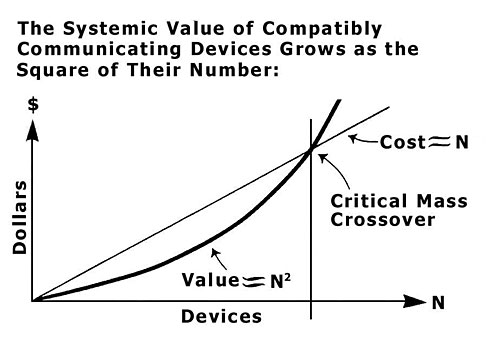
Metcalfe’s Law
Does everyone remember Metcalfe’s Law? It was formulated by Bob Metcalfe, the inventor of Ethernet and co-founder of 3Com, who stated:
The value of a network is proportional to the square of the number of users of the system (n²).
For those that are interested in the math behind it, basically the idea is that if every new node in the network connects with every pre-existing node, then as you gain nodes, you non-linearly increase the number of connections that everyone has with everyone else.
That’s pretty neat, and for the social networking folks who are aggregating large audiences and treating their businesses like communication utilities, it’s both logical and helpful to think that these social communities abide by network effects like Metcalfe’s Law. In fact, it’s a DIRECT reason why these networks want to get as big as possible, and have a social graph that’s as comprehensive as possible, and why they should ultimately be opposed to Data Portability. And I think we’ll see these players’ strategies ultimately reflect these strategies.
But Metcalfe’s Law can also affect social app creators. Let’s discuss how this might play out for folks who are building apps on social platforms, rather than operating the social platforms themselves:
“Jumping the shark” and Metcalfe’s Law
In a previous post, I wrote a bunch about how dangerous (and easy) it is to jump the shark in an enclosed space like the Facebook Platform.
Here’s the good scenario:
Let’s say that you retain users well, and you don’t get a sharkfin graph on your traffic. In that case, if you combine the two ideas – Metcalfe’s Law and with the viral loops on the social platforms – you can imagine that in the success case, you are creating N^2 value with very large N.
For folks building application on Facebook, Opensocial, etc., it’s nice to think that your new app is gaining value much faster than if you built your own
destination site. This allows you to get the N^2 benefits of Metcalfe’s Law without incurring significant costs of acquisition as you scale N up to a large number. This the best of both worlds.
Here’s the bad scenario:
Let’s consider the other case, where your app’s retention sucks, and you are going through the sharkfin graph of rapidly acquiring users, hitting a peak, and then falling down:
(scroll past the image for more)
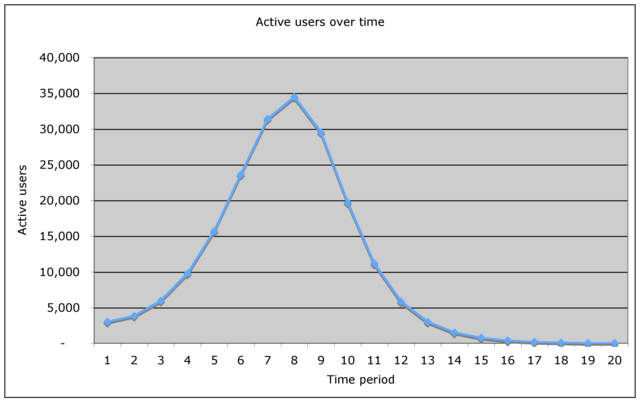
Now all of a sudden, Metcalfe’s Law works against you – for this, I will introduce the corollary, Eflactem’s Law.
Eflactem’s Law
Funny enough, everyone always talks about Metcalfe’s Law like it’s a good thing, and they say that because they assume that N is increasing! But let’s consider the opposite: If Metcalfe’s Law says that your network grows value competed by N^2, then Eflactem’s Law states the reverse. It says:
As you lose users, the value of your network is decreases exponentially (doh!)
That is:
- If you have 100 users, and then grow to 200 users, your “value” has increased from 10k to 40k.
- But if you START with 200 users, and end up with 100, then you are going from 40k in value to 10k in value.
And that sucks. Perhaps this should be called Murphy’s Law instead?
In fact, you see this happen all the time at dinner parties or events. Things are great until one or two people announce the intention to leave. If those folks are fun and entertaining, there’s an immediate realization that the quality of the experience is about to go down. And yet more people announce their intention to leave, and so on, until you are left with the party hosts and a big mess ;-)
Advanced discussion: Social Network Death Spiral
Now let’s do a more advanced discussion using the concepts above – for some new readers, this discussion might completely be incoherent ;-)
Let’s consider a specific scenario where a social network could easily start to “Death Spiral” – here’s some set up on the scenario:
- You have a bunch of users, let’s call the total number N
- The total number of users in the ecosystem, called the carrying capacity, is variable C
- These users all individually require some utility value on a site, let’s call this V_required
- Then there’s a retention %, called R, which depends on two factors:
- If the utility value for users is satisfied, that is, V > V_required, then R close to 100%
- If the utility value drops under V_required, then R is crappy, closer to 0%
- And to borrow Metcalfe’s Law, the value of the network is calculated at V = N^2
So the scenario is that as the total users for the application reaches the carrying capacity, you basically hit a point of maximum saturation – this is defined by the ratio N/C. Sometimes this ratio can also be referred to as the “efficiency” of a user acquisition process, which relays how many people you actually acquire versus the universe of all users. (Obviously you want this to be as large as possible)
Once you hit the carrying capacity and acquire all possible users, N is at the highest point, and thus the network value is also at its highest point, V = N_max^2. Similarly, because the network value V is at its highest, the retention reaches its highest point as well.
The question in this scenario is, at any point during the growth of the network, does the network value V exceed the required value of the site, which we call V_required? Does the network break through the critical mass of value?
If so, retention should be great, as defined by the explanation above. In fact, maybe you reach V_required early on during the growth of the site, which makes the acquisition process much more efficient. Early on, maybe the userbase wasn’t sticking, but a critical mass threshold is met, and suddenly the entire userbase sticks, which creates a long-term creation of ad impressions and company value.
However, if you don’t reach the required value in the network, then you’re pretty much screwed. Then the retention sucks, since the users aren’t finding value, and some percentage of them will leave. This will then remove more value from the system, causing yet another round of users to leave. This continual loss of users is a death spiral that collapses your network in fine Eflactem’s Law style.
A very interesting variation of this is when you apply Metcalfe’s Law not to the entire network of users, but rather think of a social network as a loosely grouped set of connections. In that case, some local networks might have achieved critical mass, and if they are big enough, they will be retained. However, if the smaller networks around any given group start collapsing, then sometimes even the large networks will get pulled down with them.
Conclusion
To summarize this post:
- Gaining users is great, but preventing the loss of users is also very important
- Creating a sharkfin graph on your traffic means exponential descruction of value
- Critical mass plus network effects implies that complete collapse of networks is possible too
As always, comments and questions are welcome.
GigaOm’s “10 Blogs We Love” and 15 Blogs that I love!
I’m excited to see this blog on GigaOm’s recent post, 10 Blogs We Love. Thanks to Om and team for including me on the list.
Some of my daily reads that may or may not be in your reader already:
- NewTeeVee: Online video, digital television, content syndication, etc.
- YPulse: Teen trends, attitudes, products, and companies
- Bronte Media: Online advertising, market analysis
- Raph Koster: Game design, social gaming
- Slideshare Most Favorited: Top presentations from Slideshare
- Marketingcharts: Recent data, charts, and info from marketing companies
- Agenda: Luxury goods market, global marketing
- 500 Hats: Dave McClure’s blog on Facebook, social platforms, metrics, etc.
And for the totally fun, off-topic stuff:
- Bossip: Celebrity gossip about black stars
- TheDirty: hot chicks and douchebags, mostly out of Arizona’s club scene
- Wooster Collective: Street art, graffiti, etc.
- The Sartorialist: Street fashion, global style, design
- X17 Online: Paparazzi pictures, celebrity candids
- Edge.org: Big thinking, scientific discoveries and predictions, philosophy
- Arts and Letters Daily: Discussions on art, philosophy and literature
Sorry if I’ve left anyone out ;-) Hope you guys enjoy.
Online advertising report for 2007 by the IAB
The IAB is one of the major online advertising associations, and they publish a yearly report on the ad market that’s always worth a browse. Here it is:
Social network marketing: Getting from zero to critical mass

(above is a picture of fun San Francisco tradition called Critical Mass in which cyclists take over the street! Thank god I don’t drive much around the city)
What does it mean to hit critical mass?
I’ve heard several pitches in which an entrepreneur outlines a marketing plan for their business which is lots of hard work, but eventually they reach a “critical mass” point where all of a sudden magic kicks in, and smooth sailing is ahead. What these discussions often leave out is, what exactly is a critical mass point anyway? How do you know where it is, and how do you know if you’ve hit one?
To answer this question, let’s return to the original definition of “critical mass” from the Physics world:
The smallest mass of a fissionable material that will sustain a nuclear chain reaction at a constant level.
What does fissionable material means? What is the chain reaction that happens for a web property? Let’s look at it from two separate contexts – user acquisition and retention.
User acquisition
One way to interpret this is that initially, your site has difficulties with user acquisition, until you hit some scale points in terms of total userbase. Then all of a sudden, your site goes “viral” and you start getting lots of users coming in. To formalize this idea, you could imagine the following happening:
- Initially, you are getting users through ads or PR, and your viral factor is <1
- As your site grows, word of mouth effects (bloggers, friends, etc) give you some name recognition
- This brand recognition increases your conversion rates across the board, thus boosting the percentages that make up your viral factor, increasing it to >1
That’s one way of viewing it, although I don’t believe that’s what most people mean. They usually mean that their site is not that useful until there’s a certain # of people on it, and when you cross the critical mass point, then the site becomes engaging. So let’s talk about this idea in an engagement context:
Engagement
As discussed above, there’s an idea that for a user-generated content site, you have an early bootstrapping problem. If you’re YouTube, but have no content, then no users will stick around. Yet if you have no users, then you have no one to upload content. So you need to break out of this local minimum until you cross some threshold – this is the critical mass point. To formalize this idea, here’s the retention focused view:
- Early on, you are getting users through PR or ads, but all your users bounce off the site
- However, each user you acquire have some chance of creating content (profile/pictures/video/etc)
- Eventually, new users have enough content to consume that they stick around on the site, perhaps messaging older users, who now return
- Once you have a “critical mass” of users, then there’s enough activity to keep everyone coming back
In this perspective, you can imagine that there are actually multiple phases that your user passes through – initially, they have a passive experience where they are pulled back onto the site because of notifications like friend adds, messages, etc. And it’s possible for your site to never get past this phase. However, if you acquire enough people, new users pull back old ones, who then start coming back, until they start using the site on a regular basis.
What “scale” of network does your website depend on?
However, the discussion above also neglects that users want to consume different kinds of content depending on how they view the site. For example, the following scenarios are probably FAIL states, even if on the surface they look good:
- 1,000,000 users composed of 100 strangers in 10,000 different locations
- 1,000,000 users who created 1,000,000 different forums with no cross-visiting
The reason is that the above scenarios represent ultra-fragmentation, with no ability to reach critical mass points. This illustrates that there are different scales of network, which reflect different product designs. These include:
- Networks of “real friends”
- Networks of online friends united around an activity or interest (WoW, anime, etc)
- Networks of people in the same local region
- etc.
some applications only need a small number of friends to get off the
ground, and others need more:
- Skype: 2 minimum
- Mailing list: 4-5 minimum
- Forum: 10 minimum
- Social network: 10? 15? 20?
- … etc.
So I’d encourage anyone building a social site to really consider what type of network they are building for, and how many people they need at the local level. Once you can figure that out, then the next goal is to aggregate these smaller groups into a larger one. This is essentially what Facebook did – by understanding how to dominate a smaller space like a college, they could roll up lots of small spaces into a larger population.
Aligning your user acquisition to your network goals
As many have observed, startups working on the Local space have had a very very tough time, with the exception of Yelp. In Seattle, where I’m from, Judy’s Book raised a ton of money and then promptly closed shop because it was hard to get traction.
The reason of course, is that a regional network is a pretty specific one – there are tons of them – plus the minimum social group is actually pretty high. You need a lot of diverse people on the site, reviewing everything in site, before you hit a reasonable coverage % for reviews.
Similarly, if you are doing blind addressbook importing as the way to grow your userbase, but you aren’t targeted about what traffic you’re pointing into the viral loop, then you might end up with a bunch of users from Turkey or some other random part of the world. Probably also not what you wanted.
So to review:
- Critical mass is defined by what type of network your social product operates on, and how many users you need on that network before the product becomes useful
- Thus, critical mass is a product-by-product discussion – there’s no one-size-fits all
- Similarly, people that use your product go through a collection of “phases” – from ranging from passive usage where there isn’t enough content to consume, to the point where they are very active and creating content themselves. The threshold point between the phases is a local observation of critical mass
- Sites that are useful for “online friends” and don’t require too many people are the easiest to get off the ground (but have other issues, like they might be too niche)
- Site that are useful only for large numbers of “real life friends” (local review sites are a good example) are the hardest to get off the ground, yet are hugely useful if you can get people on board
As always, comments appreciated.
Lessons from the casino industry on engagement metrics and lifetime value

Great book covering the modern casino industry
I recently
stumbled on "Winner Takes All," which is a great overview of the modern
casino industry starting with Steve Wynn, Kerk Kerkorian, and Gary
Loveman. It starts out mainly talking about the amazing vision of Steve
Wynn, and how he was able to create some of the world’s more expensive
and opulent casinos, including the Mirage and the Bellagio.
In it, they also talk about a bunch of techniques that the casinos use
to maximize on revenue, including vertical integration, in which they
build "cities within cities" at a casino, so that you can eat, sleep,
shop, entertain, and gamble all without leaving a single complex.
(scroll below for more)
Harrah’s, the casino run by quants
The big story for me was the formation and operations of Harrah’s, which mostly constituted lower-tier casino boats for much of their history. They were decidedly unglamorous, and seemed uncompetitive to the entire high-touch Vegas scene. Think of them as Wal-Mart of casinos, versus Wynn’s Prada of casinos. Whereas the Vegas casino scene was very focused on "art" and the creating massive experiences, Harrah’s was run by the numbers and very methodical about how they grew their business.
Harrah’s eventually became the largest casino company in the world, and is led by Gary Loveman, who got his PhD in Economics from MIT. And they grew their business like a business run by a quant. Here were the major steps they took, as outlined from the book:
- First, they created a loyalty card to centralize identities and create consistent experiences
- They created a granular calculation of LTV for their customers
- Then, Harrah’s segmented their key clients based on usage, and then based on "lifecycle"
All in all, a very interesting approach – I jotted down a couple notes as I was reading the book, and wanted to share some of these thoughts below:
Building a single identiy – the loyalty card
Unlike on the Web, it’s not easy for businesses to keep track of their customers – this becomes a big problem in an industry like gambling, where a small % of your customers make up a big % of the profits (aka, these guys are the "whales"). So if a gambler went to their regular Harrah’s casino, people would recognize them and they’d get differentiated service – but if they went to a different Harrah’s, for example on vacation, their history didn’t follow them. That way they couldn’t differentiate between the $100k spender versus the casual looky-loo, which was bad for business.
So Harrah’s introduced a series of loyalty cards called Total Rewards, which were used for "comps" and other free stuff. For the games folks out there, notice that you can "level up" as a member from Gold, Platinum, Diamond, Seven Stars, and for one member – Harrah’s "best" customer – there’s a Chairman’s Club card. They go so far as to fly you around, give you free hotel and accomodations, and other great perks.
This loyalty card gave them the underlying data which they could now use to drive the other parts of their data strategy.
LTV on a per-user basis
The next step once they had all this data was to create models against the lifetime value (LTV) of their customers. This was done in two ways – first, you can imagine a visit to a casino, where a customer comes in, plays cards/slots/whatever, and then leaves. Based on their actions, a "theoretical win $" is calculated, which is an expression of what the casino should expect to get from that person. Combining this number and other services consumed and comps, you end up with a net profit calculation. You can imagine that this number is a rolled up view of:
- How much money that person brought with them
- What games they played, in what mix
- How long did they play for
- What other services did they consume
- etc.
Once you can value an individual session, then you can also chain together multiple visits to calculate an aggregate value. This means that you can now tell the approximate difference between a rich customer that visits every July 4th, once a year, versus someone who plays frequently but also spends less money.
Targeting based on customer lifecycle
Josh Kopelman from FirstRound Capital recent wrote a great blogpost called Lifecycle Messaging that I’d encourage you guys to read. It basically talks about the lifecycle of a customer, and how you want to send them differentiated messaging based on what stage they’re in.
Harrah’s did exactly this – once they had the ability to model out a customer’s LTV, then when new customers arrive, you can start to put them into buckets of profiles that are already "like" them, in order to predict future LTV. Then based on LTV and their stage in the lifecycle, you can start to do some very interesting things: For new high-value customers, they can try to engage them quickly and get them highly personalized service right away, so that they’ll stick. For low-value customers who don’t fit the Harrah customer profile, it may be better to ignore than group than spend too much cash chasing it.
One of Harrah’s most profitable customer segments turned out to be older, retired gamblers who came by very often, and mostly played slots. They called these guys Avid Experienced Players (AEPs) and targeted this group for both new customer acquisition as well as retention. This group was not the "whales" of the Vegas casinos, but had a similar financial heft to the company.
Conclusion
There’s a ton to learn from external industries, and I’d like to add casinos as an interesting place to extract lessons for Web entrepreneurs. It has an interesting blend of quantitative data, in gambling transactions, as well as the qualitative, which drive the emotions behind why people prefer the Bellagio to other hotels. It’s one of the industries that is at a fascinating intersection of both, and like the social web, you need both perspectives in order to thrive.
Has the Facebook platform hit its peak?

The state of the Facebook platform
Jesse Farmer, formerly of Adonomics, has posted some great analysis on the state of the Facebook developer community. In short, if you take the Facebook developer forums as a proxy for overall activity, the indicators across the board have declined. Now, you might argue that this isn’t a fair proxy (and there’s some analysis in the article on that specific point), but I’d argue it’s a pretty good one to use in order to gauge overall interest and the health of small/medium developers.
In particular, Jesse includes this great table summarizing the data around the Facebook dev forums:
Monthly Statistics for the Facebook Developer Forum Month: Jan 2008 Apr 2008 Posts per day 461 225 -51% Signups per day 38 27 -29% Threads per day 80 44 -44% Active users 1,606 1,168 -27% Highly active users 461 225 -47%
As you can see, there’s been a decline across all indicators.
Similarly, if you take one of these factors, let’s say Posts per week, and look at the overall historic trend, you can see that Posts Per Week peaked in the late Jan / early Feb timeframe, and has significantly decreased from there:

Note that MA in the above graph is "4 week moving average" meant to smooth out the ups and downs.
Key issues facing the FB platform
He further hypothesizes a number of different issues going on, including:
- Other platforms are more attractive
- Developers are consolidating
- Facebook has made it too hard to win
Overall, a great analysis – would definitely recommend that you read the full article here.
Facebook Apps: Why they’re focused on fun instead of utility

There’s recently been some discussion that Facebook apps are silly and pointless, as proven by the categorization of apps on Facebook. The question is, why is this true?
Ben Rattray from Change.org recently sent me a great e-mail, and I asked for his permission to blog the essay. In it, he discusses the structural issues around Facebook apps, and why they encourage apps focused on communication rather than utility.
[UPDATE: Just to be clear, everything underneath the following line is Ben’s work – one of my readers wanted me to clarify]
Ben writes:
The
reason there are few and little use of utility-based applications is
not because users don’t want to use them or because app developers
don’t want to develop them, or even because Facebook doesn’t want to
encourage them (which they clearly do). It’s because the means of distribution inside Facebook are structurally biased against them.
As you know, the reason for this is simple math. The only way for a Facebook app to get any sort of distribution is to have a viral coefficient over 1. This
is an extremely high barrier for any app in which inviting friends is
not an inherent part of using it (or, in your parlance, in which it is
not structured for "viral action").
Instead,
what most utility-based apps rely on for distribution is word of mouth,
in which people tell their friends not because there is something built
into the app that naturally causes peer-to-peer transmission but simply
because it’s worth talking about – or, in your parlance "viral
branding." And as you’ve written it is very difficult to achieve a viral coefficient of over 1 through word of mouth. Ironically,
this difficulty is compounded inside Facebook because the proliferation
of viral action apps inundates users with invitations and makes them
less and less likely to accept anything – including invitations to
utility-based applications. So the barrier for going viral increases even further. Given
current invitation conversation rates of 5% or less (at least what I’m
hearing), for an app to go viral, you have to get people to invite an
average of at least 20 friends. How many utility based apps can achieve that? How many inspire so much passion that its users tell 20 friends, on average? Few, even if people find the app incredibly useful.
(Of
course, there are other ways that Facebook apps can be distributed
outside of explicit invitations – i.e. the news feed and profile – but
these are not nearly as effective as invitations and it’s very
difficult to go viral on these channels alone. Also, few
people want to highlight their "utility" apps on their profile since,
by definition, these apps are less about self expression, which is
largely the point of the profile.)
To
see how singularly biased Facebook’s distribution structure is against
utility-based apps, a comparison with the platform it so often likes to
compare itself to, Windows, is instructive. Many Windows
applications are incredibly useful, but few of them are viral (those
that are, like Word, are only so because the use of it requires that
others have it as well, and because they are increasingly useful as
more people have it – e.g. they have network effects. But this is rare and they take a long time to gain traction). Instead,
the way most Windows-based applications get distribution is through
traditional, boring marketing and distribution deals with big-box
stores like CompUSA.
But it’s very hard (and incredibly inefficient) to market apps outside of the walled garden of Facebook. And
nobody has the budget for true Windows application-style marketing
since there is no clear business model yet inside Facebook to justify
this sort of ad-spend. So the only way apps can get distribution on Facebook is by having a viral coefficient of over 1.
(This
is also why there is a wide chasm in the installs between apps – either
an app is viral and has millions of users or its viral coefficient is
less than 1 and has only a few hundred or few thousand users. It’s simply mathematically impossible in a closed system for apps that aren’t viral to get any traction. And
this is not because all apps with a viral coefficient of less than 1
are not found useful by its users – it’s because no more than a few
people will ever find them.)
Theoretically Facebook’s "application directory" could serve as the virtual equivalent to CompUSA. But there are so many applications in the directory that it is rendered virtually useless. This is a clear situation where too much choice is paralyzing – e.g. the "paradox of choice." Imagine walking into a CompUSA and having 25,000 choices for different applications. It’s just not possible to decide between so many options. And so your natural reaction would be to just to walk away and never come back. And
that’s how it seems most Facebook users have responded to the
application directory – there are very few installs directly from
there, and I suspect it’s never used much. (And, to the extent that it is used, the largely trivial viral action apps always dominate the front pages.)
Anyway, I realize that this is all already stuff you know, but it’s remarkable that nobody seems to be writing about it. Instead what we get the glib analysis that all Facebook users want are trivial apps. And
while it may be true that "just for fun" and communication apps are the
ones users enjoy the most, that is far from the complete story and
overlooks much deeper structural impediments to utility. It is also based on the misguided presumption that apps that are installed the most are those that users like the most. Which is simply not the case.
As
a final note, I’m not sure what you think, but it seems almost certain
that Facebook itself didn’t realize when they launched the platform
that they created a system in which it was nearly impossible to achieve
the very thing they claimed to seek – greater utility. They
now seem to understand the problem and are trying to take measures to
improve the situation, but to do so they’re going to have to either
tweak things to make it possible for useful (but not inherently viral)
applications to have a viral coefficient of over 1 (very difficult, I
think), or they’re going to have to implement a much improved directory. They
could also personalize the directory so that users could see all the
applications their friends rated most highly (not just used).
Either way, this is a big problem for Facebook, but not the one that most people think. It’s not that users or application developers don’t want to use or build useful apps. It’s that Facebook’s current structure is heavily biased against them.
[Ben sent me the following afterwards, as some extended remarks -Andrew]
Extended remarks:
After
re-reading what I wrote as well as the comments below, I realized I
should have probably also addressed the following two things in my
original email:
First, what do I mean by a utility-based app?
Second, should Facebook aim to be a utility?
To
answer the first question: by utility I don’t just mean applications
that are in the "utility" category of apps on Facebook or any sort of
web application that might be considered generally useful. Rather,
I mean it in the particular way I take Zuckerberg to mean it: an app
that leverages the social graph to create greater social and personal
value.
Definitions are important here. To
illustrate exactly what I do and don’t mean, I’ll outline what I
consider to be the three broad categories of web applications that
might be considered to have utility:
- Apps that are inherently social and which let users better coordinate/connect with friends
This
first category includes applications that help people coordinate or
connect with friends or others in ways that are traditionally difficult
but which the social graph makes relatively easy and potentially very
powerful. (These are distinct from "just for fun" games and
other playful communications in that they generally help people
accomplish something concrete.) For example, these might be apps that:
- Help people organize local sporting event leagues
- Share travel schedules with friends (ala Dopplr)
- Organize carpooling
- Discuss and coordinate events / gatherings with friends (ala Skobee)
- Allow
for the creation of affinity groups that require custom features not
available in the traditional "groups" feature set (e.g. Alcoholics
Anonymous groups, as humorously suggested by Max Levchin recently)
Because
of the inherently social nature of these potentially useful apps, many
of which involve inviting friends, some of them may have the potential
to have a viral coefficient of over 1. But they face a
big hurdle in sustaining a viral coefficient of over 1 for many
successive generations because (1) a large percentage of users get
value out of the app without needing to invite further friends, and (2)
although there may be a lot of people interested in the app and in
inviting all their friends, these enthusiasts are not socially
connected tightly enough to allow for the continued transmission of the
app across personal networks. For example, someone might
create a custom carpooling app and invite a lot of friends who are the
type of people who would themselves push it to many other friends they
want to carpool with, but because this social group may be socially and
geographically isolated from other groups of friends passionate about
carpooling, the app’s viral coefficient will fall below 1 as it hits a
population of people less interested in passing it on and its organic
distribution will rapidly exhaust itself before being able to reach
other interested populations – at which point few people will ever be
exposed to the app again. And this is despite it being considered a very useful app by many people.
2(a). Apps that aren’t inherently social, but which are given enhanced value with the social graph (non-business / work)
This
second category includes applications that may not be intrinsically
social or interpersonal (and therefore may exist independent of a
user’s social graph), but are those which gain additional value when
laid on top of the social graph. This includes apps that allow people to:
· Share news (e.g. a personalized Digg)
· Share
restaurant / service provider reviews (e.g. a personalized Yelp – so I
don’t just get undifferentiated restaurant reviews, but only those from
people I trust)
· Share bookmarks (e.g. delicious with all my friends)
Note that the three examples I’ve given already have canonical applications outside of Facebook. Despite
this, I think that the social graph offered by Facebook has a lot of
value to add in that would allow me to receive the recommendations
generated by these services through the trusted channels of all my
friends.
It’s
also noteworthy that all three companies did launch Facebook apps and
that none of them received more than a few thousand installs despite
their huge popularity and the extra value offered by Facebook’s social
graph. This is clear evidence of what I mentioned above about the systematic distribution bias against utility-based apps.
2(b). Apps that aren’t inherently social, but which are given enhanced value with the social graph (for business or work)
A
subset of this second category are apps that, while given enhanced
value by the social graph, are structured for work and therefore a bit
of an odd cultural fit for Facebook even though strictly they could
benefit from being inside the platform. Examples include apps that allow for:
- Job seeking / networking
- Collaboration on work / documents
I
think it’s an outstanding question whether these are appropriate for
Facebook, but I’m skeptical they will ever be (just as I’m skeptical
Facebook will ever replace Linkedin for business networking). Just
because something can fit inside Facebook from a functionality
standpoint doesn’t mean it will fit the site’s culture, and culture on
social sites matters.
- Apps that are neither inherently social nor benefit from the social graph (but are still "useful")
This
final category are web applications that are useful (like purchasing a
plane ticket, managing your finances, etc) but which don’t at all
benefit from the social graph. It’s clear these types of apps don’t have any business being inside Facebook.
So,
in summary, when I say "utility-based apps" I mostly mean apps that fit
in categories #1 and category #2a, but not those in #2b or #3.
Given this definition, should Facebook strive to be a social utility? Or should it just focus on what it’s clearly great at – personal communication and play?
To answer this question I’m first inclined to ask the more fundamental question, "do people want Facebook to be a utility?"
The
problem is that I’m not sure you can give a great answer to this yet,
since the biased nature of app distribution on Facebook means that most
people aren’t being exposed to utility based apps – so we just don’t
know yet how people would respond if these apps had widespread usage.
I think it’s possible that Facebook users as a whole just aren’t that interested in utility-based apps. But
I also think that a strong argument can be made that Facebook could be
a compelling utility (as evidenced by some of the examples I gave
above), and that the value of it becoming a true social utility is
great enough to justify aiming for this. From a business
standpoint, if Facebook wants to keep their core audience engaged
beyond college, attract an older audience that has never used Facebook,
and better monetize both groups, they’re going to do more than offer
fun ways to communicate with friends.
The
challenge, of course, is to figure out how they can give themselves a
legitimate chance of becoming a social utility with the current app
distribution problems I described above. Frankly, I’m not
sure whether the Facebook platform is the best way to achieve this, and
I personally think they would have been better off focusing on an
improved remote login API that allowed users to pull their social graph
into third-party sites and then pump personal data back into Facebook
ala FriendFeed, and that contrary to all the hype the platform may have
been a strategic mistake. But that is another story entirely…
Ben Rattray is Founder and CEO of Change.org and lives in San Francisco

These are great points, and I agree with these issues as difficulties in applying LTV. The overall gist is that when you have interactions between users, all of a sudden the dependencies that are caused become difficult to measure.
Let’s talk about how to think about assigning credit based on those dependencies.
Assigning credit in LTV calculations is the hard part
Even in the most simple case for assigning credit in the LTV calculation, there are problems. Here’s the smallest example, in which one might ask:
Well, the answer to this question is actually quite complicated. First off, it depends on whether or not User A is likely to have that pageview anyway. That this, even if this content uploaded by User B didn’t exist, perhaps User A would be bored anyway and would have consumed that piece of content. In the opposite scenario, if User A came to the site for the express purpose of viewing User B’s content, then User B ought to get a lot of the credit.
Similarly, a case like this exists on the user acquisition side. The question in that case is:
You think they would, at least a bit, but it ultimately depends on whether or not B, C, and D were going to end up on the site anyway. If your acquisition is great, and you would likely have gotten them through some other acquisition scenario, then it doesn’t seem like A should get much credit. But if they are incremental users, then it’s great, and A should be rewarded.
The point is, a lot of this exercise becomes about figuring out the incremental value. You’re trying to extricate the value that would have already been there versus the new value that gets created by a user.
That’s a very philosophical question, I know ;-)
Conclusion
To summarize the blog post above:
Suggestions and comments are always welcome.