Archive for June, 2017
Growth is getting hard from intensive competition, consolidation, and saturation

The end of the cycle
One of the best essays written last year was Elad Gil’s End of Cycle? – referencing our most recent 2007-2017 run on mobile and web software, and the implications for investing, startups, and entrepreneurs. Although he doesn’t directly talk about it, the end of a tech cycle has major implications for launching new products, growing existing product categories, because of a simple thing:
It gets much, much harder to grow new products or pivot existing ones into new markets
The reason for the above is that there are multiple trends – happening right now – that impede growth for new products. These trends are being driven by the biggest players – Google/Facebook, et al – but also by the significant leveling up around of practitioners in design/PM/data/growth.
We’ll look at a couple trends in this essay, including the following:
- Mobile platform consolidation
- Competition on paid channels
- Banner blindness = shitty clickthroughs
- Superior tooling
- Smarter, faster competitors
- Competing with boredom is easier than competing with Google/Facebook
These trends are powerful and critical to understanding why all of a sudden, entrepreneurs/investors are starting to get into many new fields (genomics, VTOL cars, cryptocurrency, autonomy, IoT, etc) in order to find new opportunities. After all, if you can’t grow in the existing markets, you very quickly need to get into new ones, as Elad describes:
One sign that technology markets often exhibit at the tail end of a cycle is a fast diversification of the types of startups getting funded. For example, following the core internet boom of the late 90s (Google, Yahoo!, eBay, PayPal), in early 2000 and 2001 there was a sudden diversification and investment into P2P and mobile (before mobile was ready) and then in 2002-2003 people started looking at CleanTech, Nanotech etc – industries that obviously all eventually failed from an entrepreneurial and investment return perspective.
Nanotech, cleantech, etc was the last cycle, and now we’re talking about the next one.
#1 Mobile platform consolidation
The new Google/Apple app duopoly is more concentrated, more closed, and far less rich (from a growth standpoint) as compared to web – which means that mobile is far more stagnant and harder to break into. App Store functionality like top ranking charts, “Essential” bundles of apps, editorialized “Featured App” sections, all help drive a winner-takes-all mobile ecosystem.
No wonder app store rankings have ossified over the years. Facebook and Google now control most of the Top 10 apps in the mobile ecosystem:
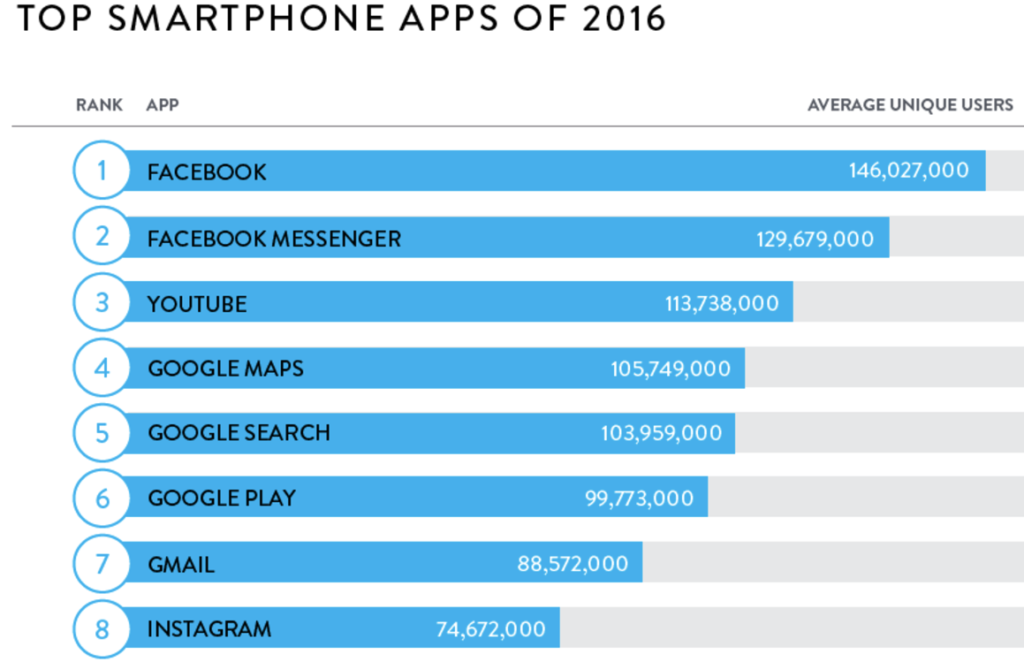
Source: Nielsen, Dec 2016
If you’re introducing a new app – whether unbundling a more complex app or launching a new startup – how do you break into this? There’s not a ton of organic opportunities. And the paid acquisition channels are getting saturated too.
#2 Competition on paid channels
Paying for acquisition is one of the key channels still available, if you can find the right untapped audience segments with high ROIs. This only works when prices aren’t bidded up and you don’t face too much competition for the same ad inventory. Unfortunately that’s not what’s happening.
For example, let’s look at some of the dynamics of Facebook increasing their revenue per DAU over the last few years:
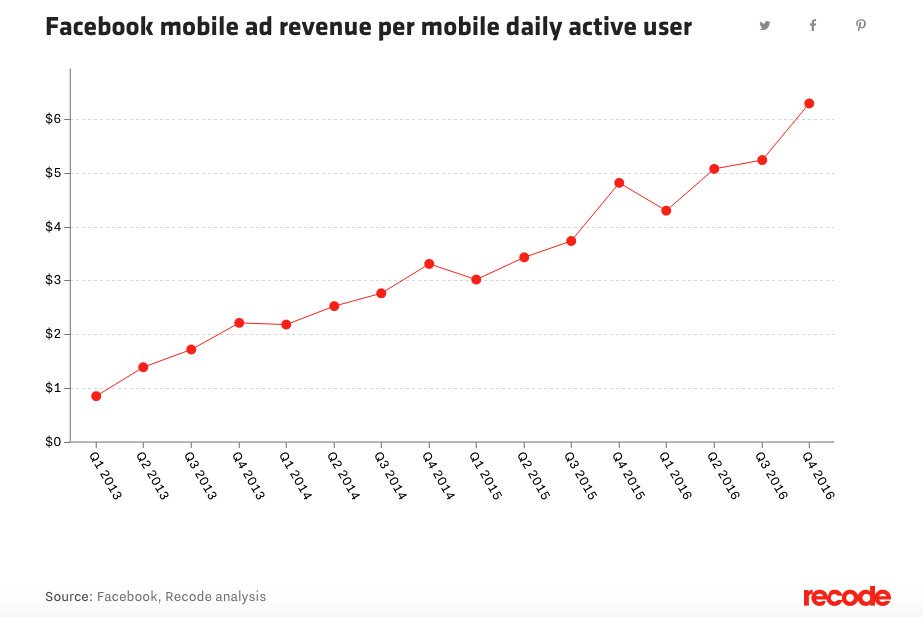
This is driven by a number of factors, of course – relevance, targeting, ad unit engagement, etc. – but it’s also because competition is getting fiercer on Facebook ads, not less, which is evidenced by the rapid increase in the advertiser count as well as the increase in revenue per user. In 2017, Facebook counts over 5 million advertisers on its platform, up from 4 million in Q3 of last year and 2 million in 2015. During its Q1 2017 earnings call, Facebook told investors that it expected ad revenue was approaching a saturation point, despite major growth in Q1 2017 earnings as compared to 2016. It’s currently at 2 billion users, with 17% YoY user growth, and its ability to add more inventory depends increasing its user base, or increasing users’ time spent on Facebook.
#3 Banner blindness = shitty clickthroughs
Additionally, everyone’s getting smarter about growth, including consumers. Today, most invite systems no longer have the same novelty value or efficacy as they did 10 years ago (Dropbox’ give/get was novel when it launched), and consumers’ “banner blindness” extends far beyond actual display advertising to encompass referral systems and virality programs.
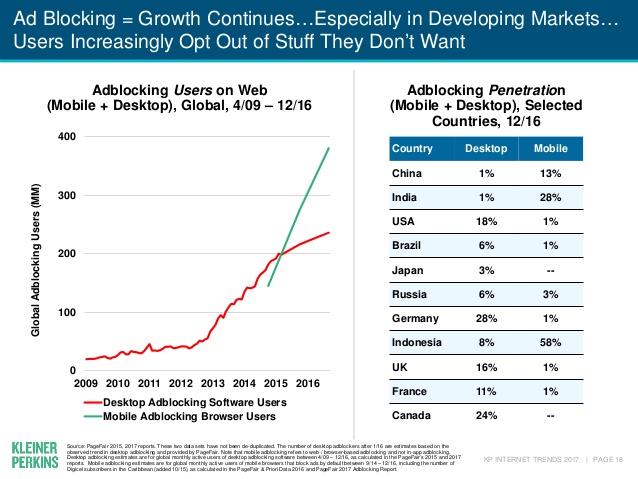
In Mary Meeker’s latest internet trends report, she reports that up to 1/3 of some countries are using ad blocking, and we’re quickly on our way to 600M internet MAU who can’t be reached by ads:
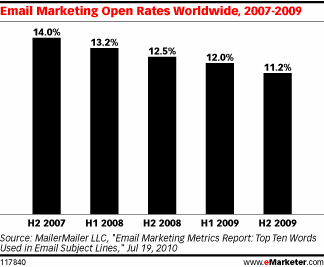
This is just the 2017 version of The Law of Shitty Clickthroughs, which I wrote about a few years ago, where I showed some stats indicating that email marketing open rates are on the decline:
… and that traditional banner CTRs seem to be asymptotically approaching zero: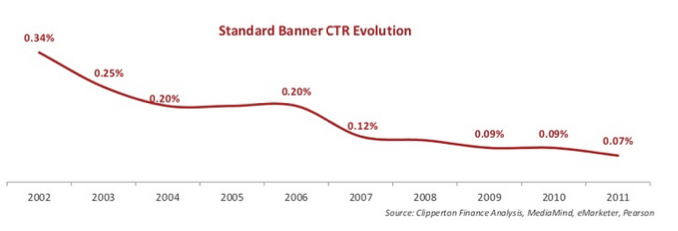
These trends are troubling, and mean that these channels are getting less engagement per user, and we haven’t found amazing new channels to replace them.
#4 Superior tooling – which levels the playing field
At the same time as advertising is getting more crowded, there’s also increasingly widespread availability and adoption of tools like Mixpanel, Leanplum, Optimizely and others that close the gap on being data-driven at companies.
Ten years ago, we used to look at total registered users. Cohort analysis was a sophisticated approach, and we also didn’t have a sense for MAU, DAU or other more granular metrics. One of the killer features of Mixpanel is that it made understanding cohort-based retention turnkey. It used to take a real investment of engineers, data scientists, and know how to be able to create simple graphs like this:
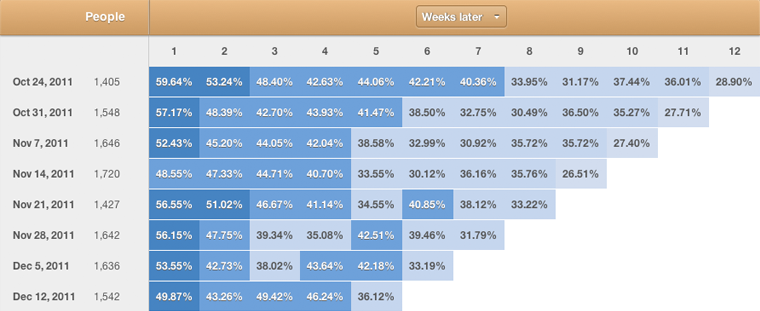
Now, it’s pretty much turnkey. You can get this chart from Mixpanel (and may others!) practically for free, as soon as you implement your analytics tracking.
In B2B, we’re seeing the same phenomenon. Outbound used to be painstaking and manual. Today, there are many sales tools that make outbound more accessible (Mixmax, Outreach, insidesales.com etc), which automates part of the process but also generates more noise and competition. Tasks that used to be more manual and higher friction are automated and easier, which leads to more people jumping in.
The result is that it makes everyone better. You and all your competitors understand your/their acquisition and retention bottlenecks. Everyone has an equal, data-driven shot at improving LTV, and as a corollary can spend more on ads.
#5 Smarter and faster competitors
It used to be that startups could count on their competitors to be big, dumb, and slow. Not anymore. We’ve all gotten smarter and faster, and that includes your competitors. It used to be that you could wait a few years before competitors would respond. Now the Facebooks, Hubspots and Salesforces of the world can and will copy you right away.
Most famously, we’ve seen Facebook fast follow Snap within their Messenger, Instagram, Whatsapp and core product:
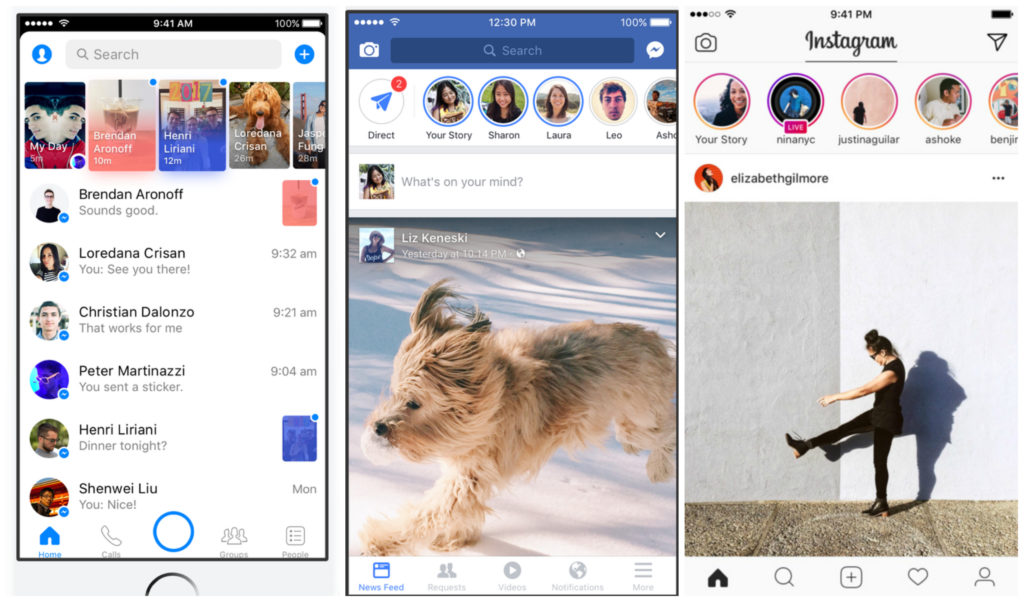
But it’s not just consumer where this is happening:
- Dropbox <> Google Drive
- Slack <> Microsoft Teams
- YesWare <> Hubspot Sales
… and many more examples too.
#6 Competing with boredom is easier than competing with Facebook + Google
When the App Store first launched, competition was easy: Boredom. Mobile app developers were taking time away from easy, ‘idle’ activities like waiting in line, commuting etc. But today, acquiring a new app user means stealing a user’s time from their favorite existing app.
As we’re near the end of the cycle, companies have moved from non-zero sum to a zero-sum competition.
Instead of competing with boredom, we’re now competing with Silicon Valley’s top tech companies, who already have all your users (back to number 2 above). This also applies to the consumerized workplace, where new entrants will be competing to steal users’ time from Slack, Dropbox and other favorite apps. This is much, much harder because the incumbents have pretty great products! And proven distribution models to respond if needed.
How the industry is evolving, in response
The above trends are troubling for new products, and especially for startups. All 6 of these trends are scary, and they’ve emerged because we’re at the end of a cycle. There’s a variety of natural monopolistic trends (like app stores, ad platforms, etc), where everything with related to growth and traction is getting harder.
If companies want to stay in the mobile/software product categories, they need to evolve their strategies. I’ll save a deeper discussion for a future essay, but here are some observations on what’s happening:
- More money diverted to paid acquisition
- Deeper monetization to open up channels – especially paid
- Creation of paid referral programs to complement ad buying
- Personalization features that rely on lots of data to amp up targeting
- Products trying to deepen differentiation by solving hard(er) problems/tech
There seems to be a deepening in both monetization, differentiation, and personalization to help open up growth. This happens by solving more fundamental customer problems – especially those that help generate real $ value for people – but also helps open up paid channels, whether that’s advertising, referrals, or promos.
More discussion on this in a future writeup!
Psych’d: A new user psychology framework for increasing funnel conversion (Guest Post)
[Hi readers, my good friend Darius Contractor (currently growth eng at Dropbox) has a brilliant new framework how user psychology has driven growth at companies like Bebo, Tickle, PhotoSugar and of course, Dropbox. Thanks to Darius and the folks at Reforge for putting this together. Hope you enjoy the writeup here! -Andrew]
Increase your funnel conversion by getting users Psych’d – by Darius Contractor
Have you ever wondered why people are bouncing from your nearly-frictionless onboarding flow? Why the same change can result in a lift on one page and cause drop-off on another? Or why people who find you via search bounce away after a few moments?
Having spent years focused on building experiences that got millions of users sharing, onboarding and inviting their friends, I’ve learned 2 things:
1. Every element on the page adds or subtracts emotional energy
2. Inspiring users is as important as reducing friction
A secret of the top growth experts in tech is to think about every UX interaction as an emotional event. But far from being random or beyond our control, emotion-driven interactions can be broken down into components, optimized at each step and replicated to get better results for onboarding and conversion.
The Psych Framework
Today I’m sharing the Psych Framework I’ve used to help grow companies like Tickle, Bebo and Dropbox. It is a systematic way to detect and improve the way an experience affects user emotional energy, which we call “psych”.
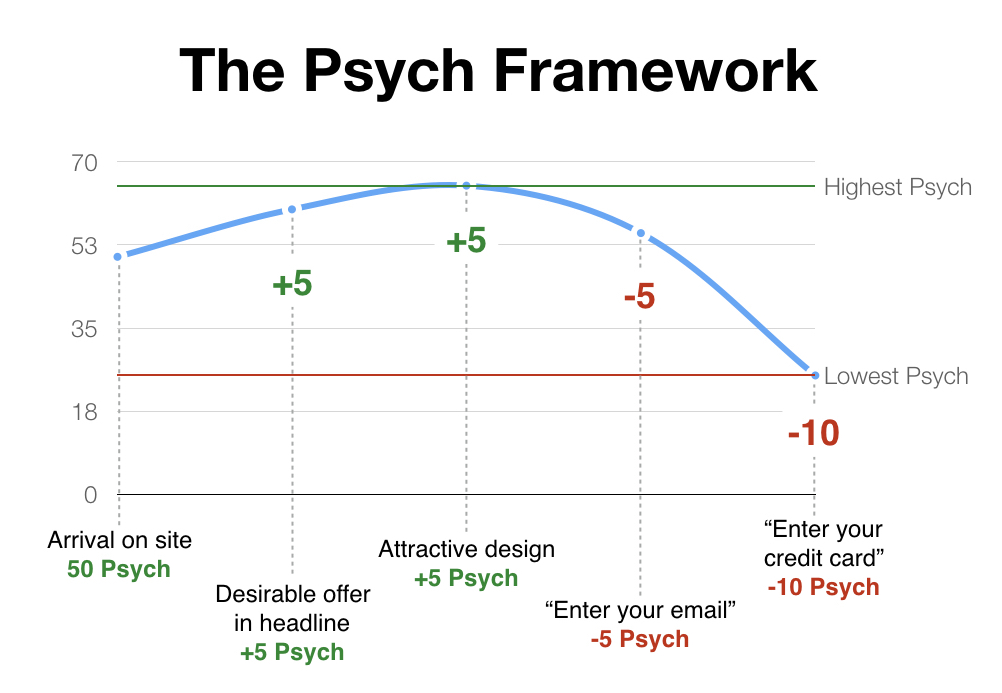
Every UX interaction increases or decreases Psych, the unit of measure for motivation to complete an action.
Every element of a webpage either inspires us by giving us more units of Psych or overwhelms us by depleting our existing store of Psych.
Once you understand what elements are adding to or depleting users’ energy, you can then start to manage that energy: adding inspiration and minimizing overwhelm to help users take your core actions.
Psych Units
We measure user energy in units of “Psych”, from 0 to 100.
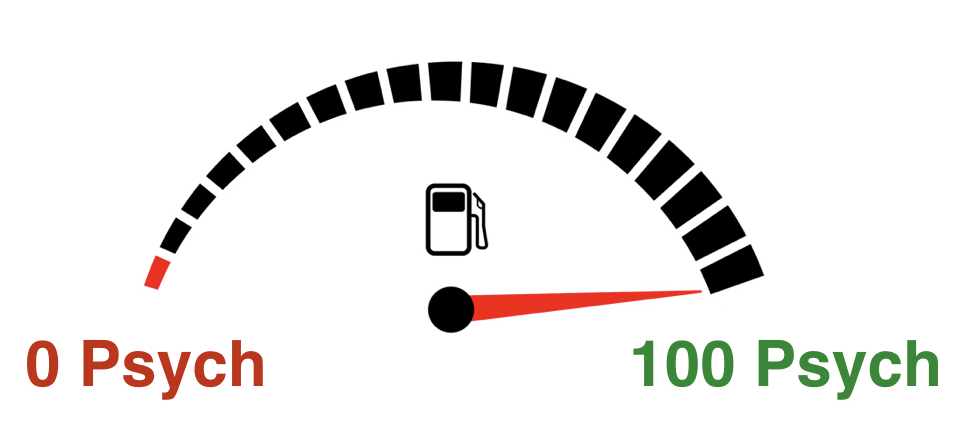 A user at 100 Psych is maximally committed to their current experience, does not need further motivation, and will overcome most challenges. For example, a person who needs to file their taxes tonight will do whatever it takes to download their W2 from their company’s payroll site. They’ll complete a forgotten password step, suffer through a poor interface they’ve never used before, and read through confusing numbers in order to get their taxes done in time.
A user at 0 Psych is exhausted and disinterested, to the point of abandoning their current experience. For example, a person accidentally clicking on an ad who realizes they’ve ended up on a scam site will have no motivation to continue and will bounce.
Psych Elements
Being aware of +Psych in your UI can massively drive user excitement/growth:
Tinder: “Discover new and interesting people nearby” → Yes, let’s!
Likewise, being unaware of the -Psych in your product can massively decrease success:
Global Entry site: “Fill in 40 form fields about yourself” → Ugh, maybe later… <closes browser>
We call elements that inspire users and add to their emotional energy +Psych.
If a car rental site pitched “Get your car for $15/day” that might be a +Psych, inspiring users to try to get this good deal. Inversely, -Psych are items that tire or overwhelm users, such as long sign up forms, unclear UX, too much text, and unclear next actions.
Let’s test drive this concept with Match’s home page. After that, we’ll talk about what to look for in your flows and examine what Airbnb gets right in their host sign-up experience.
Example 1: Match’s homepage
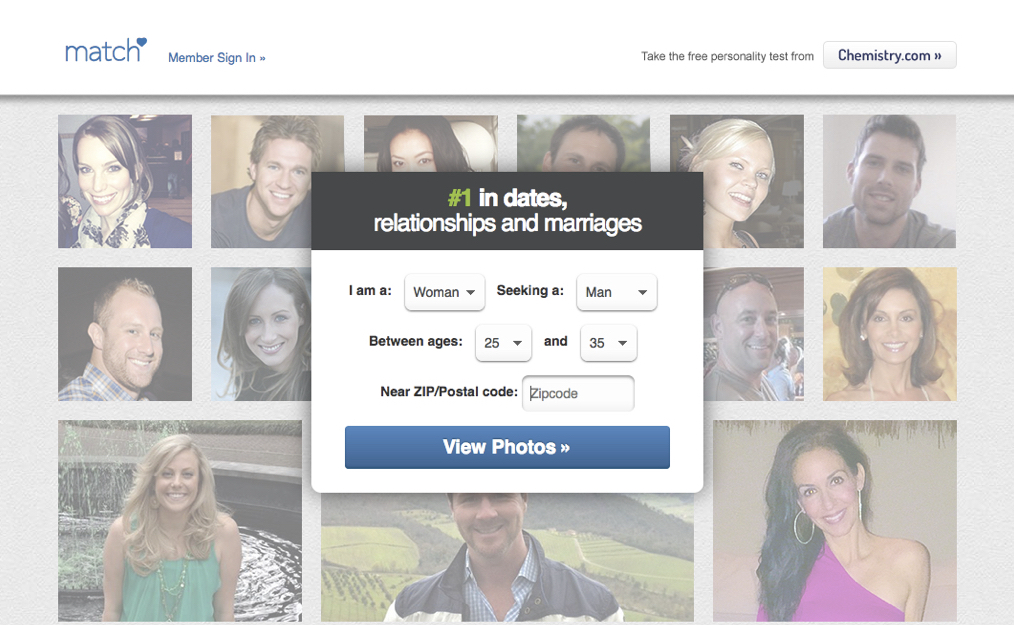
How do we evaluate the Psych score of this page?
1. Determine your starting Psych
To understand how much Psych a user has when arriving to a site, consider how they got there.
For example, users who arrive on Match through a Google Search are high-intent and have intrinsic motivation since they’re explicitly searching for dating. So they’re around a 60 Psych.
By contrast, visits from banner clicks would likely be low-intent since their clickthrough came in response to an external trigger. They’re perhaps a 30 Psych.
A referral from a friend might result in a clickthrough that’s low intent but has high social validation. So, they might be at 50 Psych.
2. Follow the user’s attention from top-left to bottom-right
In left-to-right languages like English, we consume content from top-left to bottom-right. As we follow our natural path across the page, our Psych will either go up or (more likely) down as we encounter elements that excite us or elements that are obstacles.
On the Match homepage above, these are the elements we encounter from top-left to bottom-right:
- Logo
- Photos of singles
- “#1 in dates, relationships and marriages”
- Demographic form
- “View Photos »” button
As you can see, right after the logo assuring us it’s a real company entity that we can trust, we see appealing photos of smiling people. Then we see the byline “#1 in dates, relationships and marriages,” which assures us that we’re going with the best site and that it’s there to help us achieve dates, relationships, or even marriage.
Next, there’s a form, which requires action that potentially depletes Psych. But we’re spurred on by the “View Photos” button — which is exactly the thing a user interested in “dates, relationships, and marriage” wants to do at this point.
3. Which elements are +Psych for you? Which are -Psych?
Let’s run through the Match homepage again and tally up Psych, element by element.
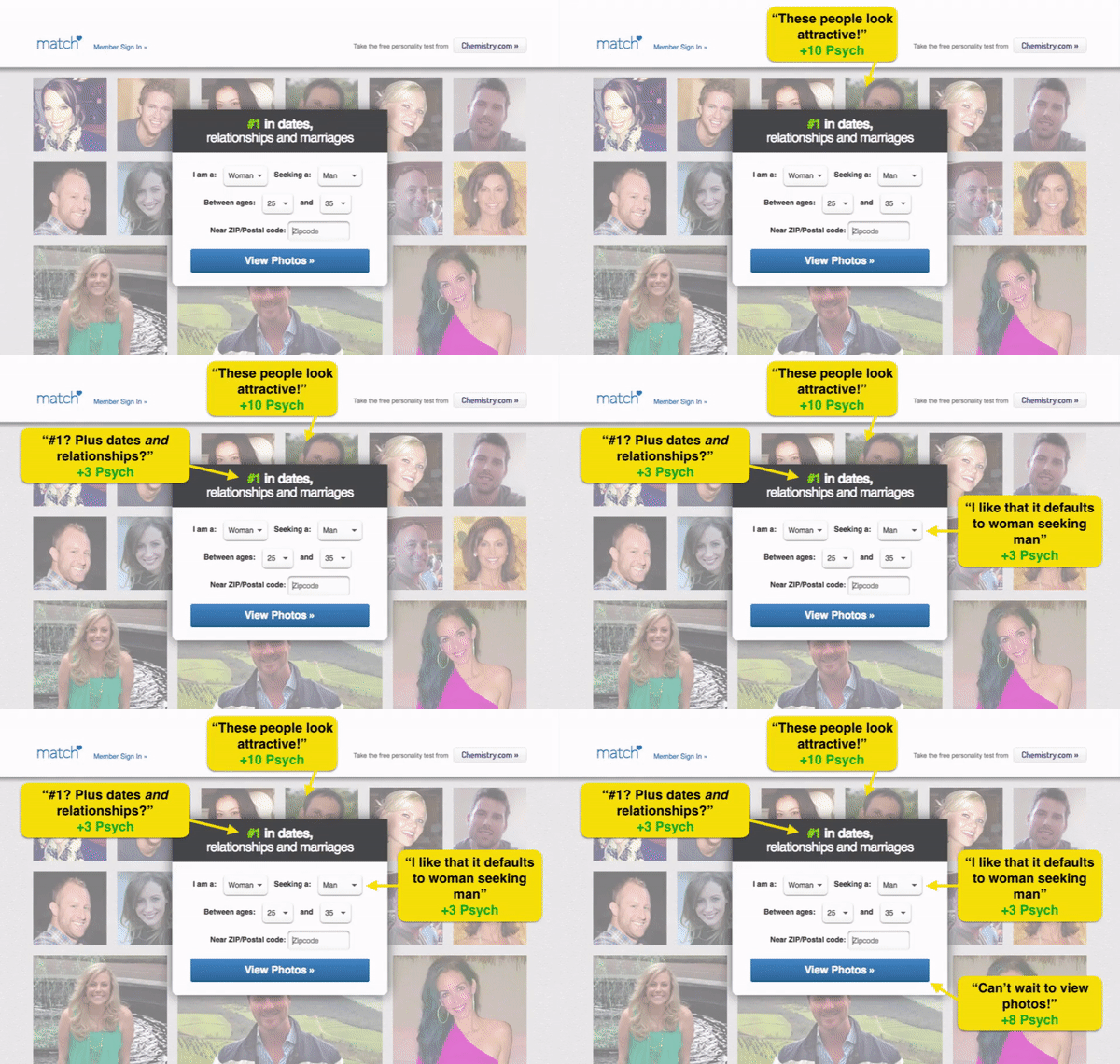
These are the + Psych elements:
- “Ooohh, these people look attractive!” → +10 Psych
- “They’re #1? And I can get dates/relationships/marriages?” → +3 Psych
- “I like that it defaults to Woman seeking Man.” → +3 Psych
- “Nice, can’t wait to View Photos” → +8 Psych
These are the – Psych elements:
- “Hrm, what age am I looking for?” → -5 Psych
- “Why do they need my zipcode? Argh, keyboard…” → -10 Psych
4. Sum it up!
Tally up all the Psych elements to see where users are by the time they get to your call-to-action.
Greater-than-zero Psych means the user got through the flow.
- Starting from a Search: 50 Psych
- +Psych: 10+3+3+8 = +24 Psych
- -Psych: -5-10 = -15 Psych
- Result: 59 Psych → They made it!
Next, we’ll go through some of the top +Psych and -Psych factors across common pages.
Maximizing Psych on each of your pages
1. Assess initial Psych
People come to your site with an initial quantity of Psych.
If you’re hungry at noon and haven’t eaten all day, then your Psych level for a sandwich will be very high. That will help you power through the friction of standing in line, deciding between options, and pulling out your wallet to be saved by an $8 hero.
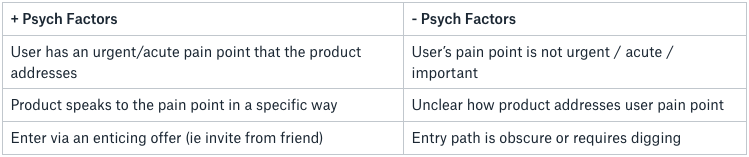
Therefore, the first step to evaluating Psych is to look at factors determining how much Psych people have when they enter your funnel:
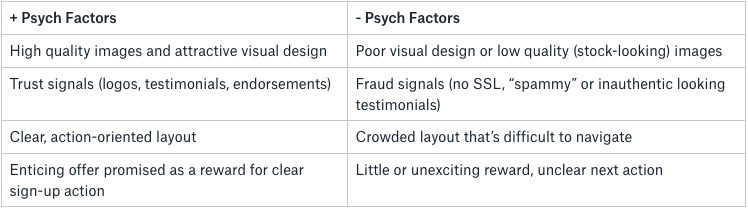
2. Psych on the landing page
Once a visitor hits your landing page — great! You now have multiple chances to increase their Psych to get them to continue to signup or, if you’re not careful, decrease their Psych and cause them to bounce.
3. Enter personal info
At some point, you’re going to have to ask your visitor to enter some personal information, even if that’s just their email address.
Asking for personal information usually creates a negative Psych moment, whether it’s because people are wary to share their information or because they’re simply feeling lazy and don’t want to complete an input action.

4. Interact with product
If you have a freemium or free trial model, your user will get a chance to interact with the product before it’s time to pay. This is a chance to increase Psych before the user gets to the Psych-depleting payment action.

5. Enter payment information
For most businesses, eventually it’ll be time for users to enter their payment information and complete a transaction.
This is the ultimate Psych-depleting action because of the psychological phenomenon of the pain of spending money.
While we might think that the purchase action should be Psych-increasing because of the anticipated pleasure of acquiring something we want, it actually triggers the same area of the brain as for physical pain. So, spending money = pain.
But, MIT researchers found that credit cards increase detachment from purchases. In other words, credit cards help decrease the pain we feel from spending (cash) money.
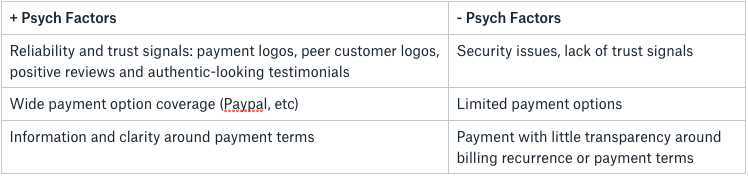
Aside from the inherent pain and negative Psych of spending, there are still things you can do to improve Psych at the payment step.
Decreasing cognitive load is more than just short signup forms
The above is a basic framework anyone can go through for figuring out the ups and downs of Psych within an onboarding flow.
But optimizing Psych isn’t just a matter of removing clicks and reducing text. In some cases, more detailed forms or copy can help by decreasing the cognitive load on making the decision — even though it’s technically more effort. For example, including more information about security and money-back guarantees can overcome trust barriers and alleviate fears for big purchases.
Now let’s look at another live example.
Example 2: Airbnb’s hosting flow
Let’s go through a more complex example — becoming a host on Airbnb.

How do we evaluate the Psych score of this page?
1. Determine your starting Psych.
To figure out the ups and downs of Psych for someone who’s thinking about hosting on Airbnb, let’s start with their mindset before they hit the landing page.
- They might have heard some stories about making a lot of money on Airbnb → +20 Psych
- They might have heard about it being lots of work or a negative hosting story → -10 Psych
But ultimately their positive starting Psych is greater than their doubts and they are motivated enough to check it out.
2. Follow the user’s attention from top-left to bottom-right
Airbnb offers three different ways for becoming a “host” on the platform:
- Renting a house or apartment
- Helping neighbors with their Airbnb listings
- Leading a tour or other travel experience
To keep it simple for this post, we’ll just look at the core Airbnb “host” action — renting a house or apartment.
As you follow the user’s attention from top-left to bottom-right, it’s pretty clear that Airbnb knows what its hosting users care most about — making extra money by renting out their places.

Here are the immediate elements we encounter above the fold, from top-left to bottom-right:
- Logo
- “Earn money” value proposition
- An interactive calculator to see how much you could earn
- A “Weekly Average” box with an impressive earnings estimate and a dollar sign
From there, the page displays more content aimed at increasing Psych and reducing doubt:
- Tactical instructions that demystify how Airbnb works
- Reassuring details about safety and security, like their host protection insurance and their $1M guarantee for hosts
- Social proof in the form of a video featuring a diverse handful of hosts talking about how income from Airbnb has helped them to stay in their homes, pay for medical bills, or fund a retirement.
Because users have to log in to continue the host flow, Airbnb’s goal on this first page is to drive up Psych high enough to carry them through the subsequent, more tedious steps in the flow — logging in or creating an account and setting up their first listing.
3. Which elements are +Psych for you? Which are -Psych?
Now let’s run through and tally up Psych, element by element.
Airbnb does a good job of loading up the page with +Psych elements because they know they’re asking a lot of the user:
- “Earn money? Yes please.” → +10 Psych
- “I can rent out an entire place, or a room, or just a couch? Then there probably is something for me.” → +5 Psych
- “$741 weekly average… higher than I thought.” → +10 Psych
- “Host insurance, and a $1M guarantee that protects my stuff… ok phew.” → +4 Psych
4. Sum it up!
Once again, you can tally up all the Psych elements to see where users are by the time they get to a call-to-action. Remember, greater-than-zero Psych means the user clicked the “Sign me up” button.
This is a simple tally of Psych on just one of the pages of the Airbnb “become a host” flow. There are obviously many more steps before a user becomes a successful host that’s contributing to the marketplace. With that in mind, you can run through the Psych Framework at each step of your onboarding or conversion flow to find opportunities to reverse -Psych and increase +Psych.
So that’s the psych framework in a nutshell. Tell me what you think in the comments and if you’d like to hear more.
Disclaimer: I’m a Dropbox employee, but I’m not posting on behalf of Dropbox or in an official capacity as a Dropbox employee. This post was originally published here.
Startups and big cos should approach growth differently (Video)
I recently did a video interview on the topic of how your growth strategy changes from being a small startup versus becoming a larger company. It’s hard to compete when you’re launching a new product and you have to think asymmetrically for your growth efforts to work. I walk through each stage, step by step, and talk through some of the strategic dynamics to think about. (Thanks to the Reforge folks for setting this up!)
Video
You can watch the full video here, and check out the notes below.
Notes
New startups have to focus on underrated acquisition channels for early growth efforts [0:00]
- Look for channels that are too small for the big companies to worry about — this is how smaller companies can gain an asymmetric advantage
- Examples: niche communities, sub reddits, mailing lists, offline, blogs, linkedin groups, facebook groups
- The best underrated channels are all small but high-intent
Find underrated channels that directly match your product’s target market [1:45]
- Look at what are the channels that match your product the most.
- It has everything to do with finding lots of little channels with high relevance.
- Regardless of where you start, you need to quickly be able to cobble together a bunch of small channels to get going — not just one or two.
Learn with very small channels by focusing on qualitative feedback to start [2:48]
- Any small channels that allow interaction with the audience, will allow you to do testing.
- Even small groups for customer development are worth exploring
- Test for the responsiveness of your audience
Scale up to the next, bigger channels, by starting with tests to optimize your performance [3:58]
- First path: Go after the bigger channels that the bigger co’s are going after, siphon off a small amount of traffic, at minimum it’s a means of testing
- Second path: trying to find a new channel / platform, that others haven’t considered that’s unique to your product. Example: Dropbox or Slack integration if you’re doing workplace productivity.
- Those channels are “medium sized” right now but have the chance to scale up bigger as their APIs develop.
Big companies approach acquisition by building a portfolio of channels that can scale [5:32]
- Once you’re big, it’s about building a portfolio
- All the little things will hit their ceiling and won’t scale
- You’ll end up with a few established, large channels, and your strategy will be about aggregation. Grow your portfolio, not replace channels
- Big opportunity is around attacking existing channels (or new ones) in a unique way that’s tied to your product
- Product-channel fit is key (Pinterest + workplace productivity tool = dissonance)
- Examples for b2b: the calendar, the browser
- For consumer, there’s YouTube
The most exciting channels “right now” need to tie uniquely/directly to your product [9:02]
- “Right now” is the wrong way to think about it; it’s about the trajectory
- Stage 1: Map the user lifecycle:
- What are all the other tools, apps, offline experiences that your users are also coming into contact with?
- Find out what your product is most adjacent to
- Stage 2: Sizing / understanding the trajectory of all these things that are out there (at an MAU level).
- What kind of integration can you get?
- Some platforms are more conducive to virality or being used as a growth channel (instagram doesn’t give you a way to link out, so it’s less good of a channel VS youtube, which does allow cross linking and linking out)
- Channels have to match what people are trying to do with your product
You have to pick the right social channels for virality [11:30]
- Social isn’t just digital experiences; it’s also offline experiences
- So, “social channels” are any ways that your users / customers talk to each other to convey that the other person should try a product
- Direct recommendation or invite: “I’ve invited you to Facebook, you should use this.”
- Indirect recommendation or invite: “I’ve taken this cool Instagram photo, do you like it?”
- Same applies to B2B; Dropbox is an example of indirect.
- Digital is important because it’s attributable, but the broader takeaway is to create a product with a bunch of touchpoints in a user’s life; those touchpoints trigger natural recommendation or invite opportunities
How do products spread on social channels? [16:06]
- Extrinsic vs intrinsic motivation, and their accompanying rewards systems
- Extrinsic — get a direct reward for referring someone
- Intrinsic — my friends using this makes the experience better for me
- They’re not mutually exclusive, and can work well together
- Extrinsic is easier to bolt on after the fact, but intrinsic (built in to the product early on) creates deeper defensibility by creating network effects
“Going viral” doesn’t mean just building something cool [21:19]
- “I’ll just make something really cool, and people will talk about it” is not as sustainable as acquisition channels that are based on combined intrinsic and extrinsic motivations
- Example: Slack going viral
Not every platform is created equal (for virality). How do you build for the right one? [22:48]
- Anything that’s spreading from user to user is spreading on a platform that already exists.
- Platforms are built on top of each other (Facebook on top of .edu, many companies built on top of the Facebook platform) and certain ones are more suitable than others.
- Key questions to ask when evaluating platform potential:
- How easy is it for customers to communicate with one another?
- How much control do you have (via APIs or anything else) to customize the invite experience?
- Do you have the ability to add a link?
- Can you get ahold of an address book or social graph, in order to generate invites?
- You have to assess not only size and trajectory, but also how open is that platform? What are the hooks the it supplies you to build growth?