Archive for March, 2013
Social products win with utility, not invites (Guest Post)
[Note from Andrew: I’ve recently traded a series of interesting emails on the evolution of social products and how the things that worked years ago- importing addressbooks and blasting out invites, no longer work today. A friend of mine, Sangeet, wrote up a longer analysis on the topic and I wanted to share that with you today. Enjoy!]
About the author: Sangeet Paul Choudary analyzes business models for networked businesses at his blog Platform Thinking. He is based in Singapore, previously at Skillshare, Intuit, and Yahoo. Follow Sangeet on Twitter at @sanguit.

The proverbial chicken and egg problem of building a new social product is well understood among tech startups, and it’s been commonplace to follow two contrasting mechanisms for getting traction.
Traditionally, startups have solved this problem by racing to connect users with each other, essentially providing them the pipes to interact with each other. Twitter, Facebook and LinkedIn have grown big with this connection-first model.
However, a new breed of networks is gaining ground with the content-first model. They provide users with tools to create a corpus of content, and then enable conversations around that content. Behance, Pinterest, Instagram, Dribble, Scoop.It have all gained traction by building a corpus of content before building a social network.
The two contrasting approaches are summarized below:
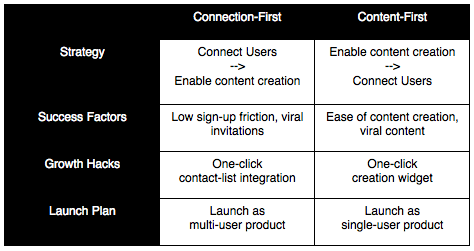
The rules of building a social product are changing. It’s important to understand this shift to build social products that can effectively gain traction on the internet today.The connection-first model is no longer as effective as it used to be. As the social web grows, and a larger number of social products compete for our attention, we are seeing a dramatic shift towards the content-first model. If you’re still getting users to send out Facebook invites, you’re adding to the noise, instead of standing out and getting noticed.
The Connections-first Social Product
Traditionally, the playbook for building network effects has been the following: Get users on board, connect them to each other and have them create content and conversations.
Social networks like Bebo, Facebook and Twitter used this playbook to create their respective networks leveraging address-book integrations and other hacks to rapidly build a large number of network connections.
The importance of building connections, in this model, cannot be emphasized enough. In fact, the growth teams at Facebook, Twitter and LinkedIn specifically aim for ‘X connections for a user within Y days of sign-up’ to activate the user.
Since a critical mass of connections is required before users experience value, the key to building a successful network is minimizing the friction in creating connections. Contact-list integration helped social networks like Facebook and LinkedIn gain initial traction through the removal of sign-up friction.
In spite of growth hacks like contact-list integration, there is always a lead time in getting users on board and reaching critical mass. This is the ‘gap’ where it becomes very difficult to demonstrate value in using the product.
Frictionless sign-up + Virality = Network Effects? Or not!
Startups often believe that removing friction in sign-up and creating some form of viral acquisition are the two key elements to reaching critical mass. In fact, with the rise of Facebook Connect and the social graph, a large number of social products have sprung up on the promise of frictionless sign-up and viral growth. However, users on the internet have limited time and attention. As more startups leverage the social graph and flood users with invitations to join their networks, users have started to develop invite fatigue.
Clearly, frictionless sign-up and virality are not the one-stop solutions we were hoping they would be.
The secret to network value
Startups often fail to appreciate the gap between technology and value proposition. For products like Evernote, technology serves the entire value proposition. However, for social products, the value proposition is a combination of technology and the content that users create on top of it. YouTube’s value lies in its hosting and streaming capability, but more importantly in its vast repository of videos.
The secret to creating a social product that demonstrates immediate value is to enable content before creating the network.
Content created on the network is the new source of competitive advantage. The videos on YouTube, the pictures on Instagram, the answers on Quora are the primary source of value for users and the key driver of competitive advantage for these platforms.
The Content-first Social Product
Today’s social startups don’t start off as networks. They start off as standalone apps. These products enable users to create a corpus of content first. They then connect the users with each other as a consequence of sharing that content.
Instagram started out as a photo-taking tool and built itself out into a social network subsequently. The initial focus was entirely on the creation of content and the connections were formed over time leveraging other social networks. It is unlikely that Facebook would have considered Instagram a direct competitor in its early days, largely owing to its model of deferring network creation.
How to create a network in stealth mode
Instagram started off as a standalone tool. In doing so, the product provides ‘single-user’ utility to the user even when other users aren’t around on the network. There are two aspects to building single-user utility:
1. The single-user utility should allow creation of content that will ultimately form the core of the network. The core of Instagram is pictures. Discussions are centered around pictures. Hence, the single-user tool needs to allow creation of pictures. This is an extension of the OpenTable model, where a restaurant first manages its real-time seating inventory on a single-user tool, before that very inventory is exposed to consumers on a network, to allow them to reserve tables. Curation-as-creation products like ScoopIt and Storify also use this model to curate content which will serve as the core for network interactions.
2. The product should deliver greater value when users share their content with their friends. The product builds out the network at the backend as more content is shared. Hence, the social network gets created, effectively solving the chicken and egg problem. A new breed of curation-as-creation startups (Scoop.It, Paper.Li etc.) is gaining traction on a similar model.
The new playbook for creating social products is essentially the following:
- Have a vision for creating the network but do not start executing on network creation
- Enable a single-user tool that creates content that is core to social interactions
- Share this content on external networks (social networks, email, blogosphere)
- Capture interactions around the content to build network linkages at the backend
- Open out the network once a critical mass of linkages have been built
The rise of the content portfolio
Instagram demonstrates how a network is created around a portfolio of user-generated content. Behance and Dribbble have followed similar strategies by providing a portfolio for hosting designs, before adding value through the creation of a peer-review community. Initially, Pinterest appealed to the designer community as a tool to ‘bookmark’ their favorite designs, before it built out the network. Early adopters found enough value in the ability to store designs and pictures, to use the product before the network became active.
The new success factors
Frictionless sign-up and virality are important but they are no longer the key to building social products. The following are key to building content-first social products:
- Removal of barriers to the creation of content: Startups like Instagram, which succeeded in simplifying the creation process and in enabling users to spread the word, succeeded in eventually building the connections between users.
- Growing the creator base, not just the user base: Since value for the overall networks is scaled by scaling content creation, the platform needs to focus on incentivizing and increasing the percentage of users who create content.
- Strong curation models: Content-first social products scale well only when there is a strong curation model in place to separate the signal from the noise. Without strong curation, greater content can actually lead to a poorer user experience leading to reverse network effects.
- Incentives: The platform needs to encourage users to build out the connections. This works best when the platform encourages an innate motivation (self-expression or self-promotion) in the user to spread the word about her content. In doing so, the users build the necessary connections that set up the network.
The new growth hacks
In the connections-first model, the one hack that minimized friction in building connections was the contact list integration. In the content-first model, the hack that minimizes friction in creating content is the creation widget. Creation widgets have grown in popularity in recent times, spreading across the internet in the form of browser add-ons and one-click buttons. Several curation-as-creation startups like Pinterest and Scoop.it have used widgets to enable users to create content easily.
The future
This new model of building networks allows a social product to gain traction while value is being created by users. Once enough content is created, the users are connected and the network builds out. Social products that win will focus on enabling users to create content first and generate conversations around it. The creation of the actual social network will be a final step, as a consequence.
Minimize your Time to Product/Market Fit

TTPMF
Startups need to get to “Product/Market Fit” or die trying. Most die trying. Steve Blank talks about the idea that tech companies die because of lack of customers, not inability to build technology. Marc Andreessen says it’s the only thing that matters. Basically you want to get to the point where your product is working, and if you can’t get there within the first 1-2 years of your company’s existence, you generally run out of money or your team falls apart.
So let’s define a new term: TTPMF – the “Time to Product/Market Fit.” You want to get TTPMF down to the point where you can achieve it, scale up the business enough on traction to either reach profitability or to raise your next round. If your plan for TTPMF exceeds your funding runway, you’re already dead.
Luckily, it turns out that getting a low TTPMF is very easy: Just completely copy something that’s already at P/M fit. (Sometimes this is easier said than done, especially if the incumbent has network effects) But with so many startups that fail because of lack of P/M fit, you’d think it’d be obvious- it’s easy right? Now, if you find that yucky or undesirable, I’m with you. It turns out that although there’s an advantage in reducing TTPMF, cloning products has a lot of business (and ethical, and personal) weaknesses.
Let’s discuss those weaknesses.
Long-term Strategic Value
If you make it an explicit goal of reducing TTPMF, you might think that cloning is great- but be aware that a 100% clone has many weaknesses:
- It’s uninspired
- You’ll never get to #1 since you can’t switch existing customers over
- You’ll never grow the market in a new direction, giving you a different base of users- compared to an incumbent competitor
- You let a competitor define the market, and you play catch up- you can never play offense
- If it’s a networks-effects business, you can’t just clone a product, you have to clone a community. That’s hard.
- .. among many other issues.
Thus, I don’t think you ever want to do a full clone.
Instead, you want to keep the fundamentals the same (80%) while substantially reinventing 20% of the product. That addresses the issues above. There’s a lot of stock methods of reinventing the 20%- you can do this in the cheaper/better/faster variety, or to go to a niche, or to go with some other segmentation. (Again, refer to Steve Blank’s blog for more details on this).
Each of these approaches allows you to create product differentiation which lets you either suck in a different set of users than the incumbent competitor. It lets you head in a different direction so that you can provide a better product for some %, and define that part of the market on your terms. Long-term this provides a more sustainable foundation for the company so you compete more effectively against others in the market.
Thus, don’t just clone, though I think most people make the opposite mistake by trying to invent too much.
How do you balance the two?
So between the two, you can guess how I land on balancing the opposing forces of TTPMF versus Long-term Strategic Value: More than anything, I believe in reducing TTPMF.
In most circumstances, I don’t even think entrepreneurs really have a choice. TTPMF has to be less than 1-2 years or else your startup will implode. Ask anyone who’s been working on a product for more than 2 years and doesn’t have traction to show: It really, really sucks. The first 6 months can be fun because it feels like you’re painting on a blank canvas, but soon enough, there’s just fatigue and the window of opportunity shifts. Platforms change, investors get disengaged, your employees start getting excited about other companies. So if you miss your window, then you’ll run out of money or energy or both.
And perhaps this is unfairly treated as a either/or decision, because in reality it’s not. You can get both a low TTPMF as well as a ton of strategic differentiation in the market, and I wouldn’t settle on anything but an idea that has both baked in.
Isn’t 20% too incremental?
The other important objection is, doesn’t just lead to more incremental companies? Ideally, no. The goal is- Pick the right 20% :)
Ideally the differentiation is baked deeply into the core of the product, not out on the edges. Something the end user can see and feel within the first 30 seconds of using the product. So even if you see that all social networking products are public and anonymous, then you go with something private with real names. But you still have profiles, friend connections, and the other things that people would recognize as a social network product. With Twitter, you might argue that a lot of features were already well understood within a blogging product: the stream of posts, being able to subscribe to others, customizable profiles, etc. But the 20% that could be different was the 140 characters.
Where I agree with you is that if the product is basically completely the same, but the 20% is out on secondary/tertiary features that aren’t used much, that’s probably a recipe for a commodity product.
The reality in the 2013 fundraising market
Given the Series A crunch on everyone’s mind, let’s put a quantitative range on what TTPMF has to be to successfully raise an A.
If you’re a consumer product company with the following characteristics:
- $40k/month in burn from a team of 4 FTEs
- $1M raise, so ~2yrs of runway
- 6 months to raise the Series A, so really 18 months of operating time
- Target 1 million installs before raising the A
- 3 months to build version 1.0 and release it
If you believe the numbers above, then how much time do you really have for TTPMF?
First, the optimistic case:
TTPMF = instant. This means that you have 3 months of development to release the v1, and you instantly have great engagement. Then you have 15 months to work on growth, getting it eventually average 2,000 signups/day, to hit 1 million installs to get ready for your Series A. Not bad, and sound doable if you have a low TTPMF.
But what if you have to pivot once or twice? And then you’re 12 months in? Well, turns out you’re not left much time to work on marketing.
TTPMF = 12 months This means you’ll have 3 months to release the v1, then 12 months of iterations. At this point, you’ll have 9 months left before your Series A raise, and you’ll need to scramble on marketing to get to 11,000 signups/day to reach 1 million.
That’s scary stuff, and doesn’t leave you much time to focus on your Facebook integrations, optimizing your signup flows, etc. Believe me, getting user engagement is hard enough, but when you couple it with a high bar on user growth, it’s 10x harder. So leave enough time to work on your marketing optimizations to get your product going.
And then by the end of it, you’re in a death spiral like what I previously described in Mobile App Startups are Failing Like It’s 1999.
Get that extra time by leading with the problem of TTPMF, but don’t forget to keep the big picture in mind also.
I’m a Google Glass skeptic and think it’ll be the next Apple Newton

Turns out nerds are crazy about Google Glass
Recently I tweeted the following:
i’m a google glass skeptic. Who’s with me?
Turns out most people think Google Glass is going to be awesome. Frankly, I was surprised- I figured it would be more balanced. But it turns out that people are more excited about the idea of Glass than any particular use case. And I’m excited about the product category too, but think the v1 might suck.
Google Glass is the new Apple Newton
One day wearable computing glasses may turn out awesome, but I’m convinced that the Google Glass will be like the Apple Newton- a visionary product well ahead of its time, and maybe 10 years after its release, someone will figure out how to make it mainstream using a different design. Regardless of whether the v1 is good, all the investment in wearable computing is certainly exciting. What nerd doesn’t want to fulfill their dream of being a cyborg? And within a few iterations, it may be that the industry will come out with a v5 that is awesome, just the same way that the iPhone/iPad eventually fulfilled the dream of the Newton. Let’s hope that becomes the case, but in the meantime, I’m not optimistic about the v1 of Google Glass.
Is it better than smartphones?
My skepticism is rooted in one idea: For $1,500 (or $1k or even $500), the Google Glass will have to do certain tasks significantly better than the smartphone justify the price. And in the next 2 years, it may have to compete with many other devices like wearable watches that fulfill some of the same tasks too. And I’m skeptical that there’s enough tasks where it’ll be worth it, and I’m skeptical that using voice as the primary input will be good enough to drive the whole interface.
Beyond the idea that it’s cool, you have to ask:
In what tasks does Google Glass actually perform better than a smartphone?
And I don’t think there’s enough use cases to make this work.
Looking at the use cases
One datapoint on this is to watch the recent Glass marketing video to find out all the use cases they demonstrate. But let’s try to ignore all the awesome acrobatics and beautiful scenery, and just focus on what people are actually doing with the UI:
List of use cases
Here’s my list of what people are doing on Google Glass:
- show the time
- record video
- send message via voice
- start video conference
- search Google images
- get the weather
- take a picture
- get directions on a map
- get flight details
- translate “delicious” to Thai
- look up something on wikipedia
- share a photo
(Of course, it should be noted that part of why they are creating this new developer preview is so that more apps can get written- but in that case, it’s fancy technology looking for a use case)
Glass versus phone (or other cheaper wearable devices)
The biggest issue with the above use cases just aren’t significantly better with a computer attached to your face rather than the computer you carry in your pocket. Most of these are basically simple things you can already do on your phone- checking the weather, the time, etc. There’s a small collection of things I’m convinced will be a lot worse, like searching for stuff or sending texts to people, because voice input is still weak. And then there’s a small set of things, like taking POV photos or looking up maps, where Glass can really offer a better experience. Are those enough?
Voice sucks as the primary input
In particular I’m skeptical of voice as the primary input. I think it’ll doom the product in the same way that horrible handwriting recognition doomed the Apple Newton. The state of the art on voice input, frankly, really sucks on both Android and iOS. Have you tried to compose a message that wasn’t “ok” or “coming home” via voice? Especially in a noisy cafe or on the bus? Plus people are going to seem like crazy folks, talking to themselves over and over again, trying to coax their devices to do what they want.
(You can easily do an experiment on this by trying to do everything on your phone without touch for a while- you won’t last long, it’s super frustrating)
It may be that they have some new magic voice capabilities they’ll release as part of Glass, yet at the same time, wouldn’t they bring it to the 500 million Android devices first? And if the magical voice capabilities on smartphones get better, won’t it erode the differentiation of using the devices versus Glass?
I hope it works
Ultimately, my final point on this is that I hope it all works. I haven’t used Google Glass yet, and will be really excited to try it out. I hope it works. But rather than being wowed by just the idea of wearable glasses, I think it’s important to start talking about developing the actual use cases. How will people interact with this thing that will make it an amazing experience? Especially in the context of all the other wearable computing devices we’re sure to carry with us- phone, watch, Fitbit, Nike bands, etc. And those are the kinds of questions we’ll need to answer to really push the next generation of devices forward, rather than just make really awesome gadget porn.