Archive for April, 2012
Growth Hacker is the new VP Marketing
The rise of the Growth Hacker
The new job title of “Growth Hacker” is integrating itself into Silicon Valley’s culture, emphasizing that coding and technical chops are now an essential part of being a great marketer. Growth hackers are a hybrid of marketer and coder, one who looks at the traditional question of “How do I get customers for my product?” and answers with A/B tests, landing pages, viral factor, email deliverability, and Open Graph. On top of this, they layer the discipline of direct marketing, with its emphasis on quantitative measurement, scenario modeling via spreadsheets, and a lot of database queries. If a startup is pre-product/market fit, growth hackers can make sure virality is embedded at the core of a product. After product/market fit, they can help run up the score on what’s already working.
This isn’t just a single role – the entire marketing team is being disrupted. Rather than a VP of Marketing with a bunch of non-technical marketers reporting to them, instead growth hackers are engineers leading teams of engineers. The process of integrating and optimizing your product to a big platform requires a blurring of lines between marketing, product, and engineering, so that they work together to make the product market itself. Projects like email deliverability, page-load times, and Facebook sign-in are no longer technical or design decisions – instead they are offensive weapons to win in the market.
Get updates to this essay, and new writing on growth hacking:
The stakes are huge because of “superplatforms” giving access to 100M+ consumers
These skills are invaluable and can change the trajectory of a new product. For the first time ever, it’s possible for new products to go from zero to 10s of millions users in just a few years. Great examples include Pinterest, Zynga, Groupon, Instagram, Dropbox. New products with incredible traction emerge every week. These products, with millions of users, are built on top of new, open platforms that in turn have hundreds of millions of users – Facebook and Apple in particular. Whereas the web in 1995 consisted of a mere 16 million users on dialup, today over 2 billion people access the internet. On top of these unprecedented numbers, consumers use super-viral communication platforms that rapidly speed up the proliferation of new products – not only is the market bigger, but it moves faster too.
Before this era, the discipline of marketing relied on the only communication channels that could reach 10s of millions of people – newspaper, TV, conferences, and channels like retail stores. To talk to these communication channels, you used people – advertising agencies, PR, keynote speeches, and business development. Today, the traditional communication channels are fragmented and passe. The fastest way to spread your product is by distributing it on a platform using APIs, not MBAs. Business development is now API-centric, not people-centric.
Whereas PR and press used to be the drivers of customer acquisition, instead it’s now a lagging indicator that your Facebook integration is working. The role of the VP of Marketing, long thought to be a non-technical role, is rapidly fading and in its place, a new breed of marketer/coder hybrids have emerged.
Airbnb, a case study
Let’s use case of Airbnb to illustrate this mindset. First, recall The Law of Shitty Clickthroughs:
Over time, all marketing strategies result in shitty clickthrough rates.
The converse of this law is that if you are first-to-market, or just as well, first-to-marketing-channel, you can get strong clickthrough and conversion rates because of novelty and lack of competition. This presents a compelling opportunity for a growth team that knows what they are doing – they can do a reasonably difficult integration into a big platform and expect to achieve an advantage early on.
Airbnb does just this, with a remarkable Craigslist integration. They’ve picked a platform with 10s of millions of users where relatively few automated tools exist, and have created a great experience to share your Airbnb listing. It’s integrated simply and deeply into the product, and is one of the most impressive ad-hoc integrations I’ve seen in years. Certainly a traditional marketer would not have come up with this, or known it was even possible – instead it’d take a marketing-minded engineer to dissect the product and build an integration this smooth.
Here’s how it works at a UI level, and then we’ll dissect the technology bits:


(This screenshots are courtesy of Luke Bornheimer and his wonderful answer on Quora)
Looks simple, right? The impressive part is that this is done with no public Craigslist API! It turns out, you have to look closely and carefully at Craigslist in order to accomplish an integration like this. Note that it’s 100X easier for me to reverse engineer something that’s already working versus coming up with the reference implementation – and for this reason, I’m super impressed with this integration.
Reverse-engineering “Post to Craigslist”
The first thing you have to do is to look at how Craigslist allows users to post to the site. Without an API, you have to write a script that can scrape Craigslist and interact with its forms, to pre-fill all the information you want.
The first thing you can notice from playing around with Craigslist is that when you go to post something, you get a unique URL where all your information is saved. So if you go to https://post.craigslist.org you’ll get redirected to a different URL that looks like https://post.craigslist.org/k/HLjRsQyQ4RGu6gFwMi3iXg/StmM3?s=type. It turns out that this URL is unique, and all information that goes into this listing is associated to this URL and not to your Craigslist cookie. This is different than the way that most sites do it, where a bunch of information is saved in a cookie and/or server-side and then pulled out. This unique way of associating your Craigslist data and the URL means that you can build a bot that visits Craigslist, gets a unique URL, fills in the listing info, and then passes the URL to the user to take the final step of publishing. That becomes the foundation for the integration.
At the same time, the bot needs to know information to deal with all the forms – beyond filling out the Craigslist category, which is simple, you also need to know which geographical region to select. For that, you’d have to visit every Craigslist in every market they serve, and scrape the names and codes for every region. Luckily, you can start with the links in the Craiglist sidepanel – there’s 100s of different versions of Craigslist, it turns out.

If you dig around a little bit you find that certain geographical markets are more detailed than others. In some, like the SF Bay Area, there’s subareas (south bay, peninsula, etc.) and neighborhoods (bernal, pacific heights) whereas in other markets there’s only subareas, or there’s just the market. So you’d have to incorporate all of that into your interface.
Then there’s the problem of the listing itself – by default, Craigslist works by giving you an anonymous email address which you use to communicate to potential customers. If you want to drive them to your site, you’d have to notice that you can turn off showing an email, and just provide the “Contact me here” link instead. Or, you could potentially fill a special email address like listing-29372@domain.com that automatically directs inquiries to the right person, which can be done using services like Mailgun or Sendgrid.
Finally, you’ll want the listing to look good – it turns out Craigslist only supports a limited amount of HTML, so you’ll need to work to make your listings work well within those constraints.
Completing the integration is only the beginning – once it’s up, you’d have to optimize it. What’s the completion % once sometime starts sharing their listing out to Craigslist? How can you change the flow, the call to action, the steps in the form, to increase this %? And similarly, when people land from Craigslist, how do you make sure they are likely to complete a transaction? Do they need special messaging?
Tracking all of this requires additional work with click-tracking with unique URLs, 1×1 GIFs on the Craigslist listing, and many more details.
Long story short, this kind of integration is not trivial. There’s many little details to notice, and I wouldn’t be surprised if the initial integration took some very smart people a lot of time to perfect.
No traditional marketer would have figured this out
Let’s be honest, a traditional marketer would not even be close to imagining the integration above – there’s too many technical details needed for it to happen. As a result, it could only have come out of the mind of an engineer tasked with the problem of acquiring more users from Craigslist. Who knows how much value Airbnb is getting from this integration, but in my book, it’s damn impressive. It taps into a low-competition, huge-volume marketing channel, and builds a marketing function deeply into the product. Best of all, it’s a win-win for everyone involved – both the people renting out their places by tapping into pre-built demand, and for renters, who see much nicer listings with better photos and descriptions.
This is just a case study, but with this type of integration, a new product is able to compete not just on features, but on distribution strategy as well. In this way, two identical products can have 100X different outcomes, just based on how well they integrate into Craigslist/Twitter/Facebook. It’s an amazing time, and a new breed of creative, technical marketers are emerging. Watch this trend.
So to summarize:
- For the first time ever, superplatforms like Facebook and Apple uniquely provide access to 10s of millions of customers
- The discipline of marketing is shifting from people-centric to API-centric activities
- Growth hackers embody the hybrid between marketer and coder needed to thrive in the age of platforms
- Airbnb has an amazing Craigslist integration
Good luck, growth hackers!
Google+ and the curse of instant distribution

I was reading today’s NYT article on Google+’s new redesign and found myself continually puzzled by the key metric Google continues to report as the success of their new social product: Registered Users.
In the very first sentence, Vic Gundotra writes:
More than 170 million people have upgraded to Google+, enjoying new ways to share in Search, Gmail, YouTube and lots of other places.
The use of registered users is a vanity metric, and reflects how easily Google can cross-sell any new product to their core base of 1 billion uniques per month. What it doesn’t reflect, however, is the actual health of the product.
Ultimately, this misalignment of metrics is due to the curse of instant distribution. Because Google can cross-sell whatever products they want against their billion unique users, it’s easy to grade on that effort. Plus it’s a big number, who doesn’t love a big number?
Google+ should be measured on per user metrics
Here’s what metrics are more important instead: Given the Google+ emphasis on Circles and Hangouts, you’d think that the best metrics to use would evaluate the extent to which these more personal and more authentic features are being used. These would include metrics like:
- Shares per user per day (especially utilizing the Circles feature)
- Friends manually added to circles per user per day (not automatically!)
- Minutes of engagement per user per day
Point is, the density and frequency of relationships within small circles ought to matter more than the aggregate counts on the network. As I’ve blogged about before, you use metrics to reflect the strategy you already have in place, and based on the Google+’s focus on authentic circles of friends, you’d think the metrics would focus on the density of friendships and activities, and not the aggregate numbers.
The curse of instant distribution
Every new product for a startup goes through a gauntlet to reach product/market fit, and then traction. In the real world, product quality and the ability to solve a real problem for people ends up correlating with your ability to distribute the product. Google+ is blessed, and cursed, with the ability to sidestep this completely. They are able to onboard hundreds of millions of users without having great product/market fit, and can claim positive metrics without going through the gauntlet of really making their product work.
Adam D’Angelo of Quora (and previously CTO of Facebook) wrote this insightful commentary regarding Google Buzz a while back:
Why have social networks tied to webmail clients failed to gain traction?
Personally I think this is mostly because the social networking products built by webmail teams haven’t been very good. Even Google Buzz, which is way ahead of the attempts built into Yahoo Mail and Hotmail, has serious problems: the connections inside it aren’t meaningful, profiles and photos are second class, comments bump items to the top of the feed meaning there’s old stuff endlessly getting recycled, and the whole product itself is a secondary feature accessible only through a click below the inbox, which hasn’t gotten it enough distribution to kick off and sustain conversations.I’m pretty sure that if Google, Microsoft, or Yahoo had cloned Facebook almost exactly (friends, profiles, news feed, photos) and integrated it well into their webmail product, that it could have taken off (before Facebook got to its current scale; at this point it will be hard for any competitor, even with a massive distribution channel pushing it).
So I think this question is really, why are social networks that webmail teams build always bad? Here’s my guess:
- The team building the social network knows that they’re going to get a huge amount of distribution via the integration and so they aren’t focused on growth and making a product that people will visit on their own.
- Integrating any two big products is really hard.
- Any big webmail provider is going to have a big organization behind it, and lots of politics and compromises probably make it difficult to execute well.
- Teams that work on webmail products have gotten good at building a webmail product, and haven’t selected for the skills and culture that a team that grows around building a social network will have.
(The bolding is from me). I couldn’t agree more with this answer. I think a key lesson behind the recent success of products like Instagram and Pinterest is that there’s still a lot of room in the market for great social products to take off- but the emphasis has to be on the product rather than the superficial act of onboarding a lot of new users into Google+.
Ultimately, it comes down to how realistic the Google+ folks are in looking at their metrics. If they drink their own kool-aid and think they have product/market fit when it’s in fact the traction is solely dependent on the power of their distribution channels, they may never get their product working.
On the other hand, if they have a balanced view on their metrics and know they don’t have product/market fit yet, then they have a fighting chance. Unfortunately, I think the changes they’ve made to the product recently are more efforts to optimize, rather than fundamental improvements to the product. I think Google+ needs much bigger changes to make it as engaging as the best social products.
The Law of Shitty Clickthroughs

The first banner ad ever, on HotWired in 1994, debuted with a clickthrough rate of 78% (thanks @ottotimmons)
First it works, and then it doesn’t
After months of iterating on different marketing strategies, you finally find something that works. However, the moment you start to scale it, the effectiveness of your marketing grinds to a halt. Sound familiar?
Welcome to the Law of Shitty Clickthroughs:
Over time, all marketing strategies result in shitty clickthrough rates.
Here’s a real example – let’s compare the average clickthrough rates of banner ads when debuted on HotWired in 1994 versus Facebook in 2011:
- HotWired CTR, 1994: 78%
- Facebook CTR, 2011: 0.05%
That’s a 1500X difference. While there are many factors that influence this difference, the basic premise is sound – the clickthrough rates of banner ads, email invites, and many other marketing channels on the web have decayed every year since they were invented.
Here’s another channel, which is email open rates over time, according to eMarketer:
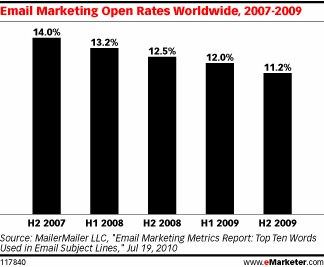
While this graph shows a decline, the other graph (which I don’t have handy) is that the number of emails sent out has increased up to 30+ billion per day.
All these channels are decaying over time, and what’s saving us is the new marketing channels are constantly getting unveiled, too. These new channels offer high performance, because of a lack of competition, big opportunities for novel marketing techniques, and these days, the cutting edge is about optimizing your mobile notifications, not your banner placements.
There are a few drivers for the Law of Shitty Clickthroughs, and here’s a summary of the top ones:
- Customers respond to novelty, which inevitably fades
- First-to-market never lasts
- More scale means less qualified customers
Novelty
Without a doubt, one of the key drivers of engagement for marketing is that customers respond to novelty. When HotWired showed banner ads for the first time in history, people clicked just to check out the experience. Same for being the first web product to email people invites to a website – it works for a while, until your customers get used to the effect, and start ignoring it.
One of the most important tools you have at your disposal is the creative and calls to action that you use in your marketing – this might be like “X has invited you to Y” or it might be the headline you use in your banner ads. Recently, Retargeter posted an interesting analysis on the Importance of Rotating Creatives, which showed how keeping the same ad creative led to declining CTRs over time:

Publishers often have a similar problem in consumers ignoring the advertising on their site, which drives down clickthrough rates for both of them (bad for CPMs). This problem is often described as banner blindness, and you can see it clearly here in an eye-tracking study by Jakob Nielsen:

You can see here how users, almost comically, avoid looking at any banners.
The point is, humans seek novelty yet are pattern-recognition machines. Your initial marketing strategy will work quite well as your users try it for the first time, but afterwards, they learn to filter your marketing efforts out unless they are genuinely useful (more on that later).
First-to-market never lasts
It’s bad enough that your own marketing efforts drive down channel performance, but usually once your marketing efforts are working, your competitors quickly follow. There’s a whole cottage industry of companies that provide competitive research in the area of how their competitors are advertising and give you the information needed to fast-follow their marketing efforts.
For example, with a quick query, I know how much Airbnb is spending on search marketing (turns out, millions per year) what keywords they are buying ads on, and who their competitors are. And this is just a free service! There are much more sophisticated products for every established marketing channel:
Airbnb Search Engine Marketing
- Daily ad budget: $10,638
- Keywords: 62,729
- Example ad: Find Affordable Rooms Starting From $20/Day. Browse & Book Online Now!
- Main competitors: Expedia.com, booking.com, hotels.com, Marriott.com
Any clone of their business can quickly fast-follow their marketing efforts and use the same ads in the same marketing channels. This quickly degrades the performance of the marketing channel as the novelty wears off and clickthroughs plummet.
Any product that is first to market has a limited window where they will enjoy unnaturally high marketing performance, until the competition enters, in which case everyone’s marketing efforts will degrade.
More scale means less qualified customers
Another important way to think about the available market for your product is in terms of the popular Technology Adoption Lifecycle, in which early adopters actively seek out your product, while the rest of the mainstream market needs a lot of convincing. The quant marketing way to look at this is that early adopters respond better to marketing efforts across any given metric (signup %, CTR, CPA) than the later customer segments. In the TAL framework, the early market seeks out novelty, whereas the mainstream market just cares if you solve a problem for them.
As a result, a marketing strategy focused on early adopters is bound to look better than what you get later. You can get some limited traffic from PR and targeted advertising from niche communities and media properties. However once you get past this group, the CTRs can drop substantially.
If you’re a SaaS or ecommerce company that’s road-tested your marketing strategy by acquiring limited batches of customers, the problem is that whatever assumptions and projections you make off of this base end up fundamentally skewed positive. If your model indicates that you can acquire customers at $10 and break even within 6 months, it’s not hard for a 30% increase in CAC and 30% decrease in LTV to double the time it takes to get to profitability. This could be the difference between life and death for a company.
Lesson to investors is: Beware marketing metrics done at a small scale, and beware marketing tech companies that facilitate momentary marketing opportunities without a bigger vision. These are arbitrage opportunities that will disappear over time.
How to fight the Law of Shitty Clickthroughs
I call it a Law, of course, because I really believe it’s a strong gravitational pull on all marketing on the web. You can’t avoid it, and in many ways, it’s counter productive to try.
You can always get incrementally better performance out of your marketing by taking a nomad strategy – always keep developing new creative, testing new publishers, and so on. That’s all easy, but is mostly about maintaining some base level of performance. This can push the Law of Shitty Clickthroughs to act over years rather than degrading your marketing efforts over months.
Similarly, this law provides a litmus test as to the difference between advertising and information. When you are marketing with useful information, then CTRs stay high. Advertising that’s just novelty and noise wrapped in a new marketing channel has a limited shelf life.
The real solution: Discover the next untapped marketing channel
The 10X solution to solving the Law of Shitty Clickthroughs, even momentarily, is to discover the next untapped marketing channel. In addition to doubling down on traditional forms of online advertising like banners, search, and email, it’s important to work hard to get to the next marketing channel while it’s uncontested.
Sometimes I get asked “have you ever seen someone do XYZ to acquire customers?” Turns out, the highest vote of confidence I can give is, “No I haven’t, and that’s good – that means there’s a higher chance of it working. You should try it.”
Today, these (relatively) uncontested marketing channels are Open Graph, mobile notifications, etc. If you can make these channels work with a strong product behind it, then great. Chances are, you’ll enjoy a few months if not a few years of strong marketing performance before they too, slowly succumb.
Visual Basic, PHP, Rails. Is Node.js next?

I had a nerdy conversation on what might be the next mainstream framework for building web products, and in particular whether the node.js community would ultimately create this framework, or if node.js will just be a fad. This blog post is a bit of a deviation from my usual focus around marketing, so just ignore if you have no interest in the area.
Here’s the summary:
- Programming languages/frameworks are like marketplaces – they have network effects
- Rails, PHP, and Visual Basic were all successful because they made it easy to build form-based applications
- Form-based apps are a popular/dominant design pattern
- The web is moving to products with real-time updates, but building real-time apps hard
- Node.js could become a popular framework by making it dead simple to create modern, real-time form-based apps
- Node.js will be niche if it continues to emphasize Javascript purity or high-scalability
The longer argument below:
Large communities of novice/intermediate programmers are important
One of the biggest technology decisions for building a new product is the choice of development language and framework. Right now for web products, the most popular choice is Ruby on Rails – it’s used to build some of the most popular websites in the world, including Github, Scribd, Groupon, and Basecamp.
Programming languages are like marketplaces – you need a large functional community of people both demanding and contributing code, documentation, libraries, consulting dollars, and more. It’s critical that these marketplaces have scale – it needs to appeal to the large ecosystem of novices, freelancers and consultants that constitute the vast majority of programmers in the world. It turns out, just because a small # of Stanford-trained Silicon Valley expert engineers use something doesn’t guarantee success.
Before Rails, the most popular language for the web was PHP, which had a similar value proposition – it was easy to build websites really fast, and it was used by a large group of novice/intermediate programmers as well. This includes a 19-yo Mark Zuckerberg to build the initial version of Facebook. Although PHP gained the reputation of churning out spaghetti code, the ability for people to start by writing HTML and then start adding application logic all in one file made it extremely convenient for development.
And even before Rails and PHP, it was Visual Basic that engaged this same development community. It appealed to novice programmers who could quickly set up an application by dragging-and-dropping controls, write application logic with BASIC, etc.
I think there’s a unifying pattern that explains much of the success of these three frameworks.
The power of form-based applications
The biggest “killer app” for all of these languages is how easy it is to build the most common application that mainstream novice-to-intermediate programmers are paid to build: Basic form-based applications.
These kinds of apps let you do a some basic variation of:
- Give the user a form for data-entry
- Store this content in a database
- Edit, view, and delete entries from this database
It turns out that this describes a very high % of useful applications, particularly in business contexts including addressbooks, medical records, event-management, but also consumer applications like blogs, photo-sharing, Q&A, etc. Because of the importance of products in this format, it’s no surprise one of Visual Basic’s strongest value props was a visual form building tool.
Similarly, what drove a lot of the buzz behind Rails’s initial was a screencast below:
How to build a blog engine in 15 min with Rails (presented in 2005)
Even if you haven’t done any programming, it’s worthwhile to watch the above video to get a sense for how magical it is to get a basic form-based application up and running in Rails. You can get the basics up super quickly. The biggest advantages in using Rails are the built-in data validation and how easy it is to create usable forms that create/update/delete entries in a database.
Different languages/frameworks have different advantages – but easy form-based apps are key
The point is, every new language/framework that gets buzz has some kind of advantage over others- but sometimes these advantages are esoteric and sometimes they tap into a huge market of developers who are all trying to solve the same problem. In my opinion, if a new language primarily helps solve scalability problems, but is inferior in most other respects, then it will fail to attract a mainstream audience. This is because most products don’t have to deal with scalability issues, though there’s no end to programmers who pick technologies dedicated to scale just in case! But much more often than not, it’s all just aspirational.
Contrast this to a language lets you develop on iOS and reach its huge audience – no matter how horrible it is, people will flock to it.
Thus, my big prediction is:
The next dominant web framework will be the one that allows you to build form-based apps that are better and easier than Rails
Let’s compare this idea with one of the most recent frameworks/languages that has gotten a ton of buzz is node.js. I’ve been reading a bit about it but haven’t used it much – so let me caveat everything in the second half with my post with that. Anyway, based on what I’ve seen there’s a bunch of different value props ascribed to its use:
- Build server-side applications with Javascript, so you don’t need two languages in the backend and frontend
- High-performance/scalability
- Allows for easier event-driven applications
A lot of the demo applications that are built seem to revolve around chat, which is easy to build in node but harder to build in Rails. Ultimately though, in its current form, there’s a lot missing from what would be required for node.js to hit the same level of popularity as Rails, PHP, or Visual Basic for that. I’d argue that the first thing that the node.js community has to do is to drive towards a framework that makes modern form-based applications dead simple to build.
What would make a framework based on node.js more mainstream?
Right now, modern webapps like Quora, Asana, Google Docs, Facebook, Twitter, and others are setting the bar high for sites that can reflect changes in data across multiple users in real-time. However, building a site like this in Rails is extremely cumbersome in many ways that the node.js community may be able to solve more fundamentally.
That’s why I’d love to see a “Build a blog engine in 15 minutes with node.js” that proves that node could become the best way to build modern form-based applications in the future. In order to do this, I think you’d have to show:
- Baseline functionality around scaffolding that makes it as easy as Rails
- Real-time updates for comment counts, title changes, etc that automatically show across any viewers of the blog
- Collaborative editing of a single blog post
- Dead simple implementation of a real-time feed driving the site’s homepage
All of the above features are super annoying to implement in Rails, yet could be easy to do in node. It would be a huge improvement.
Until then, I think people will still continue to mostly build in Rails with a large contingent going to iOS – the latter not due to the superiority of the development platform, but rather because that’s what is needed to access iOS users.
UPDATE: I just saw Meteor on Hacker News which looks promising. Very cool.