Archive for April, 2008
Quick link: Movie versus video game
Interesting that there’s a full article on CNN that a video game might substantially impact the opening day launch of a movie: ‘GTA IV’ could keep ‘Iron Man’ audience at home – CNN.com.
Would you have entertained this as a problem years ago?
The aggregate industry numbers prove it out – in 2007, the movie box office is $9.6B and games is $9.5B. It’s neck and neck!
UPDATE: A couple readers have pointed out that the movie numbers obviously don’t include DVDs, licensing, and lots of other revenue streams – it’s still an amazing comparison, but doesn’t fully capture movies versus games
Vertical ad networks: What are they, and why did Cox just buy Adify for $300MM?

Adify exits for $300MM exit
Some of you may have read about the acquisition of Adify by Cox for $300MM. It’s been covered in PaidContent, Silicon Alley Insider, and scores of other places. You gotta love the online ad industry – if this had been a consumer internet exit, it’d create intense buzz throughout the blogosphere, but since it’s a boring B2B infrastructure play, it likely bores most people.
Anyway, I wanted to jot down a couple notes about how the industry fits together below – by the end, hopefully you’ll get what Adify’s business as a "vertical ad network infrastructure" company is all about.
What is a vertical ad network, and why would you start one?
The vertical ad network business is like the startup recipe du jour of New York. I’ve been pinged many times over by folks who are looking to start one, companies pitching them. Basically, these networks are appealing if you fall into the falling description:
Ad sales dude: You can sell ad impressions better than you can generate pageviews
Compare this to the typical Silicon Valley entrepreneur, who suffers from the opposite problem:
Web 2.0 dude: You can generate pageviews, but have no idea how to monetize them
So if you’re in ad sales, and you can monetize but can’t generate pageviews, what do you do? Well, you have several choices:
- You can work for an online publisher (like ESPN/NYT/etc)
- You can work for a rep firm or ad network (like FM, Ad.com)
- You can work as an outside sales rep for a publisher
- etc.
Now the last one starts to get you into vertical ad network territory.
Starting a vertical ad network
Let’s say that you start by representing the ad inventory of a sports site, and you do a good job pitching ad agencies that represent Nike, etc. To become more relevant, and to lift all boats, you want to get MORE ad impressions, so that you can provide more reach. So you go sign up another sports site, and another, until you have a huge aggregation of the biggest sports publishers out there. At that point, you probably have a big team to do things like run your ad server, optimize the campaigns, and you might be an exclusive provider of ads to some of the sites you’ve signed up. And thus, you’re a vertical ad network.
The biggest issue is channel conflict, which you can easily avoid. The problem is that a site like ESPN would never want to join an ad network, because they sell their inventory at premium CPMs that few would be able to approach. As a result, the only way to make this work is to form a vertical ad network with long/mid-tail publishers that don’t have direct sales teams.
So in summary:
Vertical ad networks = Ad sales guys + Lots of mid/long-tail publishers in a vertical area
Basically, like all ad things, it’s a type of arbitrage based around access to relationships and skillset, which converts <$1CPM ad inventory into something many times that. Then furthermore, the dynamics that encourage this market:
- Ad sales guys often suck at creating new pageviews, but can monetize them
- Web guys often suck at selling impressions, but can make websites
- Brand ad agencies reward REACH – so a bunch of small guys together is better than by themselves
- A good ride for the economy in the last few years has increased brand spend online (which will continue)
What’s a vertical ad network infrastructure company?
Now that you know what a vertical ad network is, then it’s easy to define a vertical ad network infrastructure company. Basically, if you want to set up a vertical ad network, first you need some sales guys, but you also need a bunch of software that lets you do stuff like:
- Managing what publishers are in your network
- Billing and payments
- Campaign management
- Ad serving
- Setting pricing and outlining inventory
- Creating an automated marketplace
- etc.
So if you’re 3 salesguys out of a financial services publisher, for example, you don’t have to build the above – instead, just sign up for a license, and you can start selling from there.
I think where this fits into Cox is that they are ultimately a huge Old Media company – cable, media properties, newspapers, etc. They are seeing their ad revenues erode over time as the eyeballs move online, and their audiences aren’t sticking to their online properties either. But as an organization, they know how to sell to advertisers, and this acquisition makes them able to leverage their skillset across many different verticals and domains online.
How do vertical ad networks fit into Web 2.0 and UGC?
It’s important to note that vertical ad networks have a huge role to
play in the eco-system of Web 2.0, because they are one of the only
ways UGC content is being monetized well. Essentially, as consumers
move to social sites, the skillset to package, sell, and manage the ad
inventory for brand advertisers has been "outsourced" to these vertical
ad networks – the guys that start the websites just aren’t typically
strong in this area. As a result, this process allows brand advertisers
to talk to intermediaries that understand their concerns and help them
make the jump into buying UGC inventory.
Just look at the list of clients that Adify has, many of whom are based on UGC ad inventory.
Summary
In short, this entire space of vertical ad networks is created by the inefficiency in brand ad sales, which is likely to just continue. Let’s hope that it becomes a sustainable way for smaller publishers to monetize their inventory, rather than just dumping their ads into remnant ad networks.
As a quick plug – there are not many folks in this space other than Adify, but I share an office with AdRoll, another company that’s doing vertical ad network infrastructure. I’d encourage you to check them out, since my guess is that this area is about to heat up a lot more.
Facebook app CPM numbers from Inside Facebook
CPM rates on Facebook apps
Great data from Justin Smith on Facebook app CPMs: What CPM is your app making? Data from Facebook Developers. Thanks to Justin for putting together these great numbers.
Here are the numbers:
- tspree15 is making $0.60 CPM with Social Media
- cbovis is making $1.50 CPM with VideoEgg, but they can’t cover all his inventory (the rest runs on RockYou)
- sweetsteve is making $0.27 CPM with Cubics, down from $0.43 earlier this month
- ejono is seeing a $0.40 CPM with Cubics
- cory is making a $4.78 eCPM with Social Media (???)
- mzeitler
is making a $0.50 CPM each with AdSense, FB Exchange, Social Media, and
RockYou (and by combining 2 units on a page is making $1.00 CPM) - saintseiya is making $0.125 CPM with Lookery ($0.25 with 2 ads above the fold)
- markdoub is seeing $0.10 CPM with Cubics, down from $0.43
- ersingencturk is seeing $0.04 CPM with AdSense
Overall, the numbers are generally <$1, and you also see that there are some issues with "fill rates" – that is, how likely it is that an ad gets displayed when there’s a space. For brand advertising, it can be quite low.
How does this foot to internet-wide CPMs?
These numbers are in-line with my previous post on 5 factors that determine your advertising CPMs, where I wrote:
- Social sites (forums/chat/etc) without direct ad sales teams: <$0.25 CPM
- Largely international sites: <$0.50 CPM
- Medium-sized sites that use banner ad networks: <$1 CPM
- Reference sites in a specific category: >$5 CPM or sometimes
much higher, depending on category – we ran into home improvement
reference sites that did $20 CPMs
Given that these are all social sites with mostly US traffic but no direct sales teams, an average of 10-50 cents is pretty accurate.
Combine this with Jeremy Liew’s insights on getting to $25MM/yr on Facebook app ad impressions, and you see that it takes a good 900+ million installs. Ouch. Jeremy’s slides below…

When will Slide release their hounds on the social gaming sector?

I have huge admiration for the Slide guys how they are dominating the new industry of social apps, using deep skills in viral acquisition, metrics, and consumer psychology. So when their CEO makes a dramatic statement about the internet economy, it’s worth paying attention.
There was a recent quote in Valleywag about the impending recession and how Slide views it: Slide’s Max Levchin: It’s time to shift away from advertising.
Worried about an upcoming recession, PayPal cofounder Max Levchin told News.com that his company, Slide, is "trying to shift away from advertising partially" and go "direct to consumers" for its revenues. "It cuts out one more party from the equation," Levchin said.
Wow – "direct to consumers" – I wonder how long it’ll take before they announce a direct product in the social gaming space. After the recent funding events for Zynga, SGN, Friends for Sale, and others, it would be the next logical step.
I’ve written extensively on the topic of virtual goods for Web 2.0 web properties: Forget advertising – are virtual goods the killer revenue model for Web 2.0, What every Web 2.0 entrepreneur should know about virtual goods, and 5 things that make your social network monetize like crap.
To summarize these posts, the movement towards looking at virtual goods to monetize social sites comes from a combination of factors:
- Brand advertising on social networks is quite hard, and quite slow
- With the larger economy experiencing a downtown, brand advertising will take a big hit, making new ad unit types harder
- There’s widespread consumer familiarity with games and game mechanics
- Large-scale existence of virtual good economies exist (particularly in Asia)
- There continues to be a casual-ification of games, making them more social, less time-intensive, and more like social networks
It’ll be very interesting to see how this works out.
10% discount off of the Social Gaming Summit

My buddy Charles Hudson is putting on a conference on social games, and I wanted to share the details. I you use the discount code ANDREWCHEN, you’ll get 10% off.
See you there!
Details below…
Conference description
The
Social Gaming Summit is a one day conference focused on the
intersection of casual gaming, immersive worlds, and social networking.
Games are
becoming one of the most popular activities within social networks and
game
developers continue to spend increasing amounts of energy figuring out
how to leverage and apply the growth in social networking to the games
they are developing. The conference will bring
together leaders in the social networking and gaming spaces to share
insights
into the convergence of these worlds.
What: Social Gaming Summit (http://www.socialgamingsummit
Where: UCSF Mission Bay Conference Center, San Francisco, CA
When: Friday, June 13th 2008
Register Here: http://socialgamingsummit
Confirmed speakers already include the following list of folks:
Dave Williams, Shockwave and AddictingGames- Craig Sherman, Gaia Online
Jim Greer, Kongregate
Siqi Chen, Serious Business (Friends for Sale)
Erik Bethke, Go Pets
Daniel James, Three Rings
Amy Jo Kim, ShuffleBrain
Nicole Lazarro, XEODesign
Matt Mihaly, Sparkplay Media- Shervin Pishevar, Social Gaming Network
- Mark Pincus, Zynga
- Jeremy Liew, Lightspeed Venture Partners
- Mike Sego, (fluff)Friends
- Kyra Reppen, Neopets
The Social Gaming Summit will focus on a number of important themes in this emerging market:
- Monetization and Business
Models for Social Games - Casual MMOs and Immersive Worlds
- Asynchronous Games on Social Networks
- Building Communities and Social Interaction In and Around Games
- What Makes Games Fun?
Viral marketing, activation, and retention metrics – commentary on Dave McClure’s Web 2.0 presentation
I wanted to share Dave McClure‘s talk at Web 2.0 – it’s evolved over the last year, and shows some learnings from the Facebook world:
Some quick comments
In general, I agree with Dave’s view of the world, and he does a good job breaking down each specific component:
- Acquisition
- Activation
- Retention
- Referral
- Revenue
A couple notes on each section:
1) Acquisition
Dave’s slides list a multitude of acquisition options, from SEO to blogs and PR, to e-mail, etc. And while I was at MDV, I often saw pitches that incorporated a huge laundry list of acquisition strategies, which generally made me think the entrepreneur pitching didn’t have a strategy at all. In general, the main thing to focus on is that you have a scalable acquisition strategy. That is, you have a single strategy that has the potential to get you up to 1,000 users or 10,000,000 users or more.
The reason is that fundamentally, the science of acquisition requires that you specialize in a particular area, and invest resources such as:
- Building out analytics
- Conducting A/B or multivariate testing experiments
- Being creative and trying out different variations as strategies
- Keeping up with other folks who are using similar acquisition strategies
The point is, if you pick one of the really scalable techniques, for example Facebook/OpenSocial, or SEO, or e-mail virality, it requires an immense amount of time and effort to kick ass at it. Anyway, I don’t think Dave’s slides say otherwise, but I wanted to emphasize that acquisition is an entire area in itself, and is worth focusing on.
2) Activation
The activation slides are solid, and I’ve written about a similar topic except focused just on virality. To sum up my post and how it relates, the point is that if you have low efficiency, that actually hinders your growth substantially once you hit network saturation.
For example, in the Facebook universe (60 million users), even if you are growing exponentially, let’s compare an activation efficiency of 5% rather than 20%:
- 1 in 20: total universe of 3 million active users
- 1 in 5: total universe of 12 million active users
So even if you’re viral, once you hit network saturation, your traffic will begin to plateau and wane. On a related note, my friend Ed Baker noted that given most Facebook apps haven’t been able to sustain >12MM installs, it tells you that most apps are not able to achieve activation rates much higher than 20%, even after they’ve been acquiring users for months and months.
Because of this, it’s a smart idea to try achieve both virality and high activation efficiency – this will make sure you have the highest potential for a large base of users. This might mean reducing your spamminess level so that you don’t hit network saturation as quickly, and targeting your invites. Similarly, you’ll want to do all the optimization suggested in Dave’s slides in order to reduce friction throughout the activation funnel, so that people aren’t leaving from confusion.
3) Retention
Two words: Cohort analysis. :-)
Retention is actually one of those places where I think you can’t let metrics drive the conversation – it’s useful for validation, but the core product experience starts with understanding users. The reason is that unlike the acquisition process, it’s easy to be "on the wrong mountain" so to speak, and metrics will help you climb this wrong mountain, but not figure out the right one to be on. The problem is that choosing the right problem to solve for the customer has a lot to do with higher-level issues, like emotional needs, cultural perceptions, and nuanced social interactions.
In my humble opinion, the right community to look at here are design folks like IDEO. By clearly defining the target customer, understanding all the soft-values that go into motivating this group, and crafting an experience that’s compelling, I think this approach gets you onto the right mountain. For this reason, this community is all about hiring anthropolgists, cognitive psychologists, and other social scientists, and then throwing them in a room with engineers, business folks, etc. A comprehensive discussion of these techniques can be found in the IDEO book Designing Interactions.
Another really interesting community here is game designers, as well. After outsourcing their distribution for the last couple decades to a couple publishers, the community has grown to focus on the gameplay experience – making them experts in retention. Some of the most interests concepts revolve around how you build up a game using "core mechanics," and how RPGs structure their point systems to create compelling reward structures. My friend Dan Cook’s Lost Garden has a wonderful repository of essays on this topic.
4) Referral
It’s very smart for Dave to separate out referral traffic from acqusition traffic, though many people treat them as the same thing. Here’s the difference:
- Acquisition traffic is often one-time traffic
- Referral traffic can be continuously generated traffic
The reason, of course, is that referral traffic puts you on the SAME SIDE as your users – you’re aligned, because the better your user experience, the better you retain your users. And the better your user retention, the more people they refer.
The question just becomes, how well can you retain users, and how fast do their refer their friends? If you can get these variables to align, then off you go, you have a scalable traffic acquisition strategy.
5) Revenue
It’s very hard. And for advertising-supported businesses, don’t focus on it until you’re at many 10s of millions of pageviews per month, because it’s hard to generate substantitve revenues until you get to scale.
Conclusion
Hopefully my commentary added some value to the discussion – thanks to Dave for putting his slides up online.
Moving to SF and joining the tech community – Lessons from my first year
Thinking of moving to the startup mecca?
I’ve now been in SF for a little over a year now, and have had many friends from Seattle and elsewhere contact me thinking of relocating as well. I’ve gotten pretty integrated into the SF tech community here, so assuming that you’re ready to go, I had a couple tips I figured I’d write down.
Here they are:
You don’t need a killer idea, and you don’t need a job offer
First off, a lot of folks at places like Microsoft think about moving to SF, but are waiting for the perfect job or the perfect idea to pop up. Problem is, from your perch at a Fortune 500 company, you just don’t have access to the best people, companies, and ideas to make a decision about the “perfect” startup.
My recommendation is just to set a timeline for yourself, and just do it! – even if that means crashing on a couple couches for the initial weeks just to get yourself integrated. Given that there’s an amazing number of tech people here, if you’re halfway competent you’ll get exposed to a ton of new opportunities that you hadn’t even heard of.
In my case, in the process of moving down I ended up taking an EIR gig – but rather than spending the time working on a company, I spent it networking and getting to know the tech community here in the Bay Area.
Start going to conferences and events
A good place to start is by meeting people – there’s no central directory of events, but they are often posted on places like:
- BASES (a Stanford startup group)
- Upcoming
- Facebook (just look at the events people are going to)
- Meetup
If you are serious about it, you can go to 2-3 events per week easily, and meet a ton of people there. In addition, you should follow guys like Dave McClure, Noah Kagan, Christian Perry, Charles Hudson, and others, since they are often in the middle of the conference circuit.
For me, I’ve helped with a couple conferences here and there – it’s a great way to get people together, and to participate in the startup community. That’s why you often see me plugging specific conferences in my blog.
Be systematic about meeting people, and keep tabs on them
Of course, once you’re at the tech events, use the time well. I wrote, almost a year ago, a blog post on the topic called 10 tips for meeting people at industry events. Similarly, make sure you use Linkedin or Facebook to connect with people and keep track of what they’re doing, and also do cross-intros for people who are doing something interesting.
One interesting issue is, what do you talk to folks at these events about? Well, just come up with some angle you are thinking of – for a long time, mine was simply that I was from Seattle and worked in online advertising, and was looking at the games sector. If you can have a short conversation on something simple like that, it’s a good way to explore mutual interests. For many new startup folks, perhaps you have a small project you’re working on, or you’re looking into the Facebook economy, or whatever it is.
For me, I started out with ~250 or so connections on LinkedIn when I was in Seattle, and within 6 months, I had reached a multiple of that. Now I have my newsfeed on RSS, and I can quickly see what people have been up to lately.
Meet the Mafias
Like all great cities, the Bay Area is run by a small number of “Mafias.” The most famous, of course, is the PayPal mafia, but there’s also ex-Googlers, HotOrNot folks, Digg, YCombinator, and many others. Here’s a good article from TechCrunch listing specific names for people to get in touch with.
Many of these guys, given their success, end up starting investing vehicles – pay attention to these, since they are fascinating communities to understand. For PayPal there’s Founder’s Fund, Youniversity Ventures, and many angel investors. For Google, there’s Felicis Ventures and many angel investors as well.
Because some of these communities are very tight, they are hard to get to know until you have something interesting going, and something to offer in return. My general take on it is that ideally, you want to hang out with people who are a lot smarter than you ;-) Because of this, if you are hanging out with junior entrepreneurs all day (for example, the YCombinator folks) then you might not learn as much as if you spent time with people who have done a lot more than you.
I had the lucky opportunity to spend some time with PayPal-affiliated folks, as well as a few months hanging out at the Hi5 offices. All those guys are smarter than me, so I learned a lot ;-)
Keep a blog
I’ll make this one short, since for some it’s obvious: Blogs are a great way to stay relevant in the lives of a large group of people. There’s folks who I have met once or twice who occasionally read my blog, and it’s great, because it’s a low-work, highly-leveraged way for me to be part of the tech community’s conversation.
Need help?
And of course, if you read this and are thinking of moving to SF, shoot me a note at voodoo [at] gmail. I’m always particularly interested in meeting entrepreneurial engineers. Happy to help give more detail on any of the above.
iGoogle start pages: Vertical integration of the first, second, and Nth click

Start pages control traffic
There’s been some recent coverage of Google developing out their start page, iGoogle, and I thought it was very interesting – in particular, it fits with Google’s push to own the second click as well as the first. It’s a strategic thing for the company to do, since it lets them build on top of their "platform" – the search engine result page (SERP).
Daily usage websites
Think about the things that people do often, on a daily basis:
- Communicate (e-mail/Facebook/MySpace/etc)
- Entertainment (iTunes/YouTube/games/etc)
- News (blogs/CNN/etc)
- Reference (Google/Wikipedia/etc)
If you own the top property in one of these categories, it mean that every day, you have tens of millions of people visiting your site, which gives you a lot of leverage. This daily visit represents the so-called "first click" for each user on the internet. And from your site, depending on the context, these users then find subsequent destinations that they want to reach – this is the "second click."
Capturing user intent from the first-click/second-click transition
Of course, the transition from first click to second click is different for each channel:
- Communication – receiving a link from a friend
- Entertainment – seeing a "hot" video getting surfaced
- News – browsing the latest headlines
- Reference – looking for something specific and getting it as a result
Note that of the above, only reference is "pull" – the rest are "push." As a result, clicking on a link from a friend has less to do with your INTENT and more to do with your relationship with your friend. As a result, this type of interaction is harder to monetize. Compare this to a situation where you are specifying a specific thing you are looking for – these cases qualify the user to an extent where it becomes very easy to capture commercial intent.
Of course, Google already owns the first click for reference queries, and as a result, it only becomes logical for them to move both horizontally and vertically on the web. A horizontal move would be to capture the start page in news, communication, entertainment, etc. A vertical move would be for them to not just allow a search for "jobs 94025" but to actually give a form that a user can interact with to provide a secondary search on a specific job title. Each layer they can own allows them to further qualify the users, which makes it easier for them to cut out middlemen.
iGoogle+social = horizontal move?
Thus, you could argue that by incorporating more social activities, iGoogle is a horizontal move for Google. If iGoogle is successful in either creating their own social data or simply aggregating social network data (like FriendFeed does), then they remove a reason to check your MySpace or Facebook. Why do that when you can just go to iGoogle and see if you have any waiting messages? And while you’re there, you should do a search too ;-)
Viral loop coverage in Fast Company
Recent article on viral loops just came out from Fast Company: Ning’s Infinite Ambition.
I chatted with the writer, Adam Penenberg, when he was writing the article – we talked extensively about the history of viral marketing, starting from:
- chain letters
- style and fashion fads
- Tupperware
… and then how those techniques have now evolved on the web. The main differentiation, of course, being that you can really productize your distirbution strategy and incorporate it inside your user experience.
I’ve written much more about viral loops in a blog from last year.
Viral coefficient: What it does and does NOT measure

It’s easy to overemphasize viral user acquisition
I’ve recently been receiving a deluge of e-mail related to viral marketing – in particular, people sometimes represent it as a "magic bullet" to solving their startup’s problems. In fact, I’d argue that it’s merely one of many steps required to create a long-lasting, value-generating web property.
After all, the last thing you want to be is a fad, a one-hit wonder, or many of the other terms that are out there for rapidly spreading idea that quickly burnout.
Viral coefficient is only one metric of many
If anything, my overall point is to emphasize a hypothesis-driven, data-centric view of both the internal and external factors of your business. You need to build a sufficiently fine-grained model to expose the different levers available to you to optimize, verify, and repeat. If you care about pageviews, for example, but are only measuring the virality of your product, then you are missing out on all the other contributing variables in your business.
To summarize – metrics like the viral coefficient give you understanding of:
- For every user coming into your site, how many friends do they bring?
However, they don’t give you an understanding of:
- How long will it take for you to saturate the entire network of users?
- Do your customers love your product? Does it stimulate other positive emotions?
- Is your product sticky? Does it generate a lot of pageviews?
- Where does your traffic monetize well? And what methods of monetization work best?
- When and how does your product fit into the lives of your customers?
- Is your market big enough? Can your startup grow to be a billion+ business?
- etc.
The point is, if you’re trying to create an equation for revenue, where the virality is one part of the business – don’t be lazy. Build models and conduct experiments left and right on your product, so that you are always iterating.
Summarizing my undergrad degree in one statement
For some, this might seem like a disaster – an overflow of data. That’s absolutely a danger, and this is exactly when you have to start making smart choices to understand what variables are important to measure and which ones aren’t. Folks like engineers, statisticians, physicists, and other applied sciences will relate to this thought.
My undergrad degree was in a variation of Applied Math, and when describing to my friends what I learned, I often say I didn’t learn much beyond one phrase:
All mathematical models of the world are flaws, yet useful in their own way
Any mathy types that want to swap notes on viral marketing and user retention, feel free to shoot me an -mail ;-) I’m always curious to see how other people are modeling their traffic.
ComScore predictions versus Google performance actuals

One of my favorite bloggers, Paul Kedrosky, writes about the recent positive quarter by Google: Why Was Everyone Wrong-sided on Google?.
He summarizes:
- Comscore data had people convinced that first-quarter paid click data was disastrous
- It
just made sense that online ad spending would be cut, especially given
financial services dependency, and Google has to be hurt if/when that
happens - Google missed (sort of last quarter), and everyone assumed the wheel had come off and stayed off
I wrote about the problems with panel-based measurement in a much earlier blog (November 2006) titled Are you using Alexa numbers? (Probably).
In it, I discuss several problems, some which specifically apply to Alexa, and some which apply to comScore as well. Then I go through the different ways that these panel-based measurement providers try to rebalance their data, using extra sources like ISP-level info, normalizing based on global demographic info, and using random-digit dial (RDD) to collect data. I hadn’t read it in a while, but thought I’d dig it up for people who haven’t seen it.
Net/net, while many analysts missed their mark on Google’s projections, let me leave with a related thought:
What does it mean that these same, somewhat flawed approaches are driving the decisions of media buyers in a $40B+ global advertising industry?
:-)
Great stats on social media usage from an ad agency
Apologies for the light blogging, I’ve been tied up in Ad:Tech activities… (jk!)
I thought I’d share these recent slides from Universal McCann, one of the big ad agencies – there’s some good numbers in here about global usage of social networking sites, activities, etc. Pretty interesting info.
Quick link: Long-tail private jets using agent-based simulations
Great article in The Atlantic this month: Taxis in the Sky.
I’ve played with some of the toolkits there are out there in the past – here’s a toolkit called MASON multiagent simulation toolkit. I looked at them when I wrote some academic papers on simulating weaknesses in P2P networks – fun times.
MySpace versus Facebook: Winning in the US, Losing internationally

MySpace versus Facebook, Fight!
Several months ago, I bet my friend Arjun (then at Zillow, now at Facebook) that MySpace would continue to dominate Facebook. At the time, MySpace had 109M uniques per month, and Facebook had 47M uniques. While Facebook was growing faster at the time, MySpace had such a large multiple that I thought it was unlikely Facebook would catch up.
Yesterday I pulled up some stats, and found some interesting info:
Here’s the US chart of uniques, MySpace versus Facebook:

And here’s the global numbers for MySpace versus Facebook:

Wow.
Couple observations:
- Both MySpace and Facebook seem to have reached some form of saturation in the US – both sites seem to have plateau’d, with MySpace having 2X the uniques of Facebook
- Internationally, Facebook has narrowed the gap to the point where it’s almost the bigger site – absent the recent couple months, where there’s been a plateau
- Of course, a corollary two above observations is that most of Facebook’s new traffic is coming from overseas – from a monetization perspective, that’s a bad thing btw
This tells you how hard it is to extrapolate from past data – from my previous mathematical models of web traffic, as you reach saturation on acquireable audiences, it becomes harder and harder fight the plateau effect. That’s why oftentimes it’s easier to focus on acquiring brand new audiences (like internationally) rather than fix something that’s not working here in the US.
A test of the above paragraph is to watch the Facebook traffic – if it’s unable to beat the plateau without fundamentally re-inventing the product, it’ll mean that the site has hit its high water mark and won’t be able to ever beat MySpace monthly unique levels in the US. (Which is all that matters for big brand advertising anyway)
Side thought: If MySpace is losing internationally, I wonder if it’s because MySpace is more distinctly "American" than Facebook, where the latter has more of a utilitarian feel that might be more applicable horizontally across cultures?
Side thought #2: I wonder if MySpace is continuing to beat Facebook in the US because the audience it represents a wider "mass media" audience than Facebook. Maybe MySpace::Facebook like People Magazine::Wired? See image below:

Woohoo, broke 3,000 subscribers today! New readers: Feel free to intro yourselves

Hi everyone,
Good news – just broke through 3k users yesterday for the first time! I’m sure it’ll go up and down in the next while, but it’s always great to see a new high water mark:

Here’s how long it took me to get to this number – I started this blog about a year and change ago:
- zero to 500: 9 months
- 1000: 3 months
- 3000: 3 months
The big jump from 1000 to 3000 was accomplished through a link from Robert Scoble, who has an amazing amount of traffic – far more than any link I’ve ever gotten from TechMeme, Delicious, YC News, or the like.
Anyway, if you’re one of the new readers, feel free to shoot me a couple lines about yourself at voodoo [at] gmail. I’m always interested in hearing what folks are up to!
regards,
Andrew
Ads should be next to brand-elevating content
I’ve written in the past about brand advertisers being uncomfortable with having their ads show up next to social network ad impressions. Anyway, I ran into a funny slideshow I wanted to share.
Here are some hilarious examples of bad "editorial adjacency," some from retail, internet, and outdoor media:
Quick link on quant trading strategies
Great article, worth reading for those who have an interest in quantitative finance:
The New Math – Alpha Magazine.
5 factors that determine your advertising CPM rates
An interesting post at Techcrunch: Pubmatic Data Suggests Small Sites Command Higher Rates For Remnant Ads Than Large Sites.
I love seeing this cross-site ad monetization data, since it’s rare to get your hands on it unless you work for an ad network. For people outside the ad industry, advertising CPMs seem like black-boxes.
How to guess CPMs – 5 factors
At Revenue Science, a regular game of mine was to eyeball a site and guesstimate the CPMs.
A couple of the factors that I’d use:
- Is the site “sticky” or is it a one-hit wonder (like a reference site)?
- Is the site pretty general, or is it in a particular category (like cars)?
- Who uses the site? Everyone (including international) or just US?
- How dependent is the site on Google SEO versus a community site that draws people back?
- How many pageviews does the site have? Is it a lot? Or is it a small amount
Easy to monetize, hard to monetize
For the people who are curious, this is the easiest to monetize:
One-hit wonder site that exist in a particular category, are based in the US, and have lots of search traffic
In particular, your site is likely to have high CTRs since people are in a “transactional” mode. If you have all of those, and have a ton of pageviews, then you’ll make a ton of money.
The hardest to monetize?
Highly sticky sites that are general (like communication), based 100% outside of the US/Europe/Japan, with lots of pageviews
In a setup like this, not only are people unlikely to want to buy anything, even if they did, there’d be no way to make money off of this group.
Example categories
As a rough rule of thumb, I’d typically guess the following – these are very rough approximations, just to illustrate a couple points:
- Social sites (forums/chat/etc) without direct ad sales teams: <$0.25 CPM
- Largely international sites: <$0.50 CPM
- Medium-sized sites that use banner ad networks: <$1 CPM
- Reference sites in a specific category: >$5 CPM or sometimes much higher, depending on category – we ran into home improvement reference sites that did $20 CPMs
Because we were mostly dealing with so-called “remnant” advertising, these numbers are likely to be at the bottom of the range for these sites. That is, social networks might quote a CPM of $20 CPM, but what they really mean is that 1% of their inventory is sold at that, and the rest of the 99% is sold at <$0.25 prices.
As you can see, as a website property, you fall into either of two categories:
- Horizontal sites used daily which command low CPMs with huge pageviews
- Vertical sites that capture user intent – often used intermittently (with lots of traffic from search) with high CPMs and low pageviews
Horizontal sites, when scaled up to a large enough site, can employ direct ad sales teams that raise the CPM by a significant amount, but the entire process is demand-constrained.
Google is lucky to be both horizontal and vertical – it’s used everyday by people, but also captures user intent.
As stated before, social networks monetize poorly
Of course, sites with lots of pageviews are often ones that are general, are sticky, and have lots of context-less social content. I’ve written up a broader discussion of social network monetization at “5 things that make your social network monetize like crap.”
Back to small sites versus large sites
Now, the Techcrunch article discusses the idea that small sites monetize better than large ones. I think that’s actually a correlation rather than a causation. There are a ton of small sites out there, and much of their traffic comes from Google. It’s much harder to build a functioning social site where people coming back daily than a site where people occassionally stumble on it through their search engine.
As a result, my guess is that the mindset of the typical user includes intent – and that makes all the diference.
Your ad-supported Web 2.0 site is actually a B2B enterprise in disguise

Doing a B2C is more fun than a B2B right?
A lot of folks are doing consumer internet startups because they think Web 2.0 startups are more fun. You can focus on the end user, make them happy, get traction, and go from there. Enterprise software companies (or their equivalent brethren, SaaS companies) are perceived as annoying because:
- You have to hire a big, inefficient sales team
- Your numbers depend on closing key deals (usually at the end of the quarter)
- You have to deal with annoying suit-wearing people who don’t talk geek
- You have to make your product better not through superior technology, but often through superior PR, sales operations, or other non-geek issues
Turns out that ultimately, you can’t escape all of the above, even in the consumer internet world. Let’s talk about why:
A quote from a guy who’s been there, done that
Ted Rheingold, CEO of Dogster and Catster, recently commented on post How NOT to calculate ad revenues:
I can still recall our early heady days when we forecast revenue
based upon our (over-calculated) pageviews and our expect (also
over-calculated) network CPM. You can imagine our frustration when the
network CPM was half what we hoped and they could only server us a
fraction of the impressions we requested. Note to anyone: only sites
with massive page serves can run a business on direct response ads.
In other words, unless you are a ridiculously huge consumer internet site, you have to build up your revenues through brand advertising sales. It’s very hard to just use ad networks like Google AdSense to sustain yourself – just do the math using 10 to 25 cent CPMs and you’ll quickly see why.
And brand advertising sales looks and feels exactly the same as enterprise sales, and has all the same annoying characteristics, including:
- You have to hire a big ad sales team, potentially with an expensive office in New York
- A small percentage of advertiser/agency relationships will supply a large chunk of your revenues. This means that "key deals" matter, and you will jump if they ask you to – for example University of Phoenix was worth $200MM/yr for AOL
- Everyone you talk to in the ad industry are not nerds – many come from traditional media backgrounds, again with a NY bias
- And fundamentally, brand advertising isn’t a tech game – it’s one based on great execution and great teams – so Silicon Valley tech companies often are at a disadvantage
The key thing here is: The users of your website are not really your customers.
Instead, the entire process of gathering eyeballs is just to sell to your ACTUAL customers, who are the ad agencies and advertisers. Get it? Your Web 2.0 consumer startup is actually a B2B that sells inventory to brand advertisers.
All your hard work is just to create B2B ad inventory
At an extreme, all the love and effort you put into your consumer internet product ultimately generates a commodity. All it does is generate ad impressions, which are sometimes rare enough to be sold at a premium to ad agencies. While many companies are able to exit with the monetization potential there, but not fulfilled (i.e. YouTube), for most companies that want to hit it big, they have to focus on the transition point between generating ad inventory and monetizing ad inventory.
This transition point is a big sticking point for companies, because the folks who are best at creating product specialize in consumer-centric skills like user experience, technology, and operations, whereas the skills needed for successful B2B ad sales revolve around issues like being able to sleep on airplanes, schmoozing with advertisers, speaking at panels, and other soft-skills.
How to avoid this mess
Of course, one way to completely sidestep these issues is to directly monetize your users – this is pretty hard, because you have to deal with transaction processing, coming up with something so compelling people will pay for it, and a number of other problems.
Net/net, the approaches here that align you directly with your customers are business models like:
- Subscriptions
- Virtual goods
- E-Commerce
- etc
While putting off ad monetization might be the easier thing to do in the short-run, the above business models may have useful characteristics of their own in the long-run.
Innovation from Asian-based social sites
Found on Noah Kagan’s blog – an interesting slide deck on new business models from Asia-based social networking sites. Definitely worth looking at.
How NOT to calculate ad revenue
I recently read an interesting article that included a Bear Stearns projection on in-video advertising:
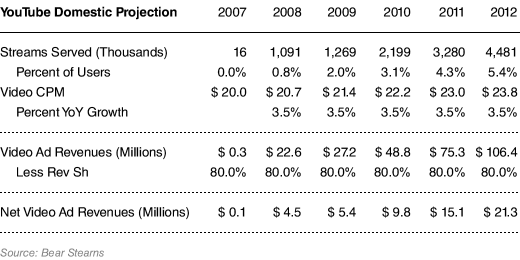
To quote the old guy in the Conan the Barbarian movie – WRONG!
In order to model out your CPMs, you should never ever do a straight calculation of:
Wrong revenue = CPM * impressions / 1000
The reason is that brand advertising is typically demand constrained – meaning that you need to field a big NYC-based sales team in order to do your sell, and as a result, you can only sell some percentage of your inventory. You can think of this process more like an enterprise sell, which scales revenue up with the number of sales folks you have.
Another corollary to this fact is that if you have a good CPM to start out with on one of these ad networks, don’t assume that the high CPM will continue as you scale up revenues. It’s easy to “tap out” ad networks, which gets you high CPM brand campaigns and turns into really crappy direct response campaigns.
Modeling brand ad sales as an enterprise sell
The right way to model out inventory is a number of equations – I’ll pretend that a site has two types of inventory, their “brand” stuff and their “direct response” (aka remnant) inventory:
Brand revenue = # campaigns sold * average campaign size * brand CPM
Direct response revenue = (total impressions – brand impressions) * remnant CPM
Total revenue = Brand + remnant revenue
In an actual forecast, you could get a ton more detail in the brand revenues side, since what you really care about is the # of ad sales people you have, how many campaigns they’re selling per quarter, the size, etc. Again, think of this as an enterprise sell, and treat it as such.
Similarly, if you were doing this for an entire site, you’d want more granularity. You’d approach this channel by channel, and do the CPMs and %s for each one. Inventory has different characteristics depending on ad placement, where you are in the usage of the site, and other factors. If you incorporate this into a grid, you can start to get a sense for how your different channels differ. That way, you can make the most accurate prediction possible.
Perhaps I’ll do a longer post on that at some point, with Excel spreadsheet attached ;-)
Faceoff between Facebook app analytics startups


New Facebook sub-sector
A sector has emerged recently that’s been interesting to follow – Facebook analytics companies.
These companies include:
It’ll be interesting to see where they go – I thought I’d elaborate a bit about the web analytics industry from my vantage point at digiMine, which later evolved into Revenue Science.
Evolution of web analytics companies
Early on the analytics space, there were a ton startups who wanted to get their hands on log files and pixel data. DigiMine was one of those companies, started by some data warehousing experts out of Microsoft led by Usama Fayyad (now Chief Data Officer at Yahoo). The idea was to do data analytics as a service, sucking in information about ecommerce, web traffic, as well as industry-specific data, and do all the math for companies – they were great at this.
Over time, however, the number of meaningful questions that customers wanted the analytics to answer went down – the focus became very much on web traffic, and specifically # of pageviews per day, # of sessions, and all the other common metrics you see on Google Analytics. As these metrics become more standard, then the customers (who were often larger F500 companies) started to buy based on "checklists" of features, rather than usability/UI, speed, or other important factors.
One problem for companies who took on the "high-end" approach of answering complex quesitons (often described as the most "powerful" queries) is that both the question and the answer elude the grasp of the end customer. If your end user doesn’t know how clustering algorithms work, it’s unlikely that they appreciate the value of software that does that for them, especially if there isn’t a direct ROI attached.
The space eventually devolved until a few winners emerged that satisfied the base requirements while supporting the infrastructure in a cheap, scaleable way.
What’ll happen in the Facebook analytics space?
If the Facebook analytics companies follow the same route, then you’ll see heavy competition as folks figure out what the core featureset required for the space. Once the basics are defined, then the next step will be for the companies who know how to scale the product to have a better cost model than everyone else.
Also, when doing a B2B infrastructure play, in a sense these small companies are taking a sector bet that all the apps in the Facebook economy will end up making some money. After all, if everyone’s just a small lifestyle play, there isn’t much revenue to go around in the apps world.
Net/net, the space seems like a challenging one – it’ll be fascinating to see where the web analytics analogy holds, and where it breaks. Analytics is seen as an important add-on and strategic entre into
other areas – will be interesting to see what emerges over time.