Archive for November, 2009
Checking out new mailing list on Lean Startups
I have been casually lurking on a new Google group focusing on the techniques around Lean Startups pioneered by Steve Blank and Eric Ries. Lots of fun conversations happening there.
Go here if you want to check out some of the threads going on. I’ve been following via the RSS feeds of new topics.
Here’s the info from the main site – thought I would give it a plug. The guy who runs it is named Rich Collins.
Let’s build a community focused on learning from lean startups.
I’ve recently been captivated by the ideas introduced by Steve Blank and Eric Ries. I’ve been reading their articles, watching their talks and listening to their podcasts. What I haven’t found is a community of other startup founders with a similar interest in lean startup strategies and tactics.
I would like to create a community centered around building lean startups. There will be a website with a forum, wiki, chat and Hacker News style social bookmarking. The focus will be on sharing battle stories and numbers from actual startup campaigns. I will also organize events for members to attend.
In true lean startup form, I created this website to gauge the interest in the formation of such a community. After 24 hours of having the site up, 131 people showed their interest by submitting their email address. As a result, I’ve created a Google Group where we can start the conversation.
Have fun! Hopefully there will be some interesting stuff to come out of it.
Product design debt versus Technical debt
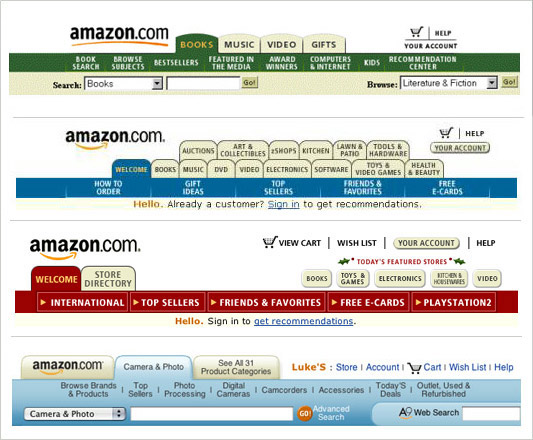
Amazon’s tabs are a classic example of product design debt and the refactoring process to pay it down
Incrementalism creates Technical Debt, and also Product Design Debt
Most startups these days build products using the various philosophies of agile – both in the formal sense but also the informal sayings of “deploy early and often,” “fail fast,” “ship and iterate,” etc. Coupled with A/B testing, customer development, and thinking through business problems in a scientific, hypothesis-driven way, you end up with a powerful cocktail of techniques to build a modern startup in the most iterative way possible. This kind of incrementalism is mostly great, and people should generally do more of it.
The interesting part is when you get a couple months into your product cycle. You often end up with lots of half-done experiments lying around, an infrastructure that isn’t built to scale, and a mishmash of code that needs to be refactored. Most engineers know that in this kind of a case, the best practice is NOT to rewrite your code, but rather refactor it continually and take down the so-called “Technical debt” so that it’s always under control.
However, there’s the other side of the coin, which is the product design. After you’ve added a ton of new features and stuck them all on the homepage, you create Product Design debt. The Amazon tabs at the top are a great example of this – you have a design philosophy built around tabs, you scale it as far as you can, and then you have to refactor your design.
Arguably, MySpace is a company that never paid down their product design debt, and their traffic has been impacted as a result.
Anyway, let’s dive into this topic more, starting with technical debt.
Technical debt
Most of my readers are probably familiar with the concept of technical debt, but just to re-summarize from this great article on the topic:
The first kind of technical debt is the kind that is incurred unintentionally. For example, a design approach just turns out to be error-prone or a junior programmer just writes bad code. This technical debt is the non-strategic result of doing a poor job. In some cases, this kind of debt can be incurred unknowingly, for example, your company might acquire a company that has accumulated significant technical debt that you don’t identify until after the acquisition. Sometimes, ironically, this debt can be created when a team stumbles in its efforts to rewrite a debt-laden platform and inadvertently creates more debt. We’ll call this general category of debt Type I.
The second kind of technical debt is the kind that is incurred intentionally. This commonly occurs when an organization makes a conscious decision to optimize for the present rather than for the future. “If we don’t get this release done on time, there won’t be a next release” is a common refrain—and often a compelling one. This leads to decisions like, “We don’t have time to reconcile these two databases, so we’ll write some glue code that keeps them synchronized for now and reconcile them after we ship.” Or “We have some code written by a contractor that doesn’t follow our coding standards; we’ll clean that up later.” Or “We didn’t have time to write all the unit tests for the code we wrote the last 2 months of the project. We’ll right those tests after the release.” (We’ll call this Type II.)
Of course, we are mostly interested in the second type. Eric Ries has a great article advocating for why it’s OK to Embrace Technical Debt. Another great article is from Joel on Software called Duct Tape Programmer. All of these articles are worth reading.
I won’t focus too much on the definition since those other posts do such a great job – instead, I think it’s worth talking about why an iterative approach tends to produce technical debt. I don’t think it happens all the time, but there’s always a temptation for it to happen.
Ultimately, the problem is that if you are trying to learn something about the business, and your technology is meant just to support that experiment, 99% of the time it’s not worth it to do things the “right way.” The reason is that you don’t know if something is going to work, and as a result, you don’t want to invest in scale or perturbing your entire codebase for something that might be disposable. So instead, you just put a 10% or 25% version of the product out there (now commonly referred to as the Minimum Viable Product) and do as little coding as possible to get there.
The problem is, when the feature is successful, very rarely is a team going to then go back and rewrite it – every experiment creates more questions, and the temptation is to move on to the next question.
Product design debt
A similar problem to this is Product Design debt, which impacts the user experience rather than the underlying technology. The same temptations that lead to technical debt also lead to product design debt, because it’s always harder to do things the “right way” and it’s almost never a rational investment of resources. Show me a site that has great visual appeal, and I’ll guarantee that they don’t A/B test.
Product design debt happens because of scenarios like the following:
- “I want to test this new feature, where should we put it? How about the tabs?”
- “Can we throw this experiment on the homepage and see if people click on it?”
- “Our navigation is kind of getting out of control, but if we fix it, most of the site’s features will lose a ton of traffic”
- “We just added a Lists feature and we want to promote it, can we just add a button next to everyone’s name?”
- “Yahoo just bought our startup and they are going to stick us on their homepage!”
(just kidding on the last one)
The point is, as a product experience grows deeper, at some point the initial design philosophy of just adding more links to a page or more tabs or more buttons just stops scaling. Yet it’s often hard to reorganize the whole site, especially if it means taking a short-term dip on traffic, so the “safe” thing to do becomes to incrementally add things until the user experience is horrible.
Kudos to Facebook for looking at their product and deciding that they needed to refactor everything first into a big newsfeed stream of “stuff,” and then all their features into a generic container of apps. They’ve also done a lot to actually remove options from the menu and navigation.
Why homepages becomes a Las Vegas visual experience
Incrementally-developed UIs that are never refactored often turn into a Las Vegas visual experience over time. Ya know, something that looks like this:

Why does Vegas look this way? I’d speculate that all these buildings are ultimately infringing on the public good of aesthetics, and light pollution becomes a tragedy of the commons. If all of those buildings were to power down, it may be that the relative distribution of business would remain the same, but we’ll never know since that will never happen :-)
Important navigational areas like homepages, inboxes, notifications, etc are all the same way. Each incremental menu item is not a big deal, and provides a lot of value downstream, but a slight incremental cost. But do this enough times, and you’ll start to pollute the overall design aesthetic, which is a public good that all features share.
For startups, this shouldn’t be a huge problem because you should have a product person who manages the whole experience and can resolve the public good problem. But there’s a danger in bottoms-up startup cultures where anyone can throw up an A/B experiment, which on one hand is great, but on the other hand creates UX pollution. The other class of cultures where this becomes a problem is short-term optimizing cultures, which may have a “feature of the week!” they want to focus on, which they need to exaggerate each feature each week.
For established companies with multiple teams competing with each other, this may become a key problem because then it really is a public good within the company.
Product types that are most susceptible to design debt
Ultimately, I think product experiences that provide a million little features are the ones that need to watch out the most.
This means:
- Social networking and Community sites that want to unify chat, forums, polls, videos, blogs, etc.
- Portals that want to unify news, communication, tools, etc.
- Games that want to unify lots of different missions, communication, characters, revenue-generating activities
- Retail products that want to unify lots of product categories and SKUs
- Classifieds sites that want to sell lots of different services, products, people, etc
All of the above products are hard to design for because they are meant to be open and support lots of diverse activities, but refactoring the UI constantly becomes a strong need as the initial navigation paradigms probably will not scale.
I wrote an article a while back specifically on social community sites, called Social Design Explosion.
Ideas for when and how to pay down product design debt?
For entrepreneurs out there who are building metrics-driven products but also committed to a great user experience, I would love to hear when and how you pay down the product design debt. Please comment!
Want more?
If you liked this post, please subscribe or follow me on Twitter. You can also find more essays here.
Adding design to an agile development process

Upfront design and agile don’t mix well
It’s an interesting problem to try and mix traditional design tasks – visual polish, user research testing, etc. – to an agile development process. A weekly development cycle doesn’t leave much room for several iterations of mockups, the immense effort of recruiting and interviewing users, and all these other important tasks.
Anyway, I was sent this recent link I’d encourage you to read on 12 emerging best practices for adding UX work to Agile development.
Here are the list of 12:
- Drive: UX practitioners are part of the customer or product owner team
- Research, model, and design up front – but only just enough
- Chunk your design work
- Use parallel track development to work ahead, and follow behind
- Buy design time with complex engineering stories
- Cultivate a user validation group for use for continuous user validation
- Schedule continuous user research in a separate track from development
- Leverage user time for multiple activities
- Use RITE to iterate UI before development
- Prototype in low fidelity
- Treat prototype as specification
- Become a design facilitator
In general, the best practices are about taking the down the level of fidelity in the design process and trying to work ahead of the engineers so that they get the fast feedback they need. Definitely worth reading.
The question that got me to leave Seattle for greener startup pastures

Seattle is a great tech city
Since I was 5 years old until 4 years after college, I called Seattle my home, and technology was intertwined with my childhood. As a kid, I found lots of avenues to my formative years in computing, including access to gopher and telnet via Seattle Community Network, the pre-web BBS scene, and a 5th grade classroom filled with Macs. As a college student, I got to work at various tech startups and ended up at a VC firm after I graduated. There’s not a lot of cities that have the ecosystem to have given me opportunities like that – maybe half a dozen at the most, and Seattle is certainly high up on the list.
Ultimately though, I left after 2006 – it took a lot of soul searching but ultimately one question got me over the edge. Let me explain what that was.
The question that got me to leave Seattle
As I pondered staying or leaving Seattle, I did a lot of thinking about the city from a startup context and what was working and not. Obviously it’s great to have companies like Microsoft, Amazon, Real, and others there – it produced a wonderful tech ecosystem that is thriving and growing every day.
But in late-2006, the social networking world had caught fire, and I wondered:
Post-bubble, when was the last time Seattle produced a world-changing consumer internet company?
And try as I might, I couldn’t shake the idea that while the rest of the tech world in California was producing YouTube, MySpace, Facebook, Google, and others, Seattle had Amazon and sort of stopped.
I wasn’t sure that I would be able to answer WHY, but I packed my bags and figured I’d figure out a theory at some point. A few years later, thinking about the question now, I think it has a lot to do with the kinds of companies being built in Seattle.
Different kinds of companies – Commerce versus Community
My current hypothesis is that Seattle has a strong history in retail and commerce, which has influenced the kinds of companies that are started there. Obviously you have Amazon, but you also have Eddie Bauer, Blue Nile, Nordstrom, Costco, Starbucks, and numerous other online/offline retail businesses there. There are also lots of transaction-focused startups based in real estate (like Redfin) or travel (Expedia).
These retail and transactionally-focused businesses are great money-makers, but because they target in-market buyers for a particular good or service, it means that you’re not really building a huge audience. You end up with the <10% of the general population that is in-market for buying a diamond or plane tickets or a house, not a viral and sticky UGC site you visit every day.
The classic way to build a huge audience is to focus on ad-driven businesses in the world of communication or content publishing, and there just aren’t that many of them in Seattle. (Though congrats to the Ben Huh for marching his horde of cats in this direction – the Cheezburger sites have the #1 traffic slot in Seattle right now) If you look at categories like social networking or YouTube or Twitter, these are more like everyday tools that hundreds of millions of people might use every day to communicate or find the content they want. Those are mass audience driven businesses and end up being high-variance outcomes – you end up with huge hits and also big failures because you need more money-losing years to build up the audience necessary to monetize at the rates you want. (just look at Imeem’s recent firesale even as they had amassed tens of millions of active users)
Different types of expertise – SEO versus viral/social
Similarly, the above influence also drives the skillset involved for one of the key startup goals: Driving traffic. My working hypothesis for Seattle is that it’s a very strong SEO-oriented community, and you have many of the top experts living and working there. The reason, of course, is that retail and transactional sites are mostly found via Google, and it makes sense to develop a skillset around getting that traffic for free rather than paying the search engine for it.
That’s great, but that also closes the door for the all-important knowledge of the viral loop that companies in social gaming are learning now, and what social networks companies learned before them.
For that reason, much of the social gaming and social network action happens down in the Bay Area.
Comments?
In short, years later I think I’ve mostly answered my own question – my hypothesis is that Seattle hasn’t produced mass audience consumer products mainly because it’s focused on down-to-earth charge-users-for-a-product types of businesses that are more transactional than community. I don’t think that’s a good or bad thing – just as you’ll get more biotech in Boston, there’s a specialization in Seattle around commerce/retail. But if you’re doing a social UGC thing, the Bay area is the best place to be.
Seattle folks (or otherwise): Do you agree or disagree with the above? Let me know in the comments – would enjoy hearing your thoughts.
UPDATE: For all the people who think I’m being a Seattle-hater, here’s a similar analysis for the Bay Area: Does Silicon Valley noise detract from long term value creation? It’s a related piece and discusses some of what I’ve noted since being down in SF.
Want more?
If you liked this post, please subscribe or follow me on Twitter. You can also find more essays here.
Why my blogging has sucked lately :)

I’ve been blogging less and less
As many of my readers may have noticed, I’ve been blogging less and less lately – it used to be multiple times a week, then it became once a week, and recently I’ve been blogging once every other week or so. I’m sure I can keep up that pace for quite a while, but it certainly makes for a less interesting blog :-)
Anyway, some of the reasons why I’ve slowed down in my blogging:
Blogging is more fun when you’re meeting people from lots of diverse companies and industries
When I was doing my Entrepreneur-in-Residence gig, I had an excuse to do lots and lots of meetings with people from across the digital media industry. On a single day, I might talk to companies in mobile, ad infrastructure, payments, social networking, games, and more. That was a great opportunity to blog because it’s easy to see connections and talk about ideas across industries. I don’t do this much anymore, so it’s harder to come up with these observations.
Getting deeper and narrower results in boring blog posts
Getting deeper and deeper in an area is a key part of the startup experience – you learn lots of weird things about your particular project, your particular target audience, and your specific industry. This doesn’t translate to great blog posts though, because most of what you learn there is completely inapplicable to other peoples’ situations. Instead, you get articles that are too “inside baseball” and esoteric.
Long blog posts are hard (and get harder over time)
Sometimes I really appreciate Twitter’s 140 character limit because it forces you to be short and sweet. A blog post, in particular my blogs, go the other direction. Over time, this has become a big pain in the ass since I’m not as comfortable posting one or two paragraph blog posts and instead go overboard with essays. I should probably just come up with a word limit and try to keep things down to a more reasonable size instead :-)
News-driven versus writing whatever
Another is getting inspired to write something – it’s a lot easier to write to comment on something in the news, versus just thinking about a particular topic and writing something great there. It’s always helpful to have some inspiration.
Potential changes?
From the above, it seems like a couple experiments might make sense. A big thing I should do is probably to write shorter things, and maybe do more news commentary. We’ll see if that helps at all :-)
Anyway, less excuses – back to blogging!
What I’m reading: Viral Loop by Adam Penenberg
Followup to Ning’s Viral Loop article
I was recently sent a copy of Viral Loop by Adam Penenberg, which just came out. I was first introduced to Adam in early 2008, when Marc Andreessen wrote us both while Adam was starting to write an article about Ning and their viral loops. That article was ultimately published in April 2008 as Ning’s Infinite Ambition, which you should read if you haven’t. After the article, Adam subsequently spent more time researching the topic, ultimately resulting in the book. I finished it and wanted to share a high-level summary and also talk through some points that the book brings up.
Summary
The book mostly covers a series of case studies from both offline and online companies. These include detailed dissections of viral companies from all stripes, including:
- Offline: Tupperware, Ponzi schemes
- Andreessen’s companies: Mosaic/Netscape, and Ning
- Bubble era companies: Hotmail, eBay, PayPal, HotOrNot
- Web 2.0 startups: Flickr, YouTube, MySpace, Bebo, Tribe, Tagged
- Widgets and apps, etc: Facebook, Slide, RockYou, Zynga
Some of the companies get pages and pages, and others just get a paragraph or two. But there’s a lot of stories that were new even to me, which is always a good sign, since I tend to love reading this kind of stuff.
The book also covers a bunch of high-level concepts about virality, such as the viral coefficient, viral loops, RockYou’s model for calculating virality, etc. All in all, a useful intro to all the major concepts in the field. It’s a great walkthrough of the history of viral companies since the late 90s when some of the formalizations started to happen.
Metrics-focused virality versus not?
One of the interesting distinctions that isn’t made in the book is the trend of startups who use quantitative techniques to optimize their virality versus products that went viral through other means. In particular, a lot of modern techniques are borrowed from the world of leadgen, ecommerce, and advertising, including:
- Formally defining landing pages (and using associated techniques)
- Creation and formal creation of funnels
- A/B testing
- Extensive use of analytics and targeting
- Deep understanding of email marketing, deliverability, and addressbook importing
From my personal experience, it seems like a lot of these ideas about virality ultimately originated from a few small teams here in the Bay Area who have now helped generations of viral companies succeed.
To me, the most important work in metrics-based viral marketing came from these companies below – I’ve listed the companies along with “descendent” startups who took the culture, playbook, and to build the next group of viral companies
- PayPal (Peter Thiel and Max Levchin)
- PayPal mafia (Slide, Yelp, YouTube, Linkedin, Geni, etc.)
- Jumpstart (Greg Tseng and Johann Schleier-Smith)
- Crushlink, Tagged, Hi5, others
- Plaxo (Sean Parker)
- Tickle (James Currier)
- Ooga Labs (Medpedia, Wonderhill)
- BirthdayAlarm (Michael Birch)
- Bebo, Flixster
There is lots and lots of overlap amongst this group above, and people cross-advise each others’ companies. Let me also caveat that the list isn’t exhaustive, and there are plenty of important VCs, advisors, and entrepreneurs that “get it” and help cross-pollinate between companies. In particular, I’ve found that the PayPal folks are involved in a tremendous number of companies in the Bay Area, and have been teaching their various companies to go viral for quite a while.
That said, I believe that the social relationships above have become less important over time to startups, as the knowledge around designing and optimizing viral loops has become more widespread. Certainly the Facebook economy has taught a wider generation of 20-something developers on how to build highly viral applications, with or without the help of the folks above. I’d note that some of them aren’t as numbers-oriented as copycat-oriented, but it’s still working for many people. As a result, I think the Bay Area is set up nicely to create the next generation of web companies as the bench in this area has gotten very deep indeed.
Who am I missing? Email me or let me know if I am in the comments. Or if someone on the above list would like to graciously identify who taught them the viral playbook, I can help trace the history further :-)
“Viral Loop” stays high-level
One aspect, both good and bad, about the Viral Loop book is that it stays pretty high level. As mentioned above, even after you understand what a viral loop is, you have to understand the tools of the trade well enough to go execute one. Learning the ins-and-outs of direct marketing takes a long time, especially to become an expert.
Adam does a great job keeping the book high-level and relevant to people both inside and outside of the industry, but certainly it doesn’t go into any of the details that have to be mastered to do the actual execution part.
It is for this reason that the total supply of viral experts will always be relatively constrained. Anyone worth their salt would likely be working on an amazing project, early on in the team, rather than working for an established startup. Instead, what tends to happen is that the community operates on a “money + knowledge” type of relationship, in which successful viral experts advise new startups to provide both angel investment and advisory.
The limitations of viral loops as a force multiplier
Another thing that isn’t discussed much in the book, which I think is very important, is the limitations of viral loops. The quantitatively marketed companies that I mention above certainly have their successes, but similarly, many of them are plateauing and failing as well.
The reason is that there are some important factors that are not well-understood by the extended community.
First, I refer to this great presentation by Siqi Chen (of Serious Business) and David King (of Green Patch), called Metrics for Social Games:
The first slide contains a deep truth: Metrics are a force multiplier. If you don’t have a great product, then you won’t get anywhere. But if you have a great product, then it help you build a huge business.
I’ve written about a similar concept in a blog post called Creating value versus optimizing revenue.
Hitting saturation in viral networks
Another important limitation is that there’s a finite number of users out there, and after you churn through all of them, all you have to look forward to is the long plateau. I first wrote about this in my post Facebook Viral Marketing: When and why do apps “jump the shark.”
I wrote that post back in March 2008, and a lot has happened on the Facebook platform since then. This includes an incredible growth rate of the underlying platform itself (now hitting 325 million monthly actives), the appearance of Social Gaming, and it turns out that the current model to beat on Facebook comes from Zynga. They get around the jumping the shark issue by releasing lots and lots of games – 17 on Facebook, 9 on MySpace, 8 on other networks, and 5 on iPhone. And more to come every day :-)
Although it doesn’t seem like much of a problem for most companies to hit the saturation ceiling in the networks they are operating in, it is a huge problem for VC-backed startups because then the story stops being about growth. So for the entrepreneurs who are working on their startups, it becomes important to hit a product/market fit early, and scale then, rather than prematurely going viral without a long-term product direction.
Buy the book here
Hope you enjoyed the post, and you can buy Adam Penenberg’s Viral Loop here.
Want more?
If you liked this post, please subscribe or follow me on Twitter. You can also find more essays here.
Are social gaming offers scamming users? A detailed analysis of Techcrunch’s Scamville article

omg she’s getting scammed by a duck!
Techcrunch on social gaming scams
As everyone knows, Techcrunch recently published a provocative article called Scamville: The Social Gaming Ecosystem of Hell. Most people will have already read this article, but just to summarize, Arrington argues the following:
- Social gaming companies (particularly Zynga) are making their revenues in a “completely unethical” way
- Users are getting scammed by the offers
- There’s harmful cycle where the scammiest companies earn more revenue, then buy more ads, then scam more people
- Similarly, some users opt in to offers and then cancel, lowering their value, driving out advertisers
- And finally, the industry is in total denial about this
It’s a compelling article, and I would encourage everyone to read it. There’s also another followup article on publishers who decided not to go the offers route, HotOrNot and PlentyOfFish.
Let’s dig in
I am very sympathetic to Arrington’s views, and investigated the issue over a year ago – here’s my blog post from August 2008 on the topic: Super Rewards and the leadgen side of Facebook virtual currency – can it last?
The more I dug into the issue, the more nuanced I decided it really was – things weren’t all bad, actually. In fact, I’ve come to believe that there are plenty of advertisers where this is working for them, plenty of consumers who are happy as well, though these offer guys are leaving a trail of unhappy users.
It’s clear that of all the issues, the user experience must be fixed. And after the user experience is fixed, I think we’ll still be left with a thriving industry, though people may be making less money than they are right now.
I want to drill into some of Techcrunch’s assertions and go one level deeper to look at the evidence.
It does makes the user experience suck
First off, I think everyone is clear that the way offers run right now, they are very confusing for users. If you search for “zynga sucks” on the Facebook.com domain, you get lots of angry complaints, most them about offers. In fact, I did an article a long time ago and got a bunch of random angry comments that clearly had just been searching for SuperRewards, completely unsolicited.
This was a long time ago, so I hope their service has changed a lot – but here’s a sample:
The post is in regards to Super Rewards. From a game user standpoint, I did the offers more when Super Rewards was not managing the offers. Super Rewards is slow to respond to problems from users, and requires proof of the completion of the offer in ways that the offer itself does not require you to do. For instance, to receive points a mini-game was played, many many offers were reviewed, then the game results were given. The offer states that the points would be awarded once the user reached the results page. If the points are not received, you are supposed to file a request for review. Well, Super Rewards would not take as proof of completion all the information from the results page. They even argued with what the results page displayed, even though it was cut and pasted directly from the site complete with the web address. Instead, they wanted two emails, one confirmation email and one confirmation of the confirmation email EVEN THOUGH DOING EMAILS WAS NOT REQUIRED BY THE OFFER.
Here’s more:
I got stung by them 10 days ago. 440 points for a Discover Card application. I applied, and I am holding the card in my hand RIGHT NOW. They say Discover has no record of recieving my info. Really? Well why did they send me a card then? A$holes.
As one of the ripped off customers of Super (assholes) Rewards on Facebook, I have to say that thier service is a total and utter crap to say the least. Of the offers I have spent time filliing in I have only recieved points for 2 out of the 20 or so offers that I have completed.
Any complaints either get a automated response or no response at all.
There are now groups being formed on Facebook complaining about this type of action. I hope the group action gets up and going, these crooks need to be shut down.
Clearly this is not what SuperRewards wants, nor their game publishers, nor Facebook. And like I said, I hope SuperRewards has cleaned up their service since then.
The folks over at Gambit have written a solid article addressing these issues head on, where they discuss 3 game ending user complaints:
- “I did your offer but didn’t get my points.”
- “I completed this offer even though it took forever and now I’m getting spammed.”
- “I completed this free offer and now I’m being charged all this money.”
The article goes on to discuss why resolving these issues is an important part of the game developers job, and how they can’t just say “oh that’s monetization” and not care about it. These user feelings ultimately come back into the game, and create problems long-term.
I would like to see more of the offers companies directly discussing and addressing the user experience problem openly – I think that will ultimately be the positive result of all of this dialog.
Everyone should be in agreement that the offers experience sucks, but no one is willing to do much because making these changes would mean a short-term monetization hit. It’s a Prisoner’s Dilemma where as long as the big offers providers continue in their ways, everyone wants to match them for competitive advantage. Thus my argument that the only player that’s able to get everyone in line would be Facebook.
It does seem to be working for advertisers
Arrington also makes the argument that the offers industry isn’t working for advertisers, and will eventually cause the monetization to crater. After talking to a lot of people on the issue, I just don’t know that it’s true, to my surprise.
Here’s the quote from the Techcrunch article:
And some users aren’t dumb, either. For every user who gets tricked into some fake mobile subscription, there’s another who can beat the system. That’s where the legitimate advertisers, like Netflix and Blockbuster, get hit. Users sign up for a free trial with a credit card, get their game currency, then cancel the membership and start over.
I specifically asked Jay Weintraub to look into this problem earlier in the year, and was genuinely surprised by the results. I figured that it was all a house of cards, but Jay came back to me with the idea that in fact it’s probably working (at least somewhat).
This is definitely required reading for anyone thinking about these issues. Jay did a great job breaking down the issues.
To summarize his analysis:
- The offers ecosystem on Facebook shares some surface similarities with the “Free iPods” incentivized offers industry that ultimately imploded (just read about Adteractive, Gratis, and similar companies for background)
- The volume of leads being produced by Facebook apps is so large that it’s unlikely that the crappy performance is just being hidden in the volume
- However, the pricing on Facebook will likely go down, and companies will make less money in the long run
- The offers may actually be performing, with the working hypothesis being that users actually choose the offer to fill out, versus the “Free iPods” case where they are run through a forced set of offers
- Also, long-term gameplay encourages accountability and repeat purchase
I think all the above points are surprising, and probably right.
Advertisers may reprice, rather than leaving Facebook
Arrington’s also argues that the bad leads will ultimately drive out all the advertisers. He writes:
Netflix has a policy of only paying for a user once. But game developers use a complex set of partner chains to launder these leads and try to get them through for payment. Netflix sees an overall lowering of quality and pays less for leads. Game developers, desperate to monetize, then search for ever more questionable offers to make up the difference. In the end, the decent advertisers are out, and only the worst of the worst remain.
My question is, why they won’t simply be repriced?
If an advertiser is buying leads at $3, but half the users cancel their orders, then why not just reprice down to $1.50? In fact, the best advertisers probably have the best products, and you might argue that their danger of cancelation is actually less than companies selling niche crappy stuff. Similarly, the Facebook leadgen infrastructure is now a big enough animal that advertisers may want to participate just to drive up volume. Even if an advertiser ends up with an additional $10M with no margin, they might do it anyway just to get more heft into their business.
So I agree with Jay’s argument that in the long-run, these leads just all get repriced, and the same set of advertisers (plus or minus) will remain.
Part of my positivity here is my direct experience buying Facebook advertising, which has actually been high-quality and high-conversion, for the most part. I think that the fundamental traffic is good, and thus the offer advertisers can see the same results, if they aren’t obnoxious about it.
It does create value, through product bundling
The other question is whether or not there is actually any underlying value to offers. And as I wrote in a post yesterday, offers theoretically should be good for everyone, the same way that Amazon and Netflix recommendations are good for consumers. The problem has been the execution, due to user experience issues.
Arrington seems to think, however, that getting users to pay more for the offer to subsidize the virtual good is a bad thing. He writes:
[…] Most of these offers are bad for consumers because it confusingly gets them to pay far more for in-game currency than if they just paid cash (there are notable exceptions, but the scammy stuff tends to crowd out the legitimate offers). And it’s also bad for legitimate advertisers.
I think the above statement doesn’t correctly describe how and why offers can add value overall. I won’t repeat the entire post here, except to give the outline of the argument:
- Amazon recommendations is good, and product bundling as a whole is good
- How do you define a “good bundle” versus bad? How will we target offers in the future?
- How does offer + virtual goods bundling actually work?
- Only 1% of people buy at an ecommerce site
If you haven’t read the article, check it out here.
What will happen next?
My working hypothesis is that the following things will happen – and it might take less than a year:
- The offers industry will continue to grow, the # of players will continue multiplying
- This will mean that the competition for doing leads will be cut throat, and no one will think long-term
- Ultimately, Facebook will intervene to preserve the user experience and make users feel safe in the checkout line
- If they decide not to do it themselves, they will heavily regulate the situation
- Otherwise, they will just make their own “clean” version, potentially by building out the Facebook ads into having landing pages, transaction forms, and redirects, rather than just sending clicks
Either way, I predict it will not end well for most of the leadgen players, unless they clean up fast.
If Facebook regulates, I would like to see them do something like this. Think of it as the FDA food packaging guidelines, but instead of calories it’ll talk about total cost to the consumer.
More reading
Here are some of the related articles that I would recommend anyone interested – they are from the view of the monetization gurus, and looking at advertiser-related performance, rather than user experience.
- Will social payment platforms really work long term? (guest by Jay Weintraub, leadgen expert)
- F*** your game offers (by Noah and friends at Gambit)
- Incentive Promotion 2.0 (also by Jay Weintraub)
- The impending doom of Facebook apps (by Niki Scevak, Jupiter Research)
- The economics of app monetization (with Noah Kagan, Gambit)
and two recent posts I just did related to the same Techcrunch article:
Want more?
If you liked this post, please subscribe or follow me on Twitter. You can also find more essays here.
How Facebook could clean up the offers industry

If Facebook doesn’t clean up the offers industry, then this guy will
As a quick follow-on of my last post on How social gaming offers create value for everyone, it strikes me that what the industry needs to survive for the long-term is for one of the big players to break out of the stalemate of zero information sharing, and start advocating for sustainability.
Why all the advertising and leadgen companies hide their information
One of the big problems for the advertising and leadgen industries is the massive lack of information sharing between different parties. The reason is that ultimately, there are really just two parties involved:
- The paying customer
- The company providing the end product or service
But then lots and lots of middlemen get involved, including:
- Agencies / SEMs
- Ad networks
- Publishers
- Infrastructure providers
- Data providers
- etc.
Everyone in that extended chain are just middlemen, and their job is that for every $1 of profit, they want to outmaneuver everyone else in the stack to get as much of that dollar as possible. So if an ad campaign is doing really well, the agency doesn’t want to tell the ad network, for fear that the ad network will raise their rates. On the other hand, the ad network can’t figure out which of the publishers in their ad network actually deliver good performance.
This all sucks, and requires a central party to think long-term. That player might ultimately just be Facebook, but could be a publisher like Zynga (though I doubt it).
What information could be worth exposing
In general, I believe the key to thinking long-term on the offers industry would be to expose all sorts of feedback information, out in the open, at a granular level.
Users would also be able to get information like:
- What are they actually signing up for?
- A standardized view of every offer, like a checklist, similar to FDA mandated food packaging guidelines:
- What is the 12-month cost of this offer?
- What is the $ value of this offer to the advertiser?
- Is this a subscription, yes or no?
- Am I going to get emails?
- Am I going to get a phone call?
- Is my information getting shared with any other parties?
- How can I cancel? (and this should be standardized too)
- How do other users feel about this offer?
- What is the cancelation rate?
- How do I get customer support if I opt in to this offer
- Every offer should link to an “advertiser profile” on Facebook, with comments, ratings, etc.
- Facebook should be able to instantly ban specific advertisers and offers from ever coming up across all of Facebook
For advertisers and everyone else, they would get to see information like:
- Where are my offers showing up? (by app)
- What kinds of users are filling out my leads? (demographics, geo, etc.)
- What is the $ incentive for users? (by app, by $ amount)
Similarly, there is soft information like:
- How are users rating the app?
- How do they feel about the particular offer?
- How often engaged are users? How much churn is in the app?
- How often do they repurchase virtual currency?
For all of the above, I think a lot of companies would hate it in the short run, and a lot of dollars might be banned, but long-term, this would be better for the overall ecosystem.
Let’s hope that something like this happens!
Want more?
If you liked this post, please subscribe or follow me on Twitter. You can also find more essays here.
How social gaming offers create value for everyone (not just Facebook, Zynga, and Offerpal)

The happy meal is the quintessential version of great product bundling
How offers add value
There have been a lot of conversations about the evils of offers in social gaming, and one thing that’s getting lost in the conversation is the potential for offers to actually generate value overall.
Ultimately, offers are about “product bundling” and it adds value to the economy the same way that any product bundling adds value – by giving people more of what they want, often for less. And naturally, some configurations of different bundles are more effective than others, as we’ll see below.
This post will touch on a couple topics:
- Amazon and “relevant” bundling
- How to define good product bundles
- What’s actually happening with offers and bundling
- Solving the 1% ecommerce problem at the Point of Sale
Let’s get started:
Amazon.com and product bundling
When you are shopping at Amazon.com, and you’re in the process of buying a book, and different book is recommended, how do you feel about that? And even more, if you happen to decide you like both books and want to buy them, and Amazon is willing to give you an aggregate discount, how do you feel?
I think that intuitively, the cross-sell and bundling that happens on Amazon is great for the customer experience, and exemplifies the good side of product bundling.
Here’s some additional information about it from Wikipedia:
Product bundling is a marketing strategy that involves offering several products for sale as one combined product. This strategy is very common in the software business (for example: bundle a word processor, a spreadsheet, and a database into a single office suite), in the cable television industry (for example, basic cable in the United States generally offers many channels at one price), and in the fast food industry in which multiple items are combined into a complete meal. A bundle of products is sometimes referred to as a package deal or a compilation or an anthology.
The article goes on to say that the strategy is most successful when:
- there are economies of scale in production,
- there are economies of scope in distribution,
- marginal costs of bundling are low.
- production set-up costs are high,
- customer acquisition costs are high.
- consumers appreciate the resulting simplification of the purchase decision and benefit from the joint performance of the combined product.
Note also there’s a darker cousin to the above, called Product Tying, in which the consumer is forced to buy the whole set and not just one. This can lead to crappier products becoming more successful, and is the kind of thing you can read about in DOJ monopoly cases.
When bundling is helpful
As mentioned in the list form Wikipedia, there are many situations when bundling is helpful to both the consumer and the business. The bundling is extra helpful when:
- The product being bundled “makes sense” to the consumer
- “Makes sense” often means a complementary good (drink+burger)
- Or, it might share the same context (2 of product X are better than 1)
- Clearly targets the same audience (people who like A also like B)
- etc.
- Also it can be a great bundle if it was something you were going to buy anyway – like if you put two items in your cart, hesitated and took one out, but were then offered the bundle together
Just as in advertising, you need to “target” your bundles and make sure they are as relevant as possible. If the industry continues to deliver irrelevant offers to consumers, then it’s no surprise that ultimately the whole thing will be written off.
I’m sure I am missing many other examples from above – please write in the comments if you have additional thoughts.
Product bundling in the offers and leadgen world
With the above points in mind, you can imagine what is happening behind the scenes in the leadgen/offers world for social gaming.
The product bundle ends up:
- X dollars worth of virtual currency
- Y dollars worth of bundled product (plus Z dollars of built-in marketing expense)
We can look at this from a couple points of view.
For the product seller, if you’re selling a product for $20, and it costs you $5 to make the item, then you have $15 worth of margin to spend on marketing and still break even. Thus as the product creator, you would be excited about buying up to $15 of virtual currency for the user, if it gets them to buy your product. And if you can buy even less currency for them, that generates profit for you and the leadgen networks and publishers between you and the user.
From the user’s perspective, the above deal can work well if the bundled product “makes sense.” If you were already going to buy a Netflix subscription, and you are being offered the same price and you get some virtual currency to your favorite social game, then that’s great.
So when Michael Arrington of Techcrunch writes that it’s bad for users to pay more for in-game currency than if they paid cash, I think that’s just misunderstanding how offers actually work in the aggregate economy:
In short, these games try to get people to pay cash for in game currency so they can level up faster and have a better overall experience. Which is fine. But for users who won’t pay cash, a wide variety of “offers” are available where they can get in-game currency in exchange for lead gen-type offers. Most of these offers are bad for consumers because it confusingly gets them to pay far more for in-game currency than if they just paid cash (there are notable exceptions, but the scammy stuff tends to crowd out the legitimate offers). And it’s also bad for legitimate advertisers.
How offers solve the 1% problem at Point of Sale
Ultimately, the biggest problem that offers solve for advertisers is the 1% problem of e-commerce. That is, at any given time, the number of people “in market” for anything is actually quite small, and the percentage chance that they will actually purchase something is also very small. As a result, if you are at a “Point of Sale” and they have their credit card out, you might as well try to cross-sell and bundle as much related stuff as possible.
The real skill and value created in all of this, of course, is in actually creating useful product bundles rather than the asinine ones I keep seeing. Social gaming and life insurance don’t mix, the same way that Free iPods and life insurance didn’t mix for incentivized leadgen.
This doesn’t mean that offers companies aren’t totally slimy and the industry isn’t broken
I want to make it clear that all of the above isn’t a judgement on whether the offers industry is working or not working. Frankly, it’s probably pretty broken (I’ll leave that discussion for another post). But I do believe that there is some fundamental value being generated, in the long-run, and someone will build a great company around dynamically creating and targeting product bundles at Point of Sale, wherever you are across the internet.
Whoever does figure that out will make a lot of money, and we’ll forget about all of this social gaming stuff.
Want more?
If you liked this post, please subscribe or follow me on Twitter. You can also find more essays here.