Archive for July, 2007
Wanna bet? In 1 year, will Facebook be bigger? Or will MySpace?
UPDATE: I lost. And bought Arjun a new iPhone. Congrats Arjun!
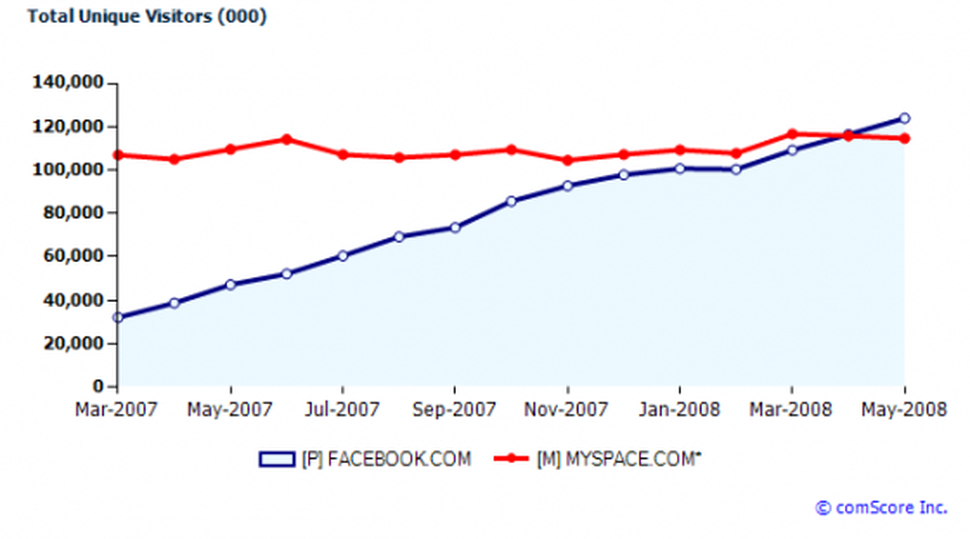
The bet: Which social network will be bigger?
Oh this will be fun ;-) My friend Arjun (ex-Amazon, currently at Zillow) and I had the following conversation when we were talking about widget development:
Andrew: why not be more excited about the myspace integration possibilities? that’s like a 5X bigger ecoysystem
Arjun: yuck.
Andrew: ??
Arjun: myspace already has too many issues
their UI is so cluttered that it would be impossibleAndrew: i think you might just be techno-elitist
Arjun: facebook is already getting cluttered
Andrew: which biases your business calculations
Arjun: yeah, that’s probably true..
Andrew: i mean, are you separating your business evaluation and your personal evaluation?
Arjun: but myspace is dead, man.
Andrew: thats so wrong lol
myspace is growing super fastArjun: facebook will be growing faster
dude, i’ll bet you that in 1 year facebook will be larger than myspaceAndrew: holy shit
absolutely
i’ll take that bet
what are we betting?Arjun: haha, are you serious?
Andrew: absolutely
Arjun: anything, what do you want
cash, fameAndrew: iphone
We later decided that the evaluation function would be:
Comscore numbers for 1 year from now, July 23rd 2008 12:28am
Monthly unique users for MySpace and Facebook
The current snapshot of numbers
And for those that are curious, here’s the current numbers stolen off a post by Eric @ VentureBeat: MySpace is over 2X larger (109MM instead of 47MM), the Facebook growth in the last month was 22% whereas MySpace’s was about 4.3%. If this rate were to continue, then Facebook would pass MySpace in about 7 months.
I’m betting that the growth slows considerably – in fact, I might have even taken this bet out to 18 months or more, whereas Arjun is betting that it’ll continue or accelerate.
What do you guys think? Which side of the bet would you take?
UPDATE: Couple more numbers: MySpace vs Facebook: MySpace declares Victory from Mashable and also Top social networks for engagement from Jeremy Liew
Fun Phishing quiz
Link: McAfee Phishing Quiz.
Wow this was really hard! I got 10/10 but I’ve been doing some reading on Phishing lately. Try it out and tell me what you get.
What’s your viral loop? Understanding the engine of adoption
What’s a “viral loop?”
A term I’ve heard tossed around frequently in real life, but not in the blogosphere is the term “viral loop.” In fact, when googling it, I only saw one mention from Jia Shen (cofounder of RockYou, with $120M raised from Sequoia/Softbank), a very smart guy:
“The viral loop of people inviting each other to most social networks revolves around a user posting a widget to their page and having friends see their page.
The viral loops for Facebook (there are multiple) revolve around the news feed, the mini-feed and the invite request. Not around people coming to your page and interacting with it”
Anyone who cares about this topic should read the entire VentureBeat article Q & A with RockYou — three hit apps on Facebook, and counting. And of course Jia is speaking at the upcoming Viral Marketing conference put on by Noah Kagan of CommunityNext.
To define the viral loop, you can think of it as:
The steps a user goes through between entering the site to inviting the next set of new users
Simple enough? Well, because this core loop is repeated so many times over generations and generations of users, getting it right is incredibly important.
What’s an example
Now let’s look at the viral classic, YouTube.
- Again, the first encounter will probably be a video embedded in a page
- If they like it, at the end of the video there’s an embed code that can be directly copied
- Or, if they don’t want to embed or e-mail that video, other videos are recommended at the end of the process so that people can try those, and potentially embed a different one
… and so on.
Building your own viral loop
Ultimately, viral loops are like induction proofs in that you are jumping to a steady state situation in which your viral widgets/emails/messages are already out there, and you are optimizing some set of steps that users have to jump through. Then, once you get this right, then you are figuring out how to build “on-ramps” into your viral loop so that you bootstrap the entire process.
1. What’s your viral media?
The first (and last) choice you have to make is where people are going to receive an entryway into your viral loop. That might be e-mail, Facebook newsfeed, or blogs. The main factors to evaluate here are how difficult it is to integrate your entryway into their surface, and the response rate. The first factor, integration, is obviously important because a difficult integration means that perhaps fewer people will see your messages, or your messages will be filtered out altogether. The second factor, response rate, depends on how in-your-face your messages are (think Facebook invites versus e-mail spam), and how competitive the medium is. Obviously, viral marketing is about a compounding viral growth rate, and if your response rates are low, that will mean a huge difference in outcomes.
2. What’s your funnel design?
The next choice to make is the design of your viral “funnel.” First off, you want it to be short and as accessible as possible, since each page is a barrier you’re asking your users to leap over. Assume up to 80% to 90% attrition if you are asking them to register for a username/password, for example. So if you can make it very short – 2-3 pages at most – with progressive commitment of personal information, you’ll get further along in your design. And obviously, you’d ideally want to test for drop-off at each point, and optimize each step as if it were a landing page.
As stated above, viral growth rate is a compounding process, so the difference between a 80% dropoff and a 50% dropoff is huge spread over 1000s of viral loops.
3. What’s the viral hook in your product?
Another important choice is product, of course. At the end of the day, a bad product can adversely affect your viral experience, because a poor slideshow (or a widget that no one wants) will lead to very few embeds. So picking something that is either a deep personal expression (music, avatars, slideshows, celebrity posters, etc) or a communication mechanism (voice messages, text, etc) are all great for getting people to WANT to put the apps on their homepages.
4. What are the onramps to your viral loops?
Once you’re done with a very tight viral loop, then it’s time to create the on ramps. In this case, you are looking at places like your website homepage, paid advertising, traditional marketing campaigns, SEO, etc, to create places where users can discover your viral loop and begin the process
That’s it!
Those are the basics of thinking through a viral loop. The best way to understand them is to browse MySpace or get spammed by invites to social networks, and then break down exactly the “funnel” they are trying to put you through.
IMHO, Tagged.com has a fascinating one to analyze, since they won’t even let you use the website without entering in your e-mail addressbook information. Definitely check out that one. They definitely short circuit the entire viral process by turning it from:
Register -> Use Product -> Evaluate Product -> Tell friends
to:
Register -> Tell friends -> Use Product -> Evaluate Product
In their case, it’s really irrelevant how good the product is – instead, the focus is just on getting that viral loop to be fewer than 2 pages, and increasing your “branching factor” by using addressbooks rather than asking users to recall their friends’ emails. Anyway, check that out and also try out some of the other very successful social networks.
See you at the conference!
UPDATE: Removed Slide.com widget example now that the links no longer work :(
Oh “SNAP” = Social Network Application
A new acronym brought to you by Chris Smoak
My friend Chris Smoak came up with a great acronym today, called “SNAP” meaning Social Network Application. I thought it was clever, so use it ;-)
I much prefer it over the “widget” terminology because widgets strongly underplay their sophistication and potential of what developers can create. I agree with Max’s idea that one day, someone will build World of Warcraft (or something of that complexity) into a social network.
SNAP: The next generation of UGC?
Social Networking Applications are the next evolution of User Generated Content.
In the first generation, it was all about text and graphics that were authored by users, going as far back as mailing lists and Usenet and eBay and all of that. Today, you still see a steady progression of that in richer and richer contexts, via video and slideshows, etc.
In the next generation, widgets are BOTH content and application logic, all rolled into one. It used to be that you would e-mail only pictures to people, but now on MySpace, you can message someone a YouTube video that has a mini-version of the website embedded into the player.
It strikes me that User Generation Content is opening up into User Generated Interaction, facilitated by these full-blown applications.
Functional apps versus decorative apps
One big distinction that has been enabled by Facebook (but arguably not from MySpace) is that there’s a new class of widgets that are functional in nature versus decorative.
MySpace widgets were all about pimping your profile – adding new decorations, glittery text, moving photos, and the like.
Facebook widgets, however, allow deeper integration points as to allow substantially different applications to be built. For example, let’s look at the list of applications tracked by Appaholic, a fantastic service that tells you what the most popular widgets are:
- Top Friends
- Graffiti
- iLike
- Fortune Cookie
- Horoscopes
- X Me
- SuperPoke!
- Video
- Free Gifts
- Movies
Of these, most of them are decorative or about “personal expression” more than anything else. I left those unhighlighted. The idea there is that people are likely to use them with or without close friends on the site, and it’s just about publishing to a 2 inch by 1 inch and that’s that.
What are functional SNAPs?
The ones that I highlighted, Graffiti, X Me, Superpoke, and Free Gifts are enabling new featureset on Facebook that has never been available before. These are truly user-generated interactions rather than purely content. It’s not just about a new way to present personal content, they are true applications.
And of course, I’m a huge fan of MySpace and love to argue with haters. In general, it’s true that a lot of the apps getting released on Facebook have existed, or could have existed, on MySpace for years. However, simply condoning widget developers rather than offering them a deep API to integrate into, they are missing the boat on a new generation of new functionality, rather than purely content.
The future of SNAPs
One random wild guess on the future of SNAPs will be that the social networks will hand over more and more control to people. Here would be the evolution:
- Allow people to put UGC data into templates (think eBay)
- Allow people to put UGC data onto their own pages
- Give people some small real estate to display applications (widgets)
- Give people entire pages and controls to display applications
- Let developers author entire sub-websites that run as apps?
Of course, this all assumes that these apps end up living as walled gardens within sites like Facebook. An equally interesting idea is if social networks become more distributed in nature, providing an underlying platform of user data, infrastructure, monetization, and other services – then you might be going to sites that are secretly Facebook widgets, but you’d never know as the user.
I have some pownce invites…
… if anyone wants to try it out. Just e-mail me (voodoo [at] gmail) and I’ll send it to ya!
Hope everyone had a great weekend ;-)
10% discount for registration in the next 24 hours, to the CommunityNext Viral Marketing conference

Intro to the CommunityNext Viral Marketing conference
I’m very excited to be advising a conference that my good friend Noah Kagan is putting together, sponsored by my current employer, the venture capital firm Mohr Davidow Ventures. So here’s a lengthy plug for the conference.
But first, let me cut to the chase:
10% discount on registration for the CommunityNext Viral Marketing conference
Here’s the schedule, which includes folks like:
- Jason Feffer, Former VP Operations for MySpace, and CEO, Sodahead: 0 to 90+ million users
- Jia Shen, CTO and co-founder of RockYou: 0 to 150+ million widgets
- Joe Greenstein, CEO and co-founder of Flixster, 0 to 20+ million users
- Ramu Yalamanchi, CEO and co-founder of Hi5, 0 to 50+ million users
- Jonathan Abrams, CEO of Socializr and ex-founder of Friendster
- Timothy Ferriss, NY Times Bestselling author of "4-hour Workweek"
- Eric Nakagawa, creator of the blog juggernaut, icanhascheezburger.com
- … and many others
What an amazing, amazing lineup.
Every web 2.0 entrepreneur needs viral marketing to succeed
Quite simply, EVERY internet entrepreneur should come to this conference. If your model is based on advertising, to make a real business you need massive scale in terms of traffic and users.
Real scale means 10s of milions of users, which you simply can’t buy. To use Google AdSense to buy as many users as you need, you’d be spending 10s of millions to acquire them, which is too much. Paid advertising simply doesn’t work there, which means you need huge, daily, organic growth.
Learn how to engineer viral growth
Viral marketing can be engineered. People are building custom analytics against repeatable viral processes (and "viral loops," as they call them) in order to drive that organic traffic. If you think that acquiring users is about making a great product, or just about making widgets, you’re missing out on the systematic techniques that the companies at this conference have used to drive tremendous traffic.
Distribution often beats quality product
In fact, in many cases the product is less important than how you get it out there. Take something like MS Paint or Notepad. These tools are ubiquitous, and millions of people use them even though there are FREE, better products out there, simply because they are the standard. In fact, that’s really what being "the standard" means – you have such great product distribution that you don’t need to worry anymore.
See you guys there!
The new web paradigm for 2007?

The new web paradigm?
Before, in 2006:
Take desktop apps and turning them into websites
Now, in 2007:
Take websites and turning them into Facebook widgets
I’m saying this half-jokingly, of course, but it’s a fun idea nevertheless.
How do you tell the difference between old Google employees and new ones?
It’s easy:
When you first meet them, this is what old Google employees (the ones with real options) say:
um yeah, I’m a software engineer for a company in Mountain View
whereas new ones say:
I’m a product manager at Google
Just a random observation :)