Archive for April, 2013
The death of RSS in a single graph
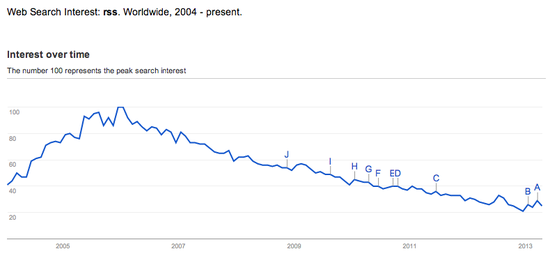
Google Trend graph for “rss” – bad news.
I recently wrote a blog post about moving all my RSS readers to email subscriptions, and I immediately got 30+ negative comments on it. Obviously it struck a cord. I still believe what I said, and here’s some more data and reasoning to back it up:
RSS has been dying for years
First off, the image above is the Google Trends search on “rss” over the last few years. That tells you how many people are searching for RSS on Google. To me, that’s the best indication that as a consumer-facing technology, there’s been waning interest for years. Does any blog want to bet on that as a long-term trend? Combine that with the imminent shutdown of Google Reader, and you can guess that a lot of folks using RSS readers will move to non-consumption rather than switching to an alternative. Yes, there will always be a vocal minority that loves feed readers, ultimately RSS will be more like QR codes or Segways than a mainstream technology.
Ultimately, my bet is that RSS will stick around but more as a way for content services to talk to each other – you’ll see random blogs appear in places like Flipboard or Zite automatically – but the idea that people will see the little orange RSS button and click on it is a lost cause. (Oh, and searches for “google reader” don’t fare well either)
RSS doesn’t have a reply function
Interactivity between a writer and their audience is is one of the most rewarding aspects of maintaining a blog. RSS was meant to be a different way to present content, and doesn’t have identity or interactivity baked in. One of the best aspects of email subscriptions (and Twitter) is that you can actually see who’s taken interest in your work. You can even reach out to them and start a friendly conversation. Some of the most important relationships in my career have been made over email and Twitter.
As I switch over to emphasize email, my hope is that I can increase the level of interactivity with my audience. The way its set up now, if you hit reply to any email post, write a quick note, it’ll go directly into my inbox unfiltered. And better yet, we might even have an intelligent conversation!
Moving off RSS will lead to better content
Feedback loops let you iterate on what kinds of content resonate with your audience. Writers need feedback loops to improve their writing – everytime a new essay is emailed to my readers, I get a ton of feedback. I know exactly who and how many folks have unsubscribed. I can reply to ask them why, by writing an email. I also know how many new people have subscribed, and often look at their email domains to figure out if they’re a corporate, a startup, a VC, etc. This kind of detail helps me write better content and get to know my audience. All good stuff. And obviously RSS is just about content, and doesn’t have this kind of feedback built in.
Consumers are moving to “integrated” readers
Related to the negative trend in RSS interest, consumers have adopting other platforms instead. RSS readers were invented in a different era. Blogger, TypePad, and WordPress were created in an era where we thought of blog networks as a bunch of standalone websites, decentralized, like the internet. But it turns out that’s not as easy to use as it could be. Turns out consumers love it when they can follow, view feeds, and create content, all on the same site. This is the core of the feed-oriented homepages of Twitter, Instagram, or Tumblr – the integrated reader has won out.
Email subscribers are 2x more active than RSS readers
The other thing I’ve noticed is that email subscribers are just stickier and more active. From my own personal data from my blog, I know that although I theoretically have 5x more RSS subscribers than email, from a traffic standpoint, the mass of RSS subscribers don’t make up for their numbers. On a per-email subscriber basis, I get about 2x the activity rate from people clicking links from RSS as compared to email.
So when it comes to the very practical question: When a blog is designed to prompt users to subscribe for future content, what should you push for? RSS or email? The answer is easy, go with email. In otherwards, in order for the numbers to work out, I’d need an RSS prompt to convert at 2x as email to get the same activity level. Given that the market size and interest in RSS is decreasing over time, and a small vocal minority uses an RSS reader, I think it’s pretty obvious where you want to go there.
Until RSS is redesigned (ha!), I repeat: RSS, I quit you. And if you have a blog, you should be thinking about this too.
Featured essays from 2011-2013: Facebook, Growth Hacking, Mobile, and more.

I’ve recently tried to recommit myself to blogging :) and as part of that, I pulled together my recent set of essays and redid the Featured Essays section of this blog. If you missed anything, check them out below- they are a collection of what I’ve written over the last 18 months or so. In the coming months, I hope to continue writing more about mobile, especially the nascent field of mobile marketing. Thanks for reading.
Oh, and if you are reading this from an RSS feed, please subscribe to email instead. I explain why here: RSS I quit you.
Growth
- Growth Hacker is the new VP Marketing
- You don’t need a growth hacker
- After the Techcrunch bump: Life in the “Trough of Sorrow”
- How do I balance user satisfaction versus virality?
Product/Market Fit
- 2011 Blogging Roadmap: “Zero to product/market fit”
- Minimize your Time to Product/Market Fit
- When has a consumer startup hit product/market fit?
- When does high growth not imply product/market fit?
- Does anyone care about your new product? (Doing market research with Google’s Keyword Tool)
- Has Facebook’s DAU/MAU always been ~50%?
Design
- How mobile startups can iterate better, faster, stronger
- Mobile app startups are failing like it’s 1999
- Don’t just design your product, design your community too
- What factors influence DAU/MAU? Nature versus nuture
- Strive for great products, whether by copying, inventing, or reinventing
- Why you’ll always think your product is shit
- Don’t compete on features
- Simple is Marketable
- Know the difference between data-informed and versus data-driven
- How to use A/B testing for better product design
Blogging
- How to write good and bad titles for your blog post
- How this blog grows: Evergreen content, Social whales, and “Don’t get bored”
- How to use Twitter to predict popular blog posts you should write
Industry and Investing
- Why are we so bad at predicting startup success?
- I’m a Google Glass skeptic and think it’ll be the next Apple Newton
- Why it’s hard to evaluate new social products
- Confessions of a Startup Seagull
- My friend Noah and his $100M lesson after being fired from Facebook
- Career Suicide versus Startup Suicide
- Stop asking “But how will they make money?”
- What makes Sequoia Capital successful? “Target big markets”
- The Law of Shitty Clickthroughs
- Visual Basic, PHP, Rails. Is Node.js next?
- Why I doubted Facebook could build a billion dollar business, and what I learned from being horribly wrong
- How sheep-like behavior breeds innovation in Silicon Valley
- “Anyone can start a Groupon!” and other startup myths
- When Does Paid Acquisition Work for SaaS Startups?
- Stanford CS major seeks sales/marketing monkey
Why developers are leaving the Facebook platform

Attitudes towards the Facebook platform have changed
Recently, Bill Gurley of Benchmark wrote a great piece on how platform companies like Facebook, iOS, Android, eBay, and others manage the ecosystem around them. It’s an important essay and I’d recommend you all read it. I found myself nodding my head as Facebook was discussed. In recent conversations with fellow entrepreneurs in Silicon Valley, it’s become a common belief that Facebook has become an undesirable platform for a startup to build their company.
Last month, I even heard one prominent VC even went so far as to say:
If your audience comes primarily from Facebook, that’s just uninvestable.
Ouch.
That’s a big shift from just 3-4 years ago when everyone was building Facebook apps and deeply integrating it into their products. I remember visiting a floor of an incubator where the head guy proudly said, “Everyone on this floor is working on Facebook apps.” And everyone thought that there was going to be a new thing, the “social OS” that was going to be the next layer of the internet.
So what happened? Why have developers soured on the Facebook platform?
Multiple factors in this analysis
The summary of the reasons why developers have increasingly left the Facebook platform for other platforms:
- Lack of virality
- Higher ad rates
- Constant retooling
- Competition
- The feed is finite
- Mobile platforms are the new sexy opportunities
This essay tries to elaborate on each of these reasons. Perhaps this will be educational for future platforms in how they work with developers, and hopefully Facebook will ultimately come to fix these issues. I don’t agree with all of these opinions, but in the spirit of comprehensiveness I’m going to document all the POVs I’ve heard.
Lack of virality
When the Facebook Platform first launched, it was the Wild West. You could do almost anything. I remember hearing that a lot iLike’s growth at the launch of the Facebook platform was because they figured out you could set up an invite screen with all your friends’ names pre-checked, and people would just click OK. It’d invite all of their friends, and the apps grew very fast. Turns out that sucks for UX, and it makes total sense for Facebook to turn that off, even if developers would rather have it there. Same with Zynga, and same with Viddy.
But now that those channels have all been dialed down, mostly for very legitimate reasons, it’s hard for even app that’s a “good actor” in the ecosystem to achieve sustainable viral growth. Many of the channels that existed last year no longer exist today, and they were taken out without replacements. So now that the excitement has faded, we’re back to launching mobile apps on Techcrunch and hoping to ride the iOS charts- that still seems to work for some people, and developers have started focusing there.
Higher ad rates
One way to view acquisition on Facebook (and Google, for that matter) is that there’s a organic marketing channel (via feeds and search results, respectively) and a paid channel, that blends paid content into the organic stuff. Back a few years ago, there was a ton of undervalued ad inventory on Facebook and a lot of companies went nuts on both the organic and paid channels. This was because Facebook took the long view in building up their ad infrastructure, and let people bid it up over time rather than sticking AdSense on all their pages. Facebook does a trillion pageviews a month, so it turns out there was a lot of cheap ad inventory. A lot of developers and advertisers were able to buy a ton of traffic cheaply, and arbitrage it against their virtual goods or ecommerce businesses.
That arbitrage began to fail as ad rates went up. And with decreased virality, the effective cost per customer also went up, because you were getting fewer “free” users as well. So now in 2013, that arbitrage is a lot harder to do profitably. In many ways, you can look at Zynga and Groupon as very successful one-time arbitrages on Facebook’s 1 trillion pageviews/month. They were able to buy 100M+ customers a few years back, but now that new user acquisition is much harder, they have to look elsewhere.
Constant retooling
I’ve heard the joke that the “Developer Love” email is scariest email you can get from Facebook, because it’s the one that tells you that your app needs to be substantially updated for a new set of APIs. Facebook has an amazing engineering culture driven by “Move fast and break things” but that means some of those things are often their developer partners’ apps. And you need to move as fast as Facebook to keep up. Just look at the Developer Changes page to see how often new things are released.
Part of this retooling means that there’s a maintenance tax on whatever app has been created on the platform, since you have to pull your prized engineers off their projects to do constant maintenance and reintegration into the new viral channels. That’s just to keep up. It also means that what works today may not work tomorrow. If you are making important decisions on staffing, business models, financing, then a lot of uncertainty is introduced because your business might get disrupted by platform changes happening in a few months.
Competition
It also turns out that at least for some categories of services, Facebook actually thinks about the competitive aspects of their product and it’s not just a completely open platform. If you talk with folks who are working on messaging or photos or even walkie-talkie apps, you’ll hear stories about how apps have been shut down. Turns out, especially because so many folks are working on mobile these days, that a lot of overlap gets created. I’ve even heard that Facebook isn’t letting some messaging apps buy advertising on their platform – not just turning off the APIs, but actually refusing to accept money for ads. Pretty interesting stuff.
The feed is finite
Many of the distribution issues on Facebook have to do with the fact that the feed is finite. A person will only look at the first 10 or 20 stories on any given visit, and anything you put into that grouping takes something out. This leads to all sorts of problems, because as users spend more time with Facebook, all sorts of new activity increases:
- They “like” more pages
- They add more friends
- They “subscribe” to more celebrities
- They try more apps
- They sign into more apps with Facebook
All of this means that there’s more potential things their newsfeed algorithm needs to sort out. Not only are there more actions people are taking, but there’s more advertisers buying “likes” and app installs. You end up competing with everyone else for a spot on the feed, and it’s a zero-sum game, as Michael Dearing pointed out to me on Twitter. All of this leads to the marketing channel getting saturated, which I’ve written about in my essay Law of Shitty Clickthroughs, and makes the channel less attractive as time goes on.
Mobile platforms are the new sexy opportunities
And finally, the very obvious thing is that developer attention has shifted over to mobile because that’s where the new successes live now. You might have read, for example, of Supercell’s recent $130M raise valuing the company at $770M. When’s the last time we heard about that for a Facebook app? And how many investors are willing to fund “Facebook apps” now? In my conversations with people, there’s still a lot of perceived opportunity in mobile, and people feel like there’s enough stability.
What’s next for the Facebook Platform?
The Facebook Platform has been an amazing success, in a lot of ways. No other company, with maybe the exception of Google, has given away so much free traffic to developers while asking for very little in return. So let’s not all be whiners here. Years after the platform launch, a lot has evolved, and as a community we’ve all learned a lot. One of those lessons: What makes developers happy and what makes for a great UX are very different things. Same with what makes Facebook a good business, rather than a platform for developers to suck out users.
Can Facebook regain the excitement around the platform that they had years ago? I think the answer is yes, but I think they have to figure out what kinds of apps they want build up on their platform, and really make those partners successful. Show us the existence proof that you can build something big and sustainable on there. Microsoft was an incredible platform because it spawned multiple public companies that built upon them – regardless of the fact they’d chase you down once you proved there was a billion dollar opportunity :) I think if the developer and startup community starts hearing about big successes on Facebook again, people will try it out. But in the meantime, the attention has shifted to where big opportunities are now, and that’s iOS and Android.
RSS, I quit you. Please subscribe to email updates for this blog instead.
The short version:
As of today, I’ve removed the links the RSS feeds on this blog, and ultimately will phase them out completely in favor of email. If you want to stay up to date, please switch to an email subscription instead- I usually don’t write more than once a week, sometimes once a month.
The long version:
Imagine a world where Google Reader and Feedburner are both shut down – that future is half true already. One clear outcome is that some of my favorite blogs – infrequent, high quality ones – end up getting a lot less traffic. They update infrequently, because they are run by individuals or companies who are really busy :) That’s where RSS subscriptions are really valuable. And their titles aren’t linkbait, because they’re not crazy focused on driving traffic.
Contrast that to blogs that publish a lot like Business Insider or Techcrunch. I think they’ll end up reaping the rewards of a world without RSS. And aggregators like Flipboard, Techmeme, or Hacker News will become even more important. These apps and blogs are now part of your daily habit, in a way where the infrequent/boutique blogs will never be.
Ultimately, there’s a hole in the market that needs to be filled. In the meantime, I can see a lot of blogs switching to email subscriptions and more aggressively submitting their content to aggregators or Twitter. I have 10,000s of subscribers on my RSS feed right now, and I wish I had gotten them all on email instead. Whoops. Rather than waiting for Feedburner to get shut down, I’m going to make the move to email instead. Today’s removal of RSS links is the first step towards that.
How this blog grows: Evergreen content, Social whales, and “Don’t get bored”
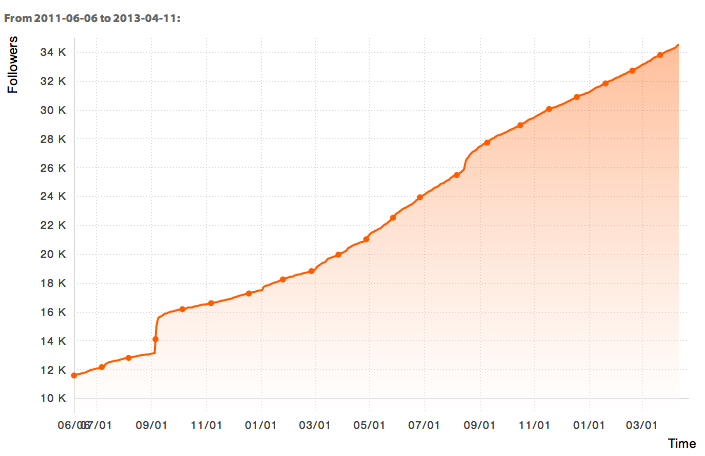
Above: My twitter followers graph for the last 2 years – it slowly grows, mostly from cross-sell from my blog to Twitter. People find it via SEO, then click the Follow button
Cold start sucks
Everyone who has tried to start a blog knows that the cold start problem is no fun. I spent about a year writing to an audience of about 10 people, including my sister and a few coworkers and friends. I inherently enjoy writing, so that was fine by me, but this phase often discourages people to write at all.
I’ve been writing this blog since 2007 and over time, have tried lots of little experiments on trying to grow the audience. I’ve built a modest sized audience with 50k+ followers/subscribers across RSS, email subscribers, and Twitter. Over the last year, I’ve stuck with one basic formula which has helped a lot, and I want to share it with you- here’s the components:
- Evergreen content
- Social whales
- Don’t get bored
Let’s talk about each one.
Evergreen content follows a Power Law curve
First off, it starts with the content. Just like anything else, there’s a Power Law curve, and a small number of my posts end up generating a very long tail of traffic over months and years. These are my “evergreen” pieces of content which creates a solid base of traffic for the blog even when I’m not particularly active with my blog. They often have a spreadsheet or presentation or some other kind of “asset” that makes it a useful post. Or it’ll define a commonly used piece of jargon that gets Googled, often as “how do I calculate X” for instance. Another strategy is to try a small tweet, and if if people seem to like it, I’ll turn it into a blog post (full discussion on that strategy here). And it may surprise you to know that the title of the blog post matters as much as the actual content of the post. That’s why the tweet-the-title-then-write-it strategy works so well.
The above strategy works because if you can only write every once in a while, you’re probably not going to be breaking news like the pro journalists. So instead you’ll have to differentiate on expertise and insight, rather than trying to tag along on whatever cool topic we are talking about these days. Drones. Bitcoin. Snapchat. Google Glass.
Viral spread of content on social platforms also follows a Power Law curve
The second thing, kind of obvious, is to share your content out to the various platforms after you write it. The less obvious thing is that you are better off “betting the farm” on one platform – say Twitter or Facebook or Linkedin – rather than trying to include links for all 3 and more. I focus on Twitter, and put a big follow button on the bottom of every one of my posts. Focus really helps because first off, the Power Law will show up again and you’ll find all your traffic comes from 1-2 sources anyway. And if you build up an audience and a consistent set of tools and techniques to spread your content on that platform, you’re better off.
Furthermore, even from an individual source of traffic, the distribution of followers on these social platforms also follows Power Law. Thus, it’s really important to have the “social whales” publish your content to their audience- that matters a lot. For me, the difference between a successful post (hitting 10,000s of people) or an unsuccessful one is often a few retweets from folks like Eric Ries, Hiten Shah, Dan Martell, and others. And often these kind of digital relationships are really built on real-life relationships, which is kind of ironic. As much as the world has become global, it’s still important to build real, authentic relationships with people in your field, and that can help with how many Twitter RTs you get.
And finally, don’t get bored
The hardest thing about maintaining a blog is that it’s hard to have something interesting to say every day. It takes years to build up a base of content, get inbound links for SEO, and create real-life relationships with folks in your industry. So rather than optimizing for posts that get traffic, ultimately I think you have to pick topics that you want to write about on a weekly basis and keep going.
How it all fits together
OK, so here’s the summary, in even more colloquial terms:
- Write evergreen content that people want to read now, but possibly a year from now (breaking “news” sucks, leave that for the pros)
- Push all of your content onto social platforms, and get people to retweet it
- This generates SEO, which brings in more people, which brings in more followers
- Rinse and repeat, and don’t get bored
Ultimately, there’s a loop in there that drives the accumulation of traffic, but the cornerstone to all of this is content that people want to read.
Why are we so bad at predicting startup success?

Startups and bad predictions
One of my favorite reads this year was Nate Silver’s The Signal and the Noise which has the subtitle “Why so many predictions fail, but some don’t.” It covers a ton of different topics, from weather to politics to gambling, and I couldn’t help but read it with a startup/tech point of view.
After all, the industry of technology startups is all about prediction- we try to predict what will be a good market, what will be a good product, as we “iterate” and “pivot” on our predictions. And of course the business of venture capital is even more directly about knowing how to pick winners- especially the seed and Series A investments.
And yet, we’re all so bad at predicting what will work and what won’t. I’ve written about my embarrassing skepticism about Facebook, but hey, I’m just a random tech guy. For the folks whose job it is to professionally pick winners, the venture capitalists, they aren’t doing very well either. It’s been widely noted that the venture capital asset class, after fees, has lagged the public markets- you’d be better off buying some index funds.
Startup exceptionalism = sparse data sets = shitty prediction models
One of the most challenging aspects of predicting the next breakout startup is that there’s so few of them. It’s been widely discussed that 10-15 startups a year generate 97% of the returns in tech, and each one seems like a crazy exception. And as an industry we get myopically focused on each one of them.
Watch Ben Horowitz elaborate on the sobering stats, starting at the 38:00 minute mark:
With these kinds of odds, our brains go crazy with pattern-matching. When a once-in-a-generation startup like Google comes around, for the next few years after that, we all ask, “OK, but do you have any PhDs on the team? What’s the ‘PageRank’ of your product?” And now that we have AirBnb, we’ve gone from being skeptical of designer-led companies to being huge fans of them. With so few datapoints, the prediction models we generate as a community aren’t great- they’re simplistic and are amplified with the swirl of attention-grabbing headlines and soundbites.
These simplistic models result in generic startup advice. As I wrote about earlier, there’s a whole ecosystem of vendors, press, consultants, and advisors who go on advice autopilot and give the same advice regardless of situation. Invest in great UX, charge users right away, iterate quickly, measure everything, launch earlier, work long hours, raise more money, raise less money – all of these ideas are helpful to complete newbies but dangerous when applied recklessly to every situation.
We all know how to parrot this common wisdom, but how do we know when we’re hearing good versus bad advice? If you think about the idea that there’s 10-15 companies every year who are breakouts, how many people really have first-hand experience making the right decisions to start and build breakout companies?
Hedgehogs and pundits
I was reminded for my dislike of generic startup advice when in his book, Nate Silver writes about hedgehogs versus foxes and their approaches towards generating predictions – here’s the Wikipedia definition on the concept:
[There are] two categories: hedgehogs, who view the world through the lens of a single defining idea and foxes who draw on a wide variety of experiences and for whom the world cannot be boiled down to a single idea.
Silver clearly identifies as a fox, and contrasted his approach to the talking head pundits that dominate political talk shows on TV and radio. For the pundits, the more aggressive, contrarian, and certain they seem, the more attention-grabbing they are. Rather similar to what we see in the blogosphere, where people are rewarded for writing headlines like “10 reasons why [hot company] will be killed by [new product].” Or “Every startup should care about [metric X]” or whatever.
This hedgehog-like behavior is amplified by the fact that there’s always pressure to articulate a thesis on what’s going on in the market. People in the press are always trying to spot trends or boil down complex ideas, and investors are constantly asked, “What kinds of startups are you investing in? Why?” And entrepreneurs are always forced to fit their businesses into the broader trends of the market, to find sexy competitors, all in the change to find a simple narrative that describes what’s going on.
The solution to all of this isn’t easy- to be a fox means to draw from a much broader set of data, to look at the problem from multiple perspectives, and to reach a conclusion that combines all of those datapoints. There’s been some great work on the science of forecasting by Philip Tetlock of UPenn, who’s set up an open contest to study good forecasting here. There’s an interview of him Edge.org here and a video describing some of his academic research below:
Worth watching.
My personal experience
Over my 5 years in Silicon Valley, the biggest lesson I’ve learned from trying to predict startups is calibration. They talk about it in the video above, but the short way to describe it is to be careful with what you think you know versus what you don’t. I’ve found that my area of expertise where I can make good decisions is actually pretty narrow- I’ve done a bunch of work in online ads, analytics, consumer communication/publishing, and I think my judgement is pretty good there, but it’s much shakier outside of that area.
When I do an analysis, I try to match my delivery with how much I think I know- and these days, it means that they sound a lot more tentative than the younger, brasher version of myself when I first came to SF. I’ve also tried to be diligent in my employment of “advice autopilot” – if I meet with entrepreneurs and find myself saying the same thing multiple times, then I try to refine the idea to take into account the specifics and nuances of that product. It’s easier, lazier, but less helpful to just say the same thing over and over again.
Be the fox, not the hedgehog.
My Quora answer to: How do you find insights like Facebook’s “7 friends in 10 days” to grow your product faster?

I recently answered a question on Quora and am sharing it on my blog:
How do you find insights like Facebook’s “7 friends in 10 days” to grow your product faster?
Here’s my thoughts below:
Why make a rule like this?
It’s important to remember the goal of making a pithy goal like “7 friends in 10 days” – it’s to help your team drive towards a clear objective. I’m sure “10 friends in 12 days” works well too, as does “5 friends in 1 day” but you just pick something that makes sense and easily memorable.
Anyway, here’s some thoughts about how to make something useful:
Defining the success metric
First, you need a way to evaluate how “successful” a user is, based on their behaviors. You might define this based on something like:
- days they were active in the last 28 days
- revenue from purchases in the last 28 days
- content uploaded in the last 28 days
- … or whatever else you want to define.
How do you figure out the right evaluation function? You just have to pick one, based on what makes sense for your business. There’s no one-size-fits-all answer here- you need to tailor this based on what makes your product work. In Facebook and Twitter’s cases, since they are ad-based models, they care a lot about frequency and engagement.
Exploring the data
Once you have a way to evaluate the success of a user, then you want to grab a cohort of users (let’s say everyone who’s joined in the last X days) and start creating rows of data for that user. Include the success metric, but also include a bunch of other stats you are tracking- maybe how many friends they have, how much content they’ve created, whether they’ve downloaded the mobile app, maybe how many comments they’ve given, or received, or anything else.
Eventually you get a row like:
success metric, biz metric 1, biz metric 2, biz metric 3, etc…
Once you have a bunch of rows, you can run a couple correlations and just see which things tend to correlate with the success metric. And obviously the whole point of this is to formulate a hypothesis in your head about what drives the success metric. The famous idea here is that, fire engines correlate with house fires, but that doesn’t mean that fire engines CAUSE house fires.
Running the regression
In some cases, it might be obvious that a particular metric correlates more strongly with your success metric than anything else. That helps you along. But if you want to get more formal, then you can do the kind of regression that David Cook describes.
The usual problem I’ve seen for startups is that there’s often not enough data, and too many variables, to be able to generate a really strong statistically significant model. And you can’t really tell your growth team “OK guys, active days is driven by friends, posts, likes, and 20 other factors. Let’s increase them.” Not very inspiring. So instead you’re just looking for something simple that explains enough of variation in success to rally your team behind it.
Verifying your model
After you’ve found the model what works for you, then the next step is to try and A/B test it. Do something that prioritizes the input variable and increases it, possibly at the expense of something else. See if those users are more successful as a result. If you see a big difference in your success metric, then you’re on to something. If not, then maybe it’s not a very good model.
“Branding” your model
Finally, once you’ve explored the data, run some regressions, and verified that your model works- then you have to be able to explain it to other people. So make it dead simple to talk about, repeat it over and over, and generally simplify it to the point where a lot of your growth product roadmap is focused on moving the metric up.
I got a startup pitch via Snapchat, here’s the story
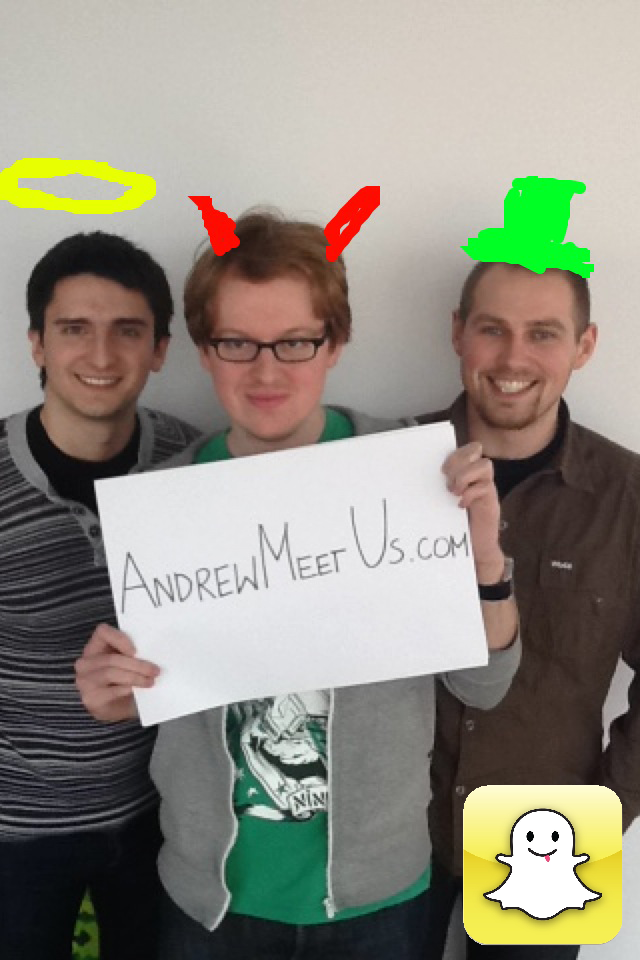
I’ve recently been asking my Twitter followers to add me on Snapchat, so I can build up a bigger addressbook there and have a more engaging experience. Even though my audience is skewed, it’s a way to attempt to break through into becoming an activated user. If you aren’t an activated users, social products can lack meaning, as I wrote about previously here.
To my surprise, after a few days, I got sent a URL to http://andrewmeetus.com, which turned out to be a new Polish team working on a local + social mobile app. Huge props for the cold snapchat pitch! I met them a few weeks later in Palo Alto, heard about their new product Nearbox, and congratulated them on their creative way to get my attention.
Last thing- feel free to add me on Snapchat, my username is andrewchen. Send me whatever!