Archive for May, 2012
Stop asking “But how will they make money?”

Business models are important, but today they’re commoditized
Let me first state: Business models are important. Of course businesses have to make money, that’s a given. But that’s not my point – my point is:
Business models are a commodity now, so “how will they make money?” isn’t an interesting question. The answers are all obvious.
So when you see the next consumer mobile/internet product with millions of engaged users, let’s stop asking about their business model expecting a clever answer – they’ll have dozens of off-the-shelf solutions to choose from – and instead, let’s start asking about the parts of their business that aren’t commoditized yet. (More on this later)
Outsource your monetization
Between the original dotcom bubble versus now, a lot has changed for consumer internet companies. Thankfully, monetization is now a boring problem to solve because there’s a ton of different options to collect revenue that didn’t exist before:
- There’s 200+ ad networks to plug into
- Payment providers like Paypal, Amazon, Stripe
- “Offer walls” like Trialpay
- Mobile payment solutions like Boku
- … and new services coming out all the time (Kickstarter)
Not only that, consumers know and expect to pay for services, something that was novel back in the late 90s. If you offer some sort of marketplace like Airbnb, they’ll expect a listing fee. If you are making a social game on Facebook, they’ll expect to be able to buy more virtual stuff. They’ll expect to pay $0.99 for an iPhone app.
Contrast this with the dotcom bubble, in which you were creating brand new user behavior as well as building these monetization services in-house. In eBay’s case, people just mailed each other (and eBay) money for their listings. Small websites had to build up ad sales teams in order to get advertising revenue, instead of plugging into ad networks. Building apps for phones involved months of negotiation with carriers to get “on deck.” At my last startup, an ad targeting technology company, we encountered companies like ESPN which had written their own ad servers because they didn’t have off-the-shelf solutions when they first started their website back in the late 1990s.
Let me repeat that: They wrote their own ad server as part of building their news site. And that means they had engineers writing lots of code to support their business model rather than making their product better.
Product experience renaissance
Let’s be thankful that we don’t all have to build an ad server every time our Ruby on Rails app is successful. This lets consumer product companies focus on what they’re best at. Also, building a new website doesn’t require $5M anymore. The number of risks in getting your company off the ground are vastly reduced when you combine cheap server hosting, an open source software stack, and multiple bolt-on revenue streams.
This frees us up to be able to work on what’s really important: Building and marketing great products.
These days, the primary cost for any pre-traction company is the apartment rent of the developers who are coding up the product. The profitability of any post-traction company is just based on how fast the team wants to ramp up headcount. If a team can hit product/market fit, a lot of other problems are taken care of.
The lesson behind Facebook’s $3.7B in revenue
Once upon a time, I was skeptical about Facebook’s business model because they received a mere 0.2 cents in advertising revenue per pageview they generated. In 2006, I calculated that maybe they could generate $15M in revenue per year maximum – a nice business, but not a world-changing one. I wrote about this topic here: Why I doubted Facebook could build a billion dollar business, and what I learned from being horribly wrong.
As I wrote in my post, it turns out I was wrong, and Facebook in fact generated $3.7B in 2011 and will generate more than $5B this year. I was wrong in an interesting way though – it turns out that they didn’t dramatically increase their revenue per pageview, but rather they just grew and grew and grew, to ~1 trillion pageviews/month. My mental model was all wrong.
In fact, we have a lot more experience with advertising and transaction based models. It’s pretty clear that an engaging social website will have 0.1% to 0.5% CTRs on their ads, and net an average $0.50 CPM. If you sell something, or have a freemium site, then you can expect 0.5% to 1% of your active users to convert. There’s lots of benchmarks out there, which I discuss in this older blog post. The point is, if you have the audience, you can find the revenue – it’s getting the big audience that’s the main problem.

The last dotcom bubble conditioned many of us to think about a different world than the one we face today. In 1997, there were a mere ~100M users on the internet, mostly on dialup modems. Let me repeat that: The entire dotcom bubble, with all of its bubbly goodness, was based off of 100M dialup users. Compare that to today, where we have 20X that number, over 2 billion users on broadband and mobile. The graph, courtesy World Bank via Google, is incredible.
The point is, the consumer market has grown by so much that the upside opportunity is tremendous if you get a product exactly right. Given all the growth opportunity, and given the plug-in revenue models, the main bottleneck for building a great company doesn’t seem to be the business model at all.
In fact, the business model seems like a second or third order problem. So again, I argue, let’s stop asking about it.
At over 450 million uniques per month, let’s stop wondering what Twitter’s revenue model will be. Obviously it will be some form of advertising, and maybe they’ll experiment with freemium or transaction fees somehow. You can debate if you think they will ultimately be a $100B company or a $10B one, but let’s skip the conversation on whether or not they’ll fail because they don’t have a business model.
The new question to ask
If you agree with me that business model is no longer a first-order question, then what’s the real question to ask? The thing that makes the business model work is really about getting to the scale where the business model becomes trivial.
Let’s ask a more important question:
Could this product engage and retain 100s of millions of active users?
For the first time ever, hitting 100+ million active users is actually realistic. First off, how incredible is that? In recent years, many startups have done it, such as: Zynga, Facebook, Twitter, Groupon, Linkedin, etc. I think we’ll also see Dropbox, Pandora, and others get there too.
For an early stage company, asking this question is really just a test of the team’s ambition, their initial market, and an evaluation of their product/market fit. Obviously if their product isn’t working, they won’t even be close.
Once a startup has product/market fit and is scaling, then the answer to this question revolves around marketing and technology competence. Also, the product might have to evolve as the initial market gets saturated- like Facebook with college and Twitter with their early adopter audience.
To sum this all up:
- Making money as a business is important, but commoditized
- You can plug into 100s of options for monetizing an audience, if you have one
- We’re working with 20X the internet audience compared to the dotcom bubble, and 1/10 the cost of starting a company
- Facebook is hitting $5B in revenue via sheer growth, not monetization innovation
- You should aim to hit 100 million active users, and get an off-the-shelf monetization solution later
- Evaluate new companies on market size and ability to grow to 100 million actives, rather than monetization methods
Know the difference between data-informed and versus data-driven

Metrics are merely a reflection of the product strategy that you have in place
Data is powerful because it is concrete. For many entrepreneurs, particularly with technical backgrounds, empirical data can trump everything else – best practices, guys with fancy educations and job titles – and for good reason. It’s really the skeptic’s best weapon, and it’s been an important tool in helping startups solve problems in new and innovative ways.
It’s easy to go too far – and that’s the distinction made between “data-informed” versus “data-driven,” which I originally heard at a Facebook talk in 2010 (included underneath the post). Ultimately, metrics are merely a reflection of the product strategy that you already have in place and are limited because they’re based on what you’ve already built, which is based on your current audience and how your current product behaves. Being data-informed means that you acknowledge the fact that you only have a small subset of the information that you need to build a successful product. After all, your product could target other audiences, or have a completely different set of features. Data is generated based on a snapshot based on what you’ve already built, and generally you can change a few variables at a time, but it’s limited.

This means you often know how to iterate towards the local maximum, but you don’t have enough data to understand how to get to the best outcome in the biggest market.
This is a messy problem, don’t let data falsely simplify it
So the difference between data-informed versus data-driven, in my mind, is that you weigh the data as one piece of a messy problem you’re solving with thousands of constantly changing variables. While data is concrete, it is often systematically biased. It’s also not the right tool, because not everything is an optimization problem. And delegating your decision-making to only what you can measure right now often de-prioritizes more important macro aspects of the problem.
Let’s examine a couple ways in which a data-driven approach can lead to weak decision-making.
Data is often systematically biased in ways that are too expensive to fix
The first problem with being data-driven is that the data you can collect is often systematically biased in unfixable ways.
It’s easy to collect data when the following conditions are met:
- You have a lot of traffic/users to collect the data
- You can collect the data quickly
- There are clear metrics for what’s good versus bad
- You can collect data with the product you have (not the one you wish you had)
- It doesn’t cost anything
This type of data is good for stuff like, say, signup %s on homepages. They are often the most trafficked parts of the site, and there’s a clear metric, so you can run an experiment in a few days and get your data back quickly.
In contrast, if you are looking to measure long-retention rates, that’s much more difficult. Or long-term perceptions of your user experience, or trying to measure the impact of an important but niche feature (like account deletion). These are all super difficult because they take a long time, or are expensive, or are impossible datapoints to collect – people don’t want to wait around for a month to see what their +1 month retention looks like.
And yet, oftentimes these metrics are exactly the most important ones to solve.
Worse yet, consider the cases where you take a “data-driven” mindset and try to trade off the metrics between concrete datapoints like signup %s versus long-term retention rates. It’s difficult for retention to ever win out, unless you take a more macro and enlightened perspective on the role of data. Short- vs long-term tradeoffs require deep thinking, not shallow data!
Not everything is an optimization problem
At a more macro level, it’s also important to note that the most important strategic issues are not optimization problems. Let’s start at the beginning, when you’re picking out your product. You could, for example, build a great business targeting consumers or enterprises or SMBs. Similarly, you can build businesses that are web-first (Pinterest!) or mobile-first (Instagram!) and both be successful. These are things where it might be nice to have a feel for some of the general parameters, like market size or mobile growth, but ultimately they are such large markets that it’s important to make the decision where you feel good about it. In these cases, you’re forced to be data-informed but it’s hard to be data-driven.
These types are strategy questions are especially important when the industry is undergoing a disruptive innovation, as discussed in Innovator’s Dilemma. In the book, Clayton Christensen discusses the pattern of companies who are successful and build a big revenue base in one area. They find that it’s almost always easier to increase their core business by 10% than it is to create a new business to do the same, but this thinking eventually leads to their demise. This happened in the tech industry from mainframes vs PCs, hardware vs software, desktop vs web, and web vs mobile now. The incumbents are doing what they think is right- listening to their current customer base, improving revenues from a % basis, and in general trying to do the most data-driven thing. But without a vision for how the industry will evolve and improve, the big guys are eventually disrupted.
Leverage data in the right way
It’s important to leverage data the same way, whether it’s a strategic or tactical issue: Have a vision for what you are trying to do. Use data to validate and help you navigate that vision, and map it down into small enough pieces where you can begin to execute in a data-informed way. Don’t let shallow analysis of data that happens to be cheap/easy/fast to collect nudge you off-course in your entrepreneurial pursuits.
Facebook on data-informed versus data-driven
I leave you with the Facebook video that inspired this post in the first place – presented by Adam Mosseri. He uses the example of multiple photo uploads, and how they use metrics to optimize the workflow. Watch the video embed below or go to YouTube.
What makes Sequoia Capital successful? “Target big markets”
Don Valentine, who founded Sequoia Capital, talks about what makes Sequoia Capital effective. It’s one of my favorite talks, and I find myself watching and re-watching it from time to time, and I’d encourage everyone to hear the wisdom themselves.
Markets, not team
In the beginning of the video, Don Valentine asks, why is Sequoia successful? He says that most VCs talk about how they finance the best and the brightest, but Sequoia focuses instead on the size of the market, the dynamics of the market, and the nature of the competition.
This is, of course, super interesting because in many ways it’s contrarian to the typical response that investing is all about “team.”
Creating markets versus exploiting markets
Another choice quote: “We’re never interested in creating markets – it’s too expensive. We’re interested in exploiting markets early.”
In consumer internet, when the divisions that separate product categories are so fuzzy, it can be hard to understand when you’re creating a market versus when you’re attacking an existing one. My rule of thumb is that:
If people know how to search for products in your category then you are in an existing market.
I’ve written more about this in posts here and here
Watch the video of Don Valentine of Sequoia capital on “Target Big Markets” on YouTube or in the embed below:
How to use Twitter to predict popular blog posts you should write

Using retweets to assess content virality
Recently I’ve been running an experiment:
- Tweet an insight, idea, or quote
- See how many people retweet it
- If it catches, then write a blog post elaborating on the topic
My recent Growth Hacker post was the result of one such tweet, which you can see above in my Crowdbooster dashboard. I wrote it on a whim, but after the retweets, I developed it into a longer and more comprehensive blog post. (Note that sometimes a tweet is not suitable to developed into a blog post, but most of the time this technique works)
Why this works
This works because the headline is key. It spreads the content behind it.
This is especially true on Twitter, but it’s also true for news sites that will pick up and syndicate your content. If that headline is viral and the content behind it is high quality, there’s a multiplier effect – sometimes a difference of 100X or more. Naturally, you want to optimize the flow of how people interact with your content, starting with what they see first: The title.
After all, what’s a better test for whether the following will be viral:
New blog post: Growth Hacker is the new VP Marketing [link]
than the tweet:
Growth Hacker is the new VP marketing
It’s a natural test.
I’ll also argue that if you can express the core of your idea in a short, pithy tweet, then that’s a good test for whether the underlying blog post will be interesting as well. Great tweets are often provocative insights or mesmerizing quotes, and there’s a lot to say by examining the issues more deeply. Contrast this to writing a long, unfocused, laundry-list essay examining a topic from all angles, taking no interesting positions or risks along the way – now that’s a recipe for boredom.
Combining virality with a high-quality product, of course, is the key to a lot of things – not just blogging :)
Don’t waste your time writing what people don’t want to read
Testing your ideas like this allows you to invest more time and effort into the content – a clear win.
Personally, I love writing long-form content that dives deep into an area, and also enjoy reading it as well. Unfortunately, writing a blog post often takes a long time – an hour or more. Use this technique to make it safer to spend more time, think more deeply, and research more broadly on you write. In my experience, writing a high-quality, highly retweetable blog post once per month is better than writing a daily stream of short, low-quality posts that no one will read. Plus, it takes less time.
As a smart guy once said: “Do less, but better.”
Quora: Has Facebook’s DAU/MAU always been ~50%?
I recently asked, and then answered my own question on Quora and wanted to share here as well.
Has Facebook’s DAU/MAU always been ~50%?
According to public info, Facebook’s DAU/MAU is 58% these days. Here’s a link.
It states:
- 901 million monthly active users at the end of March 2012
- 526 million daily active users on average in March 2012
Has Facebook’s DAU/MAU always been this good, as a consequence of its product category (communication/photo-sharing/etc.)? Or was it once a lot worse and was improved over time?
(UPDATE: Here’s a followup question I have about the same topic- Was Facebook’s DAU/MAU ~50% prior to launching the Newsfeed in 2009?)
Answer: Yes, Facebook’s DAU/MAU has been close to 50%, at least since 2004.
Based on their media kit from 2004, their DAU/MAU was already 75%.
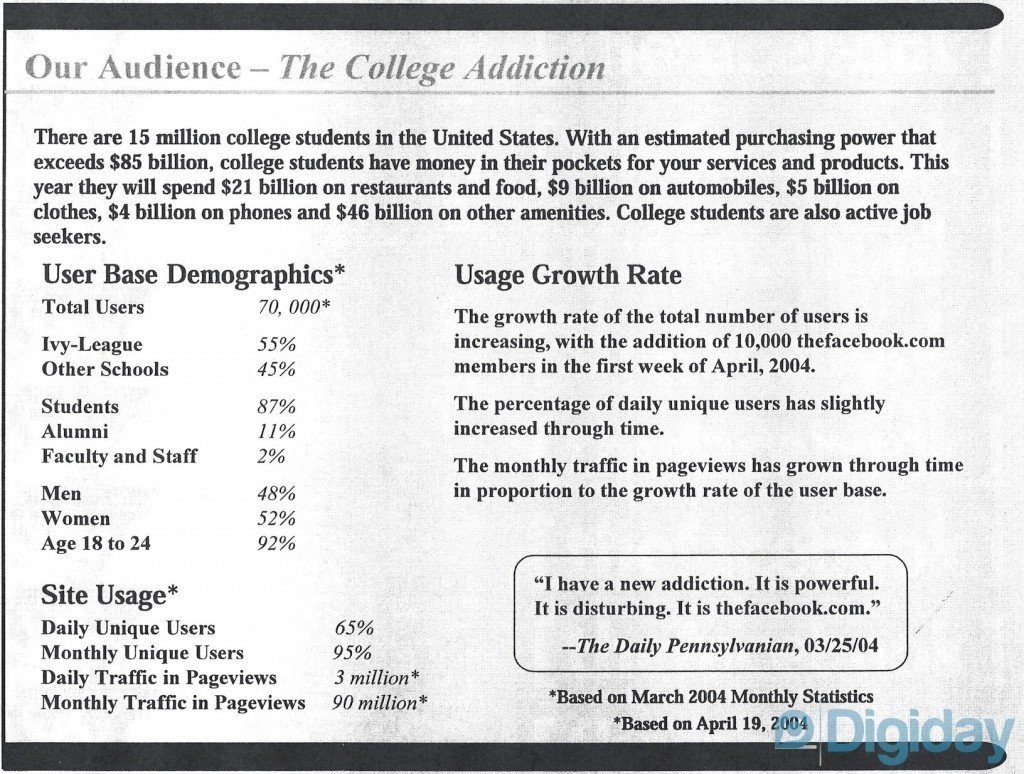
Since this media kit, their DAU/MAU data has been included in their financials since 2009. However, I theorize that Facebook’s DAU/MAU has always been high as a natural outcome of the communication-oriented usage of the product. Contrast this to a product category like ecommerce which you are unlikely to use and purchase with every day.
In their recent financial filings, the following chart is shown for Facebook’s DAU and MAU since 2009:

If you do a graph of the DAU/MAU on this data, since 2009, you’ll see that it starts around 45-47% and goes up to a very impressive 58% recently.

(As an aside, another interesting aspect is that Facebook’s MAU growth looks pretty much like a straight line, and so the % growth has been slowing down as of late. The MAU growth was around 23% starting in 2009, but is now down to 6-7% in recent months. See below for a graph on MAU vs % MAU growth)

How do I learn to be a growth hacker? Work for one of these guys :)
After writing my recent article on Growth Hackers, I’ve been asked by quite a few folks on how to learn the discipline. The best answer is, learn from someone who’s already good at it – if you’re technical and creative, it’s well worth the time.
I would encourage everyone to also read Andy Johns’s Quora answers on What is Facebook’s User Growth team responsible for and what have they launched? and
What are some decisions taken by the “Growth team” at Facebook that helped Facebook reach 500 million users?– it lays out a lot of the key activities used in a well-run growth team.
The list below includes some of these folks I know personally, some just by reputation- but collectively they’ve grown products up to millions, 10s of millions, and in some cases, 100M+ users. Typically they use quantitatively-oriented techniques centered on virality across different channels such as iOS, Facebook, email, etc. There’s lots of iteration, A/B testing, and experimentation involved. There’s also really great growth hackers centered around SEO, SEM/ad arb, and other techniques, but for the most part I’m just listing out the folks around quant-based virality. The important thing about virality is, it’s free :) So it’s an important skill for startups.
Missing from this list are many unsung heroes over at Zynga, Dropbox, Branchout, Viddy/Socialcam, lots of ex-Paypal/Slide people, etc., etc. Also, all of these guys typically have co-founders or entire growth teams around them that are experts, even if I don’t know them by name.
If others in the community would like to make suggestions, tweet me at @andrewchen or just reply in the comments.
| Name | Background | |
| Noah Kagan | AppSumo, Mint, Facebook | noahkagan |
| David King | Blip.me, ex-Lil Green Patch | deekay |
| Mike Greenfield | Circle of Moms, ex LinkedIn | mike_greenfield |
| Ivan Kirigin | Dropbox, ex-Facebook | ikirigin |
| Michael Birch | ex-Bebo, BirthdayAlarm | mickbirch |
| Blake Commegere | ex-Causes/Many games | commagere |
| Ivko Maksimovic | ex-Chainn/Compare People | ivko |
| Dave Zohrob | ex-Hot or Not, MegaTasty | dzohrob |
| Jia Shen | ex-RockYou | metatek |
| James Currier | ex-Tickle | jamescurrier |
| Stan Chudnovsky | ex-Tickle | stan_chudnovsky |
| Siqi Chen | ex-Zynga | blader |
| Ed Baker | esbaker | |
| Alex Schultz | alexschultz | |
| Joe Greenstein | Flixster | joseph77b |
| Yee Lee | yeeguy | |
| Josh Elman | Greylock, ex-Twitter | joshelman |
| Jamie Quint | Lookcraft, ex-Swipely | jamiequint |
| Elliot Shmukler | eshmu | |
| Aatif Awan | aatif_awan | |
| Andy Johns | Quora, Twitter, Facebook | ibringtraffic |
| Robert Cezar Matei | Quora, ex-Zynga | rmatei |
| Nabeel Hyatt | Spark, ex-Zynga | nabeel |
| Paul McKellar | SV Angel, ex-Square | pm |
| Greg Tseng | Tagged | gregtseng |
| Othman Laraki | othman | |
| Akash Garg | Twitter, ex-Hi5 | akashgarg |
| Jonathan Katzman | Yahoo, ex-Xoopit | jkatzman |
| Gustaf Alstromer | Voxer | gustaf |
| Jon Tien | Zynga | jontien |
UPDATE: My friend Dan Martell’s new company, Clarity, provides a way to access experts like this via phone and email. Here’s the directory of folks with expertise on growth.