Archive for July, 2018
DAU/MAU is an important metric to measure engagement, but here’s where it fails

How DAU/MAU got popular
DAU/MAU is a popular metric for user engagement – it’s the ratio of your daily active users over your monthly active users, expressed as a percentage. Usually apps over 20% are said to be good, and 50%+ is world class.
How did this metric come into use? DAU/MAU has been a popular metric because of Facebook, which popularized the metric. As a result, as they began to talk about it, other consumer apps came to often be judged by the same KPIs. I first encountered DAU/MAU as a ratio during the Facebook Platform days, when it was used to evaluate apps on their platform.
Get new updates, usually once a week – featuring long-form essays with what’s going on in tech.
This metric was always impressive for Facebook because it’s always been high. It’s historically been >50%. In fact, I was curious at one point whether or not it’s always been that good. And it has! I found this from a Facebook 2004 media kit showing crazy high numbers even with a small base of 70k users:
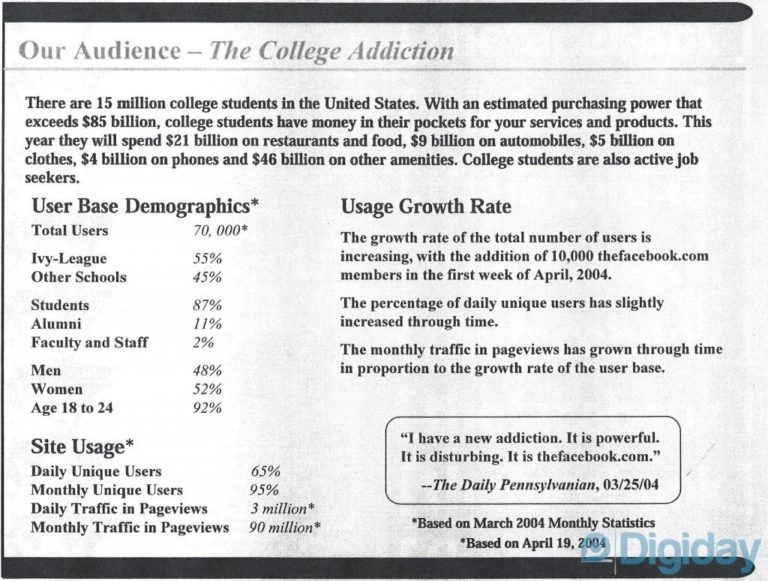
Assessing product/market fit with DAU/MAU
It’s an important metric, to be sure, but it’s often misused to say that “XYZ isn’t working” when in fact, there’s a slightly less frequent usage pattern that’s still equally valuable.
For consumer and bottoms up SaaS products, this metric is super useful, but seems to mostly exclude everything besides messaging/social products that are daily use. These are valuable products, but not the only ones.
Products that aren’t daily, but still hugely valuable
Not everything has to be daily use to be valuable. On the other side of the spectrum are products where the usage is episodic but each interaction is high value. DAU/MAU isn’t the right metric there.
- At Uber, our most profitable rides are to airports, via Black Car for a special night out, business travel, etc. These don’t happen every day, and although there are folks using us to commute, that’s not the average use case. So our DAU/MAU wasn’t >50%. The driver side has clusters of “power drivers” who are active >30hrs/week, but as it’s been widely published, our average driver is actually part-time. (Pareto Principle!)
- Linkedin is another interesting example which is low frequency – only recruiters and people looking for jobs use it in daily spurts – but it throws off so much unique data that you can build a bunch of vertical SaaS companies on top of this virally growing database.
- Products in travel, like Airbnb and Booking, are only used a few times per year by consumers. The average consumer only travels ~2x/year. Yet there are multi deca-billion dollar companies built in this space.
- In fact, for SaaS, it seems to be the exception not the rule. While email and business chat can be nearly daily use, a lot of super important tools like Workday, Google Analytics, Dropbox, Salesforce, etc. might only be used 1-2x/week at most.
- Much of e-commerce looks like this too, of course. You buy mattresses, new sunglasses, watches, etc fairly infrequently. Yet there are $1B+ wins in the category.
You may notice a pattern here. If you’re low-frequency/episodic, then you have to generate enough dollars or data that it’s valuable. If you’re high-frequency, you have a higher chance of growing virally and building an audience business that monetizes using ads.
Nature versus nurture
To extend this idea further, you can argue that messaging/social products with high DAU/MAU is actually the extreme case, and in fact most product categories don’t index highly. A few years back I shared this interesting diagram from Flurry which compared different app categories and their retention versus frequency of use:
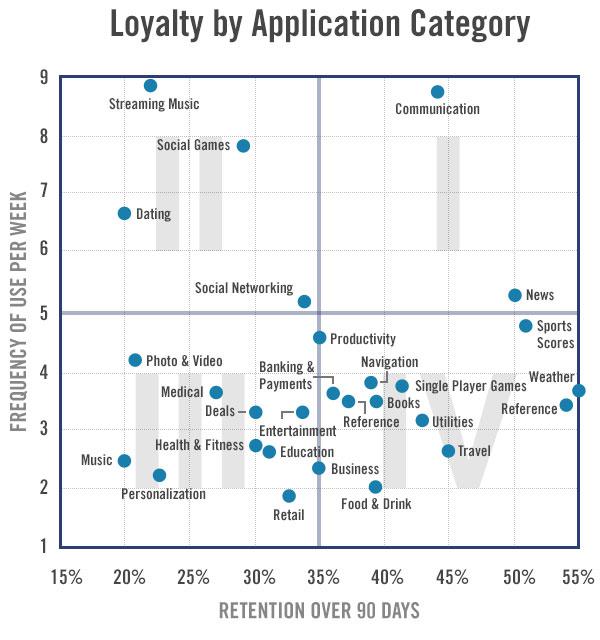
In this chart, a couple categories jump out:
- Social games have high frequency (“I’m getting addicted!”) but once you burn through the content, you tend to churn
- Weather is interesting too – you don’t often check, maybe only on cloudy days, but you will have a need to check throughout your entire life- so it maxes out on highest retention rate over 90 days
- Communication, for all the reasons discussed before, is both high frequency and high retention. That’s awesome!
What I’d love to see on this chart would be another overlay, monetization. There, I bet Travel, Dating, and Gaming would tend to stand out for different reasons. Travel because each transaction is big, and Dating/Gaming because it’s frequency combined with a focus on monetization because you won’t have the user for long.
So you want to increase DAU/MAU? It’s hard
So let’s say that you want your DAU/MAU to increase – so what do you do? Funny enough, a lot of people seem to implement emails and push notifications thinking it’ll help. My experience is that it tends to increase casual numbers (the MAU) but not the daily users. In other words, it’ll actually lower your DAU/MAU to focus on notifications because you’ll grow your MAUs more highly than your DAUs.
I’ve also not seen a 10% DAU/MAU product, through sheer effort, become 40% DAU/MAU. There seems to be a natural cadence to the usage of these product categories that doesn’t change much over time.
Increase, measure your hardcore users, network effects, monetization
If your DAU/MAU isn’t super high, this is what I like to see instead: Show me your hardcore userbase. What % of your users are active every day last week? What are they doing? How are you going to produce more of them? Showing this group exists goes a long way.
Similarly, show how the freq of use increases in correlation to something. Perhaps size of their network – showing network effects – or how much content they’ve produced or saved. Then make the argument that by increasing that variable, DAU/MAU will rise in cohorts over time.
Finally, maybe DAU/MAU is just not for you. Sometimes you don’t have to be a foreground app to be successful. Maybe you just need to build something awesome that does something valuable for people, makes enough money, and they use it twice a year! Also great.
DAU/MAU is useful, but has its limits
In conclusion, if your product is a high-frequency, high-retention product that’s ultimately going to be ads supported, DAU/MAU should be your guiding light. But if you can monetize well, develop network effects, or quite frankly, your natural cadence isn’t going to be high – then just measure something else! It’s impossible to battle nature… just find the right metric for you that’s telling you that your product is providing value to your users.
Required reading for marketplace startups: The 20 best essays

The current generation of marketplace startups has been incredibly successful. Airbnb, Lime, Uber, Lyft, Instacart, etc. I’ve been doing a broad survey of the best writing on this topic and wanted to share my list of 20 best links I’ve seen.
Marketplaces at Andreessen Horowitz
We look at a lot of marketplace startups at Andreessen Horowitz @a16z – and we fund a lot of them! – so it’s great to compile all the best thinking.
To lead off this list, my colleague @jeff_jordan has an awesome preso that covers everything from the marketplace “wheel” – network effects, and how they’re different than ecommerce products. Amazing, thoughtful preso. Must watch.https://www.youtube.com/watch?v=n57UaE08h7A
Solving the Chicken and Egg problem of marketplaces
Now let’s get to the links. First, here’s a series of links on the “Chicken and Egg” problem of marketplaces. How to do you get the initial liquidity to get the flywheel turning? Here’s a few links on the topic.
1. Josh Breinlinger (early oDesk) on “Liquidity Hacking.” Couple ways to do it: Provide value to one side: offer portfolios, community, tools. Find aggregators: Physical aggregators (like campuses), enterprise clients, supply aggregators, or scrape listings. Narrow the problem: geo, niche, vertical. Curate one side. Read the whole thing here: https://pando.com/2012/11/20/liquidity-hacking-how-to-build-a-two-sided-marketplace/
2. Here’s a nice podcast from Casey Winters (ex-Pinterest/Grubhub/etc) and Brian Rothenberg @bmrothenberg (VP Growth at Eventbrite) who talk about: The “chicken and egg” problem for marketplaces. Horizontal vs vertical. Online to Offline. https://news.greylock.com/paving-the-way-to-marketplace-liquidity-76c8e7854cad
3. Eli Chait (ex-OpenTable) on all the ways to boostrap a chicken and egg problem. Single player, Fill seats for suppliers, Create a marketplace where the buyers are sellers. Read the whole thing here: https://blog.elichait.com/2018/04/09/how-the-100-largest-marketplaces-solve-the-chicken-and-egg-problem/
4. Anand Iyer (ex-Threadflip) writes about using trust throughout the product: Ratings, Curation, Customer service, Mobile first, Good onboarding, Frictionless Payment, Social proof. http://firstround.com/review/How-Modern-Marketplaces-Like-Uber-Airbnb-Build-Trust-to-Hit-Liquidity/
5. Jonathan Golden (ex-Airbnb) on bootstrapping liquidity, adding host guarantees, reacting to competition, user experience. https://medium.com/@jgolden/lessons-learned-scaling-airbnb-100x-b862364fb3a7
Current trends in marketplaces
Next topic, the current crop of marketplaces has gotten huge for a reason. They’re doing a lot different, but going more “full-stack,” building deeper tools, etc. One important label is the new “market network” concept
6) Another by Casey Winters (ex-Grubhub) on how new marketplace companies are evolving: 1) connect buyers and sellers, 2) own the delivery network, 3) own the supply (managed/verticalized). http://caseyaccidental.com/three-stages-online-marketplaces/
7. Anand Iyer (Trusted) again, talks about the evolution from leadgen/search-based marketplaces to full-stack where the platform helps manage: 1) customer UX, 2) supply software tools, 3) retention/frequency, 4) transactional model, 5) trust/safety/risk, 6) pricing mgmt + guidance. Read the whole thing here: https://medium.com/@ai/the-evolution-of-managed-marketplaces-3382290963b2
8. James Currier (of NFX) pens one of the classics of the last few years, defining the term “Market Network” – multiple participants, SaaS tools, with transactions at the center.
Key differences: 1) Market networks target more complex services. 2) People matter – complex services mean each client is unique and not interchangeable. 3) Collaboration happens around a project. 4) There’s unique profiles of people involved. 5) Long term relationships between participants. 6) Referrals flow freely. 7) Increases transaction velocity and satisfaction. Re-read the whole thing here: https://www.nfx.com/post/10-years-about-market-networks
9. Andrei Brasovean (Accel) gives a comprehensive list of Marketplace metrics. https://medium.com/@algovc/10-marketplace-kpis-that-matter-22e0fd2d2779
Here’s the list: GMV, net revenue, gross margin / contribution margin, MoM growth rate, Market share, Liquidity, AOV, Items per basket, Messages, NPS, User reviews, Cohort retention, Repeat orders, Whale curves, Sector/Geo/Product concentration, Fragmentation, CAC, Channel scalability, Channel mix, LTV, LTV/CAC, Unit economics, Burn rate. A lot more detail in the essay.
10. Borja Moreno de los Rios, ceo of Merlin, writes one of my favorite articles where he has a bunch of graphs/concepts on measuring liquidity: https://techcrunch.com/2017/07/11/marketplace-liquidity/
Get new updates, usually once a week – featuring long-form essays with what’s going on in tech.
11. Angela Tran Kingyens (VersionOne) on a Marketplace metrics dashboard. GMV, revenue, Seller/supply metrics (engagement/overall), Buyer metrics (engagement/overall). https://versionone.vc/marketplace-kpi/
Product strategy for marketplaces
Finally, I wanted to add a section for overall marketplace strategy – how do you know you’re in the right vertical? What is a network effect exactly? How to think about frequency and retention?
12. Me! @andrewchen (ex-Uber). A few years back, I wrote this about Uber’s virtuous cycle around acquiring more drivers, keeping the marketplace in balance, and how to think about the hyperlocal nature of the product. http://andrewchen.co/ubers-virtuous-cycle-5-important-reads-about-uber/
13. My colleague Jeff Jordan again (a16z, on the Airbnb/Lime/Instacart boards) on how marketplaces must nurture and manage perfect competition. Gives a sense on why B2B marketplaces often don’t work: https://a16z.com/2015/01/22/online-marketplaces/
14. a16z has also put together two amazing resources on Network Effects. Defining them, case studies, strategies for building them, etc. https://a16z.com/2016/03/07/all-about-network-effects/
15. More from Jonathan (ex-Airbnb) on defining a marketplace, global network effects (versus root density), homogeneous/heterogeneous supply, two-sided incentives, size and frequency of interaction, unit economics: https://medium.com/@jgolden/four-questions-every-marketplace-startup-should-be-able-to-answer-defb0590e049
16. Another from Casey on 4 strategies to win on low frequency marketplaces: 1) SEO (expedia model), 2) Better/cheaper (Airbnb), 3) Insurance (HotelTonight), 4) Engagement (Houzz). http://caseyaccidental.com/low-frequency-marketplaces/
17. Two writeups on TaskRabbit which are worth reading. The first, from Leah (founder of TaskRabbit, now an investor at Fuel) visualizing the building blocks: https://www.fuelcapital.com/stories/2017/12/7/the-anatomy-of-a-marketplace
Also, the Reforge team collects key learnings from TaskRabbit as a case study: 1) Fixed pricing. 2) Faster txns, 3) Going vertical, 4) Raising enough VC , 5) Reputation systems, 6) Gig economy verticals are a power law. https://www.reforge.com/blog/taskrabbit-marketplace-growth
18. Bill Gurley (Benchmark) has a classic: 10 factors to evaluate with marketplaces: 1) New Experience vs. the Status Quo, 2) Economic Advantages vs. the Status Quo, 3) Opportunity for Technology to Add Value, 4) High fragmentation, 5) Friction of Supplier Sign-Up, 6) Size of the Market Opportunity, 7) Expand the Market, 8) Frequency, 9) Payment Flow, 10) Network Effects. http://abovethecrowd.com/2012/11/13/all-markets-are-not-created-equal-10-factors-to-consider-when-evaluating-digital-marketplaces/
19. Josh Breinlinger (early oDesk) on the ingredients for a successful marketplace: 1) recurring 2) episodic 3) standardized work 4) little trust required 5) non-monogamous. http://acrowdedspace.com/post/73232464154/the-ingredients-for-a-successful-marketplace
20. Worth a mention – not an essay, but The Perfect Store is a behind the scenes look at eBay that I read a long time ago that is great. https://www.amazon.com/Perfect-Store-Inside-eBay-ebook/dp/B001MYJ3VA
Re: Uber, I’ve read everything out there about Uber but there’s nothing good yet. @mikeisaac’s upcoming book is the one to watch.
I’m still collecting/curating my list! So if you have clues for other great pieces, please let me know. Also interested in books if I’m missing anything.
More ideas/thoughts welcome! I read every reply :)
[Originally tweetstormed, with some edits, at @andrewchen. Follow me there for more!]
Conservation of Intent: The hidden reason why A/B tests aren’t as effective as they look
When a +10% isn’t really a +10%
OK, this is an infuriating startup experience: You ship an experiment that’s +10% in your conversion funnel. Then your revenue/installs/whatever goes up by +10% right?
Wrong :(
Turns out usually it goes up a little bit, or maybe not at all.
Why is that? Let’s call this the “Conservation of Intent” (Inspired by the Law of the Conservation of Momentum 😊)
The difference between high- and low-intent users
For all your users coming in, only some of them are high-intent. It’s hard to increase that intent just by making a couple steps easier – that’ll just grow your low-intent users. Doing tactical things like moving buttons above the fold, optimizing headlines, removing form fields – those are great, but the increases won’t directly drop to your bottom line.
In other words, the total amount of intent in your system is fixed. Thus the law of the conservation of intent!
This is why you can’t add up your A/B test results
If you’re at a company that A/B tests everything and then announces the great results – that’s wonderful, of course, but just run the thought experiment of summing together all of those A/B tests. And then look at your top-line results. Rarely does it match.
The most obvious way to see this is to test something high up on a funnel, for example maybe the landing page where a new user hits, or an email that a re-engaged users opens – you can see that a big lift on the top of the funnel flows down unevenly. Each step of friction burns off the low-intent users that are flowing step-by-step.
Be skeptical of internal results, but more importantly, external case studies too
If you’re at a big company and another team publishes a test result, make sure you agree on the actual final metric you’re trying to impact – whether that’s revenue, highly engaged users, or something else. Make sure you always review that.
Similarly, this is a reason to be skeptical of vendors and 3rd parties who have case studies that’ll increase your revenue by X just because they increase their ad conversion rate (or whatever) by X. In these kinds of misleading case studies – often presented at conferences – not only do vendors have the ability to only cherry pick the best examples that reinforce their case, but also the metric that’s highest impacted! Be skeptical and don’t be fooled.
Unlock increases to the bottom line
First, understand what’s really blocking your high-intent users. Those are the ones who’d like to flow all the way through the funnel, but can’t, for whatever reason. For Uber, that was things like payment methods, app quality (for Android especially!), the forgot password flow, etc. If you can’t pay or can’t get back into your account, then even if you use the app every day, you might switch to a different app that’s less of a pain in the ass.
Also, you can focus your experiments. You obviously get real net incremental increases on conversion the further down the funnel you go. By that point, the low-intent folks have burned off. You’re closer to the bottom line. Look the steps right around your transaction flow – for ecommerce sites that might be the process to review your cart and add your shipping info, or the request invoice flow for SaaS products, etc. Think about high-intent scenarios, for example when you hit a paywall or run out of credits/disk space/resources/etc. All of these can be optimized and it’ll hit the bottom line quickly.
Make sure your roadmap reflects reality
When it comes to your product roadmapping, yes you can definitely brainstorm and ship a bunch of +10% increases, but you need to add a discount factor to your spreadsheets to reflect reality. Can’t just add up all your results.
When you focus on low-intent folks, you’ll have to get creative to build their intent quickly. Things like being able to try out the product, having their friends into the product – these are the “activation” steps that generate intent. Here’s a great place to start – a highly relevant essay on getting users more psych’d, guest written by Darius Contractor from the Dropbox growth team.
Conservation of Intent
Many of you have directly experienced the “Conservation of Intent” but now you have a name for it! It’s tricky.
This is really a reflection of how working on product growth is really a combo of psychology and data-driven product. You can’t just look at this stuff in a spreadsheet and assume that a lift in one place automatically cascades into the rest of the model.
[Originally tweetstormed at @andrewchen – follow me for future updates!]